//
Watch full talk at: www.youtube.com
Networking the complexity community since 1999
Michael Batty
To explore the impact of the pandemic on the form and function of cities, we propose to simulate the forces of centralisation and decentralisation for different urban futures which we encapsulate in the spatial interaction patterns linking places of work to residence. Because the current pandemic has distorted locational patterns in current cities so radically, we first build a hypothetical city on a square grid that we then proceed to lock down in terms of the percentage of the population no longer at their traditional places of work but working from home. We explore various pictures under different levels of lockdown showing how non-locked down activity responds to the changing urban landscape. We add some randomness to provide a greater degree of diversity and this partially breaks the symmetry of the idealised system. We then introduce different patterns of deterrence which imply different average trip lengths exploring a range of forms from highly centralised to decentralised. We illustrate how the system moves to different forms as we release the lockdown and let the system react to the continually changing urban landscape which produces a series of highly concentrated equilibria. This generates different patterns that we then perturb by adding a degree of randomness in the size of locations and we conclude by scaling the city from its 11×11 grid to one of 41×41 more illustrative of the diversity and degree of asymmetry in large cities like London. To progress this approach, we need to adapt our hypothetical model to real cities and continue such speculation through
Read the full article at: www.ucl.ac.uk

The molecular biologist Bonnie Bassler is deciphering the chemical languages that bacteria use to coordinate their assaults on a host.
Read the full article at: www.quantamagazine.org

The COVID-19 pandemic accelerated existing future of work trends, with 25% more workers than previously estimated potentially needing to switch occupations.
This report on the future of work after COVID-19 is the first of three MGI reports that examine aspects of the postpandemic economy. The others look at the pandemic’s long-term influence on consumption and the potential for a broad recovery led by enhanced productivity and innovation. Here, we assess the lasting impact of the pandemic on labor demand, the mix of occupations, and the workforce skills required in eight countries with diverse economic and labor market models: China, France, Germany, India, Japan, Spain, the United Kingdom, and the United States. Together, these eight countries account for almost half the global population and 62 percent of GDP.
Read the full article at: www.mckinsey.com

Ferenc Molnar, Takashi Nishikawa & Adilson E. Motter
Nature Communications 12, 1457 (2021)
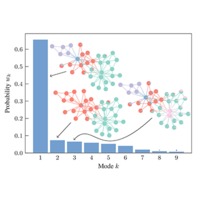
Abstract: Behavioral homogeneity is often critical for the functioning of network systems of interacting entities. In power grids, whose stable operation requires generator frequencies to be synchronized—and thus homogeneous—across the network, previous work suggests that the stability of synchronous states can be improved by making the generators homogeneous. Here, we show that a substantial additional improvement is possible by instead making the generators suitably heterogeneous. We develop a general method for attributing this counterintuitive effect to converse symmetry breaking, a recently established phenomenon in which the system must be asymmetric to maintain a stable symmetric state. These findings constitute the first demonstration of converse symmetry breaking in real-world systems, and our method promises to enable identification of this phenomenon in other networks whose functions rely on behavioral homogeneity.
Read the full article at: www.nature.com