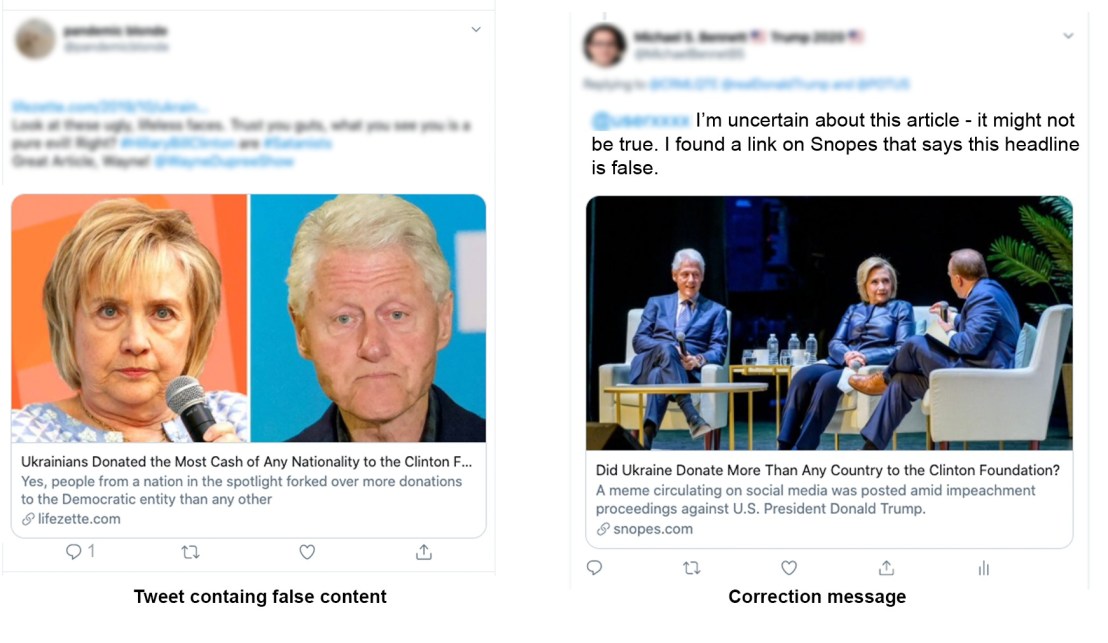
You’re Definitely Wrong, Maybe: Correction Style Has Minimal Effect on Corrections of Misinformation Online

Cameron Martel, Mohsen Mosleh, and David G. Rand

Media and Communication  Vol 9, No 1 (2021): Dark Participation in Online Communication: The World of the Wicked Web

How can online communication most effectively respond to misinformation posted on social media? Recent studies examining the content of corrective messages provide mixed results—several studies suggest that politer, hedged messages may increase engagement with corrections, while others favor direct messaging which does not shed doubt on the credibility of the corrective message. Furthermore, common debunking strategies often include keeping the message simple and clear, while others recommend including a detailed explanation of why the initial misinformation is incorrect. To shed more light on how correction style affects correction efficacy, we manipulated both correction strength (direct, hedged) and explanatory depth (simple explanation, detailed explanation) in response to participants from Lucid (N = 2,228) who indicated they would share a false story in a survey experiment. We found minimal evidence suggesting that correction strength or depth affects correction engagement, both in terms of likelihood of replying, and accepting or resisting corrective information. However, we do find that analytic thinking and actively open-minded thinking are associated with greater acceptance of information in response to corrective messages, regardless of correction style. Our results help elucidate the efficacy of user-generated corrections of misinformation on social media.

Read the full article at: www.cogitatiopress.com

Scriptinformatics: Extended Phenetic Approach to Script Evolution, by Gábor Hosszú

Scriptinformatics, in other words, scriptological informatics or computational scriptology, as a branch of applied computer science (informatics), deals with the investigation concerning the evolution of graphemes in various scripts and with the exploration of relationships between scripts, where the scripts could be any sequence of symbols of cultural origin, such as historical writing systems or urban graffiti. In a scriptinformatic research, the machine learning, artificial intelligence and bioinformatics tools are used (Hosszú 2010a; Hosszú 2017). It deals with phylogenetic (phyletic) modelling, developing the necessary algorithms and the phenetic, evolutionary and statistical analyses of features of the studied scripts (Hosszú 2014b; Hosszú 2019: 120).

Read the full book at: real.mtak.hu

Sean Carroll’s Mindscape: Michael Levin on Growth, Form, Information, and the Self

Sean Carroll talks with biologist Michael Levin about how a combination of genetic information and physical constraints shape an organism.

Listen at: https://www.preposterousuniverse.com/podcast/2021/02/01/132-michael-levin-on-growth-form-information-and-the-self/

The Science of Science 1, Wang, Dashun, Barabási, Albert-László – Amazon.com

This is the first comprehensive overview of the ‘science of science,’ an emerging interdisciplinary field that relies on big data to unveil the reproducible patterns that govern individual scientific careers and the workings of science. It explores the roots of scientific impact, the role of productivity and creativity, when and what kind of collaborations are effective, the impact of failure and success in a scientific career, and what metrics can tell us about the fundamental workings of science. The book relies on data to draw actionable insights, which can be applied by individuals to further their career or decision makers to enhance the role of science in society. With anecdotes and detailed, easy-to-follow explanations of the research, this book is accessible to all scientists and graduate students, policymakers, and administrators with an interest in the wider scientific enterprise.

Get it at: www.amazon.com

2nd IEEE International Conference on Autonomic Computing and Self-Organizing Systems – ACSOS 2021

We are happy to announce that the second edition of the IEEE International Conference on Autonomic Computing and Self-Organizing Systems (ACSOS) will take place in Washington DC (depending on the Covid-19 situation) from September 27 to October 1, 2021. The ACSOS was founded as a merger of the IEEE International Conference on Autonomic Computing (ICAC) and the IEEE International Conference on Self-Adaptive and Self-Organizing Systems (SASO). The goal of the ACSOS is to provide a forum for sharing the latest research results, ideas and experiences in autonomic computing, self-adaptation, and self-organization.

http://2021.acsos.org/