The hysteresis of the Antarctic Ice Sheet

Julius Garbe, Torsten Albrecht, Anders Levermann, Jonathan F. Donges & Ricarda Winkelmann 
Nature volume 585, pages538–544(2020)


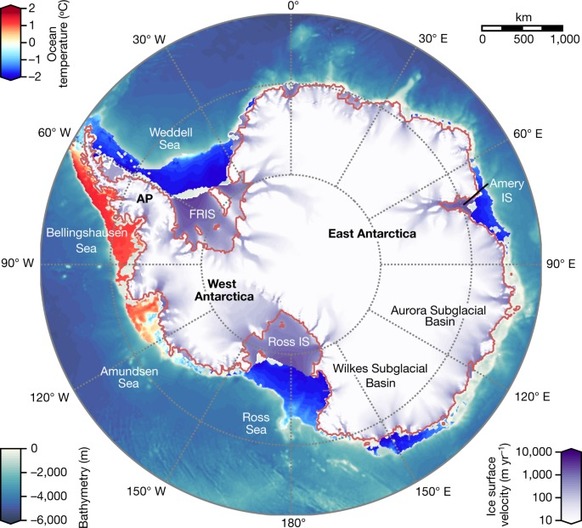
More than half of Earth’s freshwater resources are held by the Antarctic Ice Sheet, which thus represents by far the largest potential source for global sea-level rise under future warming conditions1. Its long-term stability determines the fate of our coastal cities and cultural heritage. Feedbacks between ice, atmosphere, ocean, and the solid Earth give rise to potential nonlinearities in its response to temperature changes. So far, we are lacking a comprehensive stability analysis of the Antarctic Ice Sheet for different amounts of global warming. Here we show that the Antarctic Ice Sheet exhibits a multitude of temperature thresholds beyond which ice loss is irreversible. Consistent with palaeodata2 we find, using the Parallel Ice Sheet Model3,4,5, that at global warming levels around 2 degrees Celsius above pre-industrial levels, West Antarctica is committed to long-term partial collapse owing to the marine ice-sheet instability. Between 6 and 9 degrees of warming above pre-industrial levels, the loss of more than 70 per cent of the present-day ice volume is triggered, mainly caused by the surface elevation feedback. At more than 10 degrees of warming above pre-industrial levels, Antarctica is committed to become virtually ice-free. The ice sheet’s temperature sensitivity is 1.3 metres of sea-level equivalent per degree of warming up to 2 degrees above pre-industrial levels, almost doubling to 2.4 metres per degree of warming between 2 and 6 degrees and increasing to about 10 metres per degree of warming between 6 and 9 degrees. Each of these thresholds gives rise to hysteresis behaviour: that is, the currently observed ice-sheet configuration is not regained even if temperatures are reversed to present-day levels. In particular, the West Antarctic Ice Sheet does not regrow to its modern extent until temperatures are at least one degree Celsius lower than pre-industrial levels. Our results show that if the Paris Agreement is not met, Antarctica’s long-term sea-level contribution will dramatically increase and exceed that of all other sources.

Source: www.nature.com

A neural correlate of sensory consciousness in a corvid bird

Andreas Nieder, Lysann Wagener, Paul Rinnert

Science  25 Sep 2020:
Vol. 369, Issue 6511, pp. 1626-1629
DOI: 10.1126/science.abb1447


Subjective experiences that can be consciously accessed and reported are associated with the cerebral cortex. Whether sensory consciousness can also arise from differently organized brains that lack a layered cerebral cortex, such as the bird brain, remains unknown. We show that single-neuron responses in the pallial endbrain of crows performing a visual detection task correlate with the birds’ perception about stimulus presence or absence and argue that this is an empirical marker of avian consciousness. Neuronal activity follows a temporal two-stage process in which the first activity component mainly reflects physical stimulus intensity, whereas the later component predicts the crows’ perceptual reports. These results suggest that the neural foundations that allow sensory consciousness arose either before the emergence of mammals or independently in at least the avian lineage and do not necessarily require a cerebral cortex.

Source: science.sciencemag.org

A Dialogue Concerning the Essence and Role of Information in the World System

Mark Burgin and Jaime F. Cárdenas-García

Information 2020, 11(9), 406


The goal of this paper is to represent two approaches to the phenomenon of information, explicating its nature and essence. In this context, Mark Burgin demonstrates how the general theory of information (GTI) describes and elucidates the phenomenon of information by explaining the axiomatic foundations for information studies and presenting the comprising mathematical theory of information. The perspective promoted by Jaime F. Cárdenas-García is based on Gregory Bateson’s description of information as “difference which makes a difference” and involves the process of info-autopoiesis as a sensory commensurable, self-referential feedback process.

Source: www.mdpi.com

Symbiosis Promotes Fitness Improvements in the Game of Life

Peter D. Turney

Artificial Life
Volume 26 | Issue 3 | Summer 2020
p.338-365


We present a computational simulation of evolving entities that includes symbiosis with shifting levels of selection. Evolution by natural selection shifts from the level of the original entities to the level of the new symbiotic entity. In the simulation, the fitness of an entity is measured by a series of one-on-one competitions in the Immigration Game, a two-player variation of Conway’s Game of Life. Mutation, reproduction, and symbiosis are implemented as operations that are external to the Immigration Game. Because these operations are external to the game, we can freely manipulate the operations and observe the effects of the manipulations. The simulation is composed of four layers, each layer building on the previous layer. The first layer implements a simple form of asexual reproduction, the second layer introduces a more sophisticated form of asexual reproduction, the third layer adds sexual reproduction, and the fourth layer adds symbiosis. The experiments show that a small amount of symbiosis, added to the other layers, significantly increases the fitness of the population. We suggest that the model may provide new insights into symbiosis in biological and cultural evolution.

Source: www.mitpressjournals.org