Science, Promise and Peril in the Age of AI

It started as a fantasy, then a promise — inspired by biology and animated by the ideas of physicists — and grew to become a powerful research tool. Now artificial intelligence has evolved into something else: a junior colleague, a partner in creativity, an impressive if unreliable wish-granting genie. It has changed everything, from how we relate to data and truth, to how researchers devise experiments and mathematicians think about proofs. In this special series, we explore how AI is changing what it means to do science and math, and what it means to be a scientist.

Read the full article at: www.quantamagazine.org

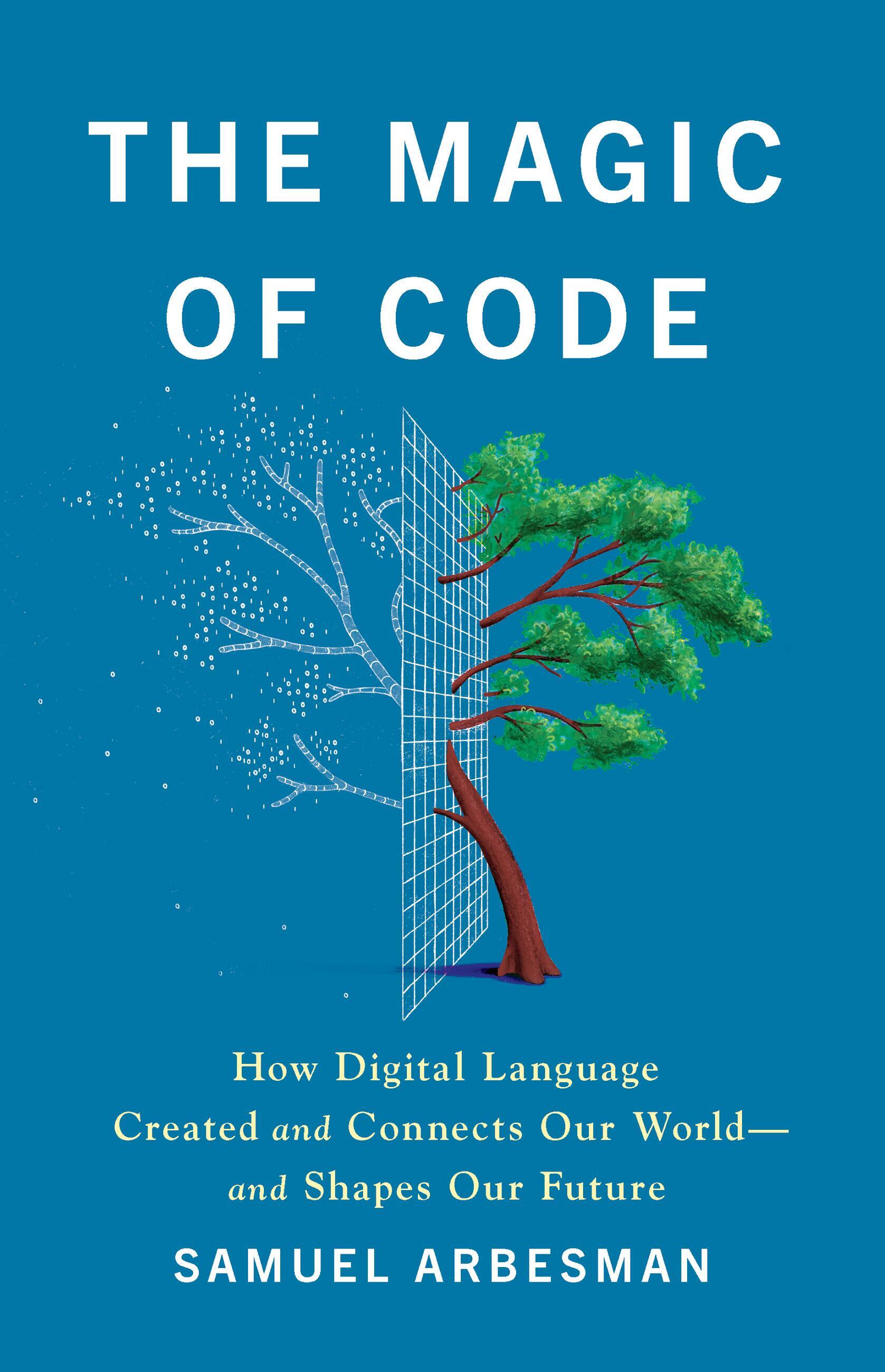
The Magic of Code How Digital Language Created and Connects Our World—and Shapes Our Future, by Samuel Arbesman

In the tradition of classics such as The Lives of a Cell, a bold reframing of our relationship with technology that is more positive and human centered.
In the digital world, code is the essential primary building block, the equivalent of the cell or DNA in the biological sphere—and almost as mysterious. Code can create entire worlds, real and virtual; it allows us to connect instantly to people and places around the globe; and it performs tasks that were once only possible in science fiction. It is a superpower, and not just in a technical sense. It is also a gateway to ideas. As vividly illustrated by Samuel Arbesman, it is the ultimate connector, providing new insight and meaning into how everything from language and mythology to biblical texts, biology, and even our patterns of thought connect with the history and nature of computing.

While the building block of code can be used for many wondrous things it can also create deeper wedges in our society and be weaponized to cause damage to our planet or our civilization. Code and computing are too important to be left to the tech community; it is essential that each of us engage with it. And we fail to understand it to our detriment.

By providing us with a framework to think about coding and its effects upon the world and placing the past, current, and future developments in computing into its broader setting we see how software and computers can work for people as opposed to against our needs. With this deeper understanding into the “why” of coding we can be masters of technology rather than its subjects.

More at: www.publicaffairsbooks.com

Artificial Intelligences: A Bridge Toward Diverse Intelligence and Humanity’s Future

Michael Levin

Advanced Intelligent Systems,

Recent discussions and debate around artificial intelligence (AI) and its status are notably incomplete, missing the implications of highly relevant aspects of the emerging fields of diverse intelligence (DI) and synthetic morphology, as well as of basic facts of developmental biology. Herein, it is argued that human flourishing is impossible without an appreciation of the space of possible beings and of the ways in which today’s intelligent machine debates are about universal existential questions facing biological beings, not just AI. The inevitable arrival of a wide set of unconventional bodies and minds as humans modify and create new forms will disrupt untenable old narratives of what people are and how to recognize their sentient allies in unfamiliar guises. Herein, the issues engendered by the advent of AI from the perspective of the field of DI and the evolutionary history of the bodies and minds are discussed.

Read the full article at: advanced.onlinelibrary.wiley.com

Adversarial testing of global neuronal workspace and integrated information theories of consciousness

Cogitate Consortium, Oscar Ferrante, Urszula Gorska-Klimowska, Simon Henin, Rony Hirschhorn, Aya Khalaf, Alex Lepauvre, Ling Liu, David Richter, Yamil Vidal, Niccolò Bonacchi, Tanya Brown, Praveen Sripad, Marcelo Armendariz, Katarina Bendtz, Tara Ghafari, Dorottya Hetenyi, Jay Jeschke, Csaba Kozma, David R. Mazumder, Stephanie Montenegro, Alia Seedat, Abdelrahman Sharafeldin, Shujun Yang, Sylvain Baillet, David J. Chalmers, Radoslaw M. Cichy, Francis Fallon, Theofanis I. Panagiotaropoulos, Hal Blumenfeld, Floris P. de Lange, Sasha Devore, Ole Jensen, Gabriel Kreiman, Huan Luo, Melanie Boly, Stanislas Dehaene, Christof Koch, Giulio Tononi, Michael Pitts, Liad Mudrik & Lucia Melloni

Nature (2025)

Different theories explain how subjective experience arises from brain activity1,2. These theories have independently accrued evidence, but have not been directly compared3. Here we present an open science adversarial collaboration directly juxtaposing integrated information theory (IIT)4,5 and global neuronal workspace theory (GNWT)6,7,8,9,10 via a theory-neutral consortium11,12,13. The theory proponents and the consortium developed and preregistered the experimental design, divergent predictions, expected outcomes and interpretation thereof12. Human participants (n = 256) viewed suprathreshold stimuli for variable durations while neural activity was measured with functional magnetic resonance imaging, magnetoencephalography and intracranial electroencephalography. We found information about conscious content in visual, ventrotemporal and inferior frontal cortex, with sustained responses in occipital and lateral temporal cortex reflecting stimulus duration, and content-specific synchronization between frontal and early visual areas. These results align with some predictions of IIT and GNWT, while substantially challenging key tenets of both theories. For IIT, a lack of sustained synchronization within the posterior cortex contradicts the claim that network connectivity specifies consciousness. GNWT is challenged by the general lack of ignition at stimulus offset and limited representation of certain conscious dimensions in the prefrontal cortex. These challenges extend to other theories of consciousness that share some of the predictions tested here14,15,16,17. Beyond challenging the theories, we present an alternative approach to advance cognitive neuroscience through principled, theory-driven, collaborative research and highlight the need for a quantitative framework for systematic theory testing and building.

Read the full article at: www.nature.com

DOMAINS OF LAWS YET DOMAINS OF NO LAW: Energy and Work, Responsible Free Will Choice and Doing

Sudip Patra and Stuart Kauffman

We explore here the fundamental and striking paradigmatic shifts between ‘Domain of Laws’ and ‘Domain of No Laws’, where the former is an apt encapsulation of our remarkably successful but orthodox science world view (including classical physics and quantum mechanics) with well- defined and stable configuration spaces having deterministic or stochastic evolution, and the latter is a radically new Domain of No Law with evolving configuration spaces, non-deducible information creation, genuine novelties and an un-prestatable Adjacent Possible. We explore the features of these two distinct domains asking what can be defined with respect to work, energy, entropy, and agency. We offer a reconstruction of quantum mechanics to reframe traditional assumptions and address lingering questions concerning the nature of living, complex adaptive systems. We propose that a genuine responsible free will and a central role of agency are essential features of an evolving Biosphere. Here we extend this theme to call for a radically new and comprehensive view of science itself.

Read the full article at: osf.io