Partisan disparities in the use of science in policy

ALEXANDER C. FURNAS, TIMOTHY M. LAPIRA, AND DASHUN WANG
SCIENCE 24 Apr 2025 Vol 388, Issue 6745 pp. 362-367 DOI: 10.1126/science.adt9895

Science has long been regarded as essential to policy-making, serving as one of the primary sources of evidence that informs decisions (1, 2) with its particular epistemic authority (3). Its role has become especially vital, as many pressing societal challenges today—from climate change to public health crises to technological advancement—are intricately linked with scientific progress. However, amid rising political polarization (4), a fundamental question remains open: Is science used differently by policy-makers in different parties? Here we combine two large-scale databases capturing policy, science, and their interactions to examine the partisan differences in citing science in policy-making in the United States. Overall, we observe systematic differences in the amount, content, and character of science cited in policy by partisan factions in the United States. These differences are strikingly persistent across fields of research, policy issues, time, and institutional contexts.

Read the full article at: www.science.org
Mathematical and Computational Methods for Complex Social Systems

Heather Z. Brooks, Michelle Feng, Mason A. Porter, and Alexandria Volkening

The spread of memes and misinformation on social media, political redistricting, gentrification in urban communities, pedestrian movement in crowds, and the dynamics of voters are among the many social phenomena that researchers investigate in the field of complex systems. In the study of complex social systems, there is often also societal relevance to improving our understanding of how individuals interact with each other and their environment, giving rise to collective group dynamics.

The mathematical and computational study of complex social systems relies on and motivates the development of methods in many topics, including mathematical modeling, data analysis, network science, and topology and geometry. This volume is a collection of diverse articles about complex social systems. This collection includes both (1) survey and tutorial articles that introduce complex social systems and methods to study them and (2) manuscripts with original research that highlight a variety of mathematical areas and applications.

This book introduces the study of complex social systems to a broad mathematical audience. It will particularly appeal to people who are interested in applied mathematics.

Read the full article at: www.ams.org

Structural Cellular Hash Chemistry

Hiroki Sayama

2025 IEEE Symposium on Computational Intelligence in Artificial Life and Cooperative Intelligent Systems (ALIFE-CIS)

Hash Chemistry, a minimalistic artificial chemistry model of open-ended evolution, has recently been extended to non-spatial and cellular versions. The non-spatial version successfully demonstrated continuous adaptation and unbounded growth of complexity (size) of self-replicating entities, but it did not simulate multiscale ecological interactions among the entities. On the contrary, the cellular version explicitly represented multiscale spatial ecological interactions among evolving patterns, yet it failed to show meaningful adaptive evolution or complexity growth. It remains an open question whether it is possible to create a similar minimalistic evolutionary system that can exhibit all of those desired properties at once, within a computationally efficient framework. Here we propose an improved version of Cellular Hash Chemistry, called “Structural Cellular Hash Chemistry” (SCHC). In SCHC, individual identities of evolving patterns are explicitly represented and processed as the connected components of the nearest neighbor graph of active (non-empty) cells. The neighborhood connections are established by connecting active cells with other active cells in their Moore neighborhoods in a 2D cellular grid. Evolutionary dynamics in SCHC are simulated via pairwise competitions of two randomly selected patterns, following the approach used in the non-spatial Hash Chemistry. SCHC’s computational cost was significantly less than the original and non-spatial versions. Numerical simulations showed that these model modifications achieved spontaneous movement, self-replication and unbounded growth of complexity (size) of spatial evolving patterns, which were clearly visible in space in a highly intuitive manner. Detailed analysis of simulation results showed that there were spatial ecological interactions among self-replicating patterns and their diversity was also substantially promoted in SCHC, neither of which was present in the non-spatial version.

Read the full article at: ieeexplore.ieee.org

A first-principles mathematical model integrates the disparate timescales of human learning

Mingzhen Lu, Tyler Marghetis & Vicky Chuqiao Yang 
npj Complexity volume 2, Article number: 15 (2025)

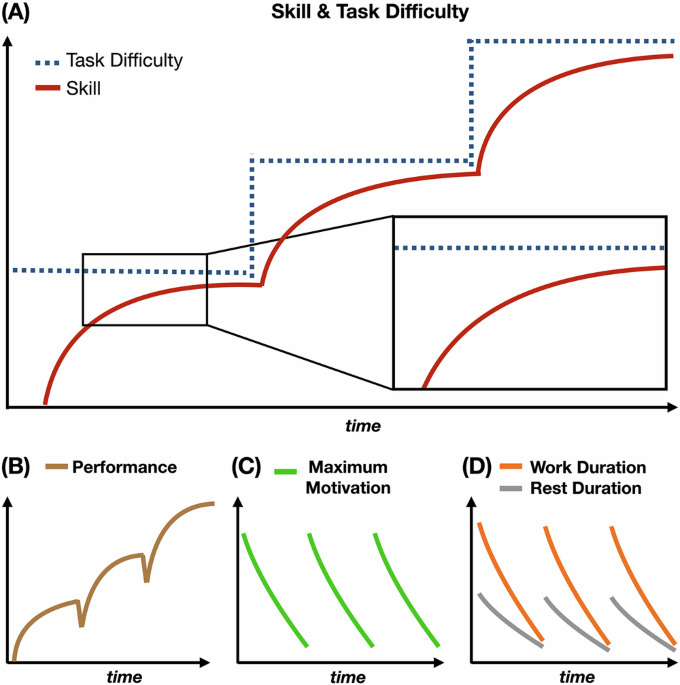
Lifelong learning occurs on timescales ranging from moments to decades. People can lose themselves in a new skill, practice for hours until exhausted, and pursue mastery intermittently over decades. A full understanding of learning requires an account that integrates these timescales. Here, in response to calls for more formal theory in the psychological sciences, we present a parsimonious mathematical model that unifies the nested timescales of learning. Our model recovers well-established patterns of skill acquisition, and explains how these patterns can emerge from short-timescale dynamics of motivation, fatigue, and effort. Conversely, the model explains how patterns in these short-timescale dynamics are shaped by longer-term dynamics of skill selection, mastery, and abandonment. We use this model to explore the theoretical benefits and pitfalls of a variety of training regimes. Our model connects disparate timescales—and the subdisciplines that typically study each timescale in isolation—to offer a unified, multiscale account of skill acquisition.

Read the full article at: www.nature.com

Basal Xenobot transcriptomics reveals changes and novel control modality in cells freed from organismal influence

Vaibhav P. Pai, Léo Pio-Lopez, Megan M. Sperry, Patrick Erickson, Parande Tayyebi & Michael Levin 
Communications Biology volume 8, Article number: 646 (2025)

Would transcriptomes change if cell collectives acquired a novel morphogenetic and behavioral phenotype in the absence of genomic editing, transgenes, heterologous materials, or drugs? We investigate the effects of morphology and nascent emergent life history on gene expression in the basal (no engineering, no sculpting) form of Xenobots —autonomously motile constructs derived from Xenopus embryo ectodermal cell explants. To investigate gene expression differences between cells in the context of an embryo with those that have been freed from instructive signals and acquired novel lived experiences, we compare transcriptomes of these basal Xenobots with age-matched Xenopus embryos. Basal Xenobots show significantly larger inter-individual gene variability than age-matched embryos, suggesting increased exploration of the transcriptional space. We identify at least 537 (non-epidermal) transcripts uniquely upregulated in these Xenobots. Phylostratigraphy shows a majority of transcriptomic shifts in the basal Xenobots towards evolutionarily ancient transcripts. Pathway analyses indicate transcriptomic shifts in the categories of motility machinery, multicellularity, stress and immune response, metabolism, thanatotranscriptome, and sensory perception of sound and mechanical stimuli. We experimentally confirm that basal Xenobots respond to acoustic stimuli via changes in behavior. Together, these data may have implications for evolution, biomedicine, and synthetic morphoengineering.

Read the full article at: www.nature.com