
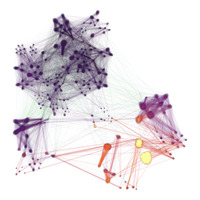
Network Reconstruction via the Minimum Description Length Principle

Tiago P. Peixoto

Phys. Rev. X 15, 011065

A fundamental problem associated with the task of network reconstruction from dynamical or behavioral data consists in determining the most appropriate model complexity in a manner that prevents overfitting and produces an inferred network with a statistically justifiable number of edges and their weight distribution. The status quo in this context is based on 𝐿1 regularization combined with cross-validation. However, besides its high computational cost, this commonplace approach unnecessarily ties the promotion of sparsity, i.e., abundance of zero weights, with weight “shrinkage.” This combination forces a trade-off between the bias introduced by shrinkage and the network sparsity, which often results in substantial overfitting even after cross-validation. In this work, we propose an alternative nonparametric regularization scheme based on hierarchical Bayesian inference and weight quantization, which does not rely on weight shrinkage to promote sparsity. Our approach follows the minimum description length principle, and uncovers the weight distribution that allows for the most compression of the data, thus avoiding overfitting without requiring cross-validation. The latter property renders our approach substantially faster and simpler to employ, as it requires a single fit to the complete data, instead of many fits for multiple data splits and choice of regularization parameter. As a result, we have a principled and efficient inference scheme that can be used with a large variety of generative models, without requiring the number of reconstructed edges and their weight distribution to be known in advance. In a series of examples, we also demonstrate that our scheme yields systematically increased accuracy in the reconstruction of both artificial and empirical networks. We highlight the use of our method with the reconstruction of interaction networks between microbial communities from large-scale abundance samples involving on the order of 104–105 species and demonstrate how the inferred model can be used to predict the outcome of potential interventions and tipping points in the system.

Read the full article at: link.aps.org

Self-Organizing Graph Reasoning Evolves into a Critical State for Continuous Discovery Through Structural-Semantic Dynamics

Markus J. Buehler

We report fundamental insights into how agentic graph reasoning systems spontaneously evolve toward a critical state that sustains continuous semantic discovery. By rigorously analyzing structural (Von Neumann graph entropy) and semantic (embedding) entropy, we identify a subtle yet robust regime in which semantic entropy persistently dominates over structural entropy. This interplay is quantified by a dimensionless Critical Discovery Parameter that stabilizes at a small negative value, indicating a consistent excess of semantic entropy. Empirically, we observe a stable fraction (12%) of “surprising” edges, links between semantically distant concepts, providing evidence of long-range or cross-domain connections that drive continuous innovation. Concomitantly, the system exhibits scale-free and small-world topological features, alongside a negative cross-correlation between structural and semantic measures, reinforcing the analogy to self-organized criticality. These results establish clear parallels with critical phenomena in physical, biological, and cognitive complex systems, revealing an entropy-based principle governing adaptability and continuous innovation. Crucially, semantic richness emerges as the underlying driver of sustained exploration, despite not being explicitly used by the reasoning process. Our findings provide interdisciplinary insights and practical strategies for engineering intelligent systems with intrinsic capacities for long-term discovery and adaptation, and offer insights into how model training strategies can be developed that reinforce critical discovery.

Read the full article at: arxiv.org

Self-organizing systems: what, how, and why?

Carlos Gershenson
npj Complexity volume 2, Article number: 10 (2025)

I present a personal account of self-organizing systems, framing relevant questions to better understand self-organization, information, complexity, and emergence. With this aim, I start with a notion and examples of self-organizing systems (what?), continue with their properties and related concepts (how?), and close with applications (why?) in physics, chemistry, biology, collective behavior, ecology, communication networks, robotics, artificial intelligence, linguistics, social science, urbanism, philosophy, and engineering.

Read the full article at: www.nature.com

Causal Emergence 2.0: Quantifying emergent complexity

Erik Hoel

Complex systems can be described at myriad different scales, and their causal workings often have multiscale structure (e.g., a computer can be described at the microscale of its hardware circuitry, the mesoscale of its machine code, and the macroscale of its operating system). While scientists study and model systems across the full hierarchy of their scales, from microphysics to macroeconomics, there is debate about what the macroscales of systems can possibly add beyond mere compression. To resolve this longstanding issue, here a new theory of emergence is introduced wherein the different scales of a system are treated like slices of a higher-dimensional object. The theory can distinguish which of these scales possess unique causal contributions, and which are not causally relevant. Constructed from an axiomatic notion of causation, the theory’s application is demonstrated in coarse-grains of Markov chains. It identifies all cases of macroscale causation: instances where reduction to a microscale is possible, yet lossy about causation. Furthermore, the theory posits a causal apportioning schema that calculates the causal contribution of each scale, showing what each uniquely adds. Finally, it reveals a novel measure of emergent complexity: how widely distributed a system’s causal workings are across its hierarchy of scales.

Read the full article at: arxiv.org