Sustainable visions: unsupervised machine learning insights on global development goals

Alberto García-Rodríguez, Matias Núñez, Miguel Robles Pérez, Tzipe Govezensky, Rafael A Barrio, Carlos Gershenson, Kimmo K Kaski, Julia Tagüeña

PLoS ONE 20(3): e0317412.

The 2030 Agenda for Sustainable Development of the United Nations outlines 17 goals for countries of the world to address global challenges in their development. However, the progress of countries towards these goal has been slower than expected and, consequently, there is a need to investigate the reasons behind this fact. In this study, we have used a novel data-driven methodology to analyze time-series data for over 20 years (2000–2022) from 107 countries using unsupervised machine learning (ML) techniques. Our analysis reveals strong positive and negative correlations between certain SDGs (Sustainable Development Goals). Our findings show that progress toward the SDGs is heavily influenced by geographical, cultural and socioeconomic factors, with no country on track to achieve all the goals by 2030. This highlights the need for a region-specific, systemic approach to sustainable development that acknowledges the complex interdependencies between the goals and the variable capacities of countries to reach them. For this our machine learning based approach provides a robust framework for developing efficient and data-informed strategies to promote cooperative and targeted initiatives for sustainable progress.

Read the full article at: journals.plos.org
How COVID-19 Changed the World

Five years ago this week, the World Health Organization declared the COVID-19 pandemic, and the world has never been the same. What began in December 2019 as a cluster of patients in Wuhan, China, with a mysterious pneumonia-like illness exploded into an existential threat that has killed more than 7 million people. Life changed for everyone, practically overnight. Millions of workers lost their jobs as businesses shuttered, and those who were fortunate enough to work remotely had to adjust quickly to digitalization. Supply chains were disrupted, and economies were in turmoil. Health care professionals faced unprecedented challenges caring for the sick while trying to protect themselves amid a shortage of equipment. The real estate market, particularly in the United States, transformed dramatically as prices rose along with interest rates. No country, no industry, no individual was left unaffected by the pandemic, in ways both large and small.

We asked several Wharton professors to reflect on these profound changes and how they continue to shape the world. Keep reading for their responses.

Read the full article at: knowledge.wharton.upenn.edu

The Reasonable Ineffectiveness of Mathematics in the Biological Sciences

Seymour Garte, Perry Marshall, and Stuart Kauffman

Entropy 2025, 27(3), 280

The known laws of nature in the physical sciences are well expressed in the language of mathematics, a fact that caused Eugene Wigner to wonder at the “unreasonable effectiveness” of mathematical concepts to explain physical phenomena. The biological sciences, in contrast, have resisted the formulation of precise mathematical laws that model the complexity of the living world. The limits of mathematics in biology are discussed as stemming from the impossibility of constructing a deterministic “Laplacian” model and the failure of set theory to capture the creative nature of evolutionary processes in the biosphere. Indeed, biology transcends the limits of computation. This leads to a necessity of finding new formalisms to describe biological reality, with or without strictly mathematical approaches. In the former case, mathematical expressions that do not demand numerical equivalence (equations) provide useful information without exact predictions. Examples of approximations without equal signs are given. The ineffectiveness of mathematics in biology is an invitation to expand the limits of science and to see that the creativity of nature transcends mathematical formalism.

Read the full article at: www.mdpi.com

The Nature of Organization in Living Systems

Pedro Márquez-Zacarías, Andrés Ortiz-Muñoz, Emma P. Bingham

Living systems are thermodynamically open but closed in their organization. In other words, even though their material components turn over constantly, a material-independent property persists, which we call organization. Moreover, organization comes from within organisms themselves, which requires us to explain how this self-organization is established and maintained. In this paper we propose a mathematical and conceptual framework to understand the kinds of organized systems that living systems are, aiming to explain how self-organization emerges from more basic elemental processes. Additionally, we map our own notions to existing traditions in theoretical biology and philosophy, aiming to bring the main formal ideas into conceptual congruence.

Read the full article at: arxiv.org

Academic mentees thrive in big groups, but survive in small groups

Yanmeng Xing, Yifang Ma, Ying Fan, Roberta Sinatra & An Zeng
Nature Human Behaviour (2025)

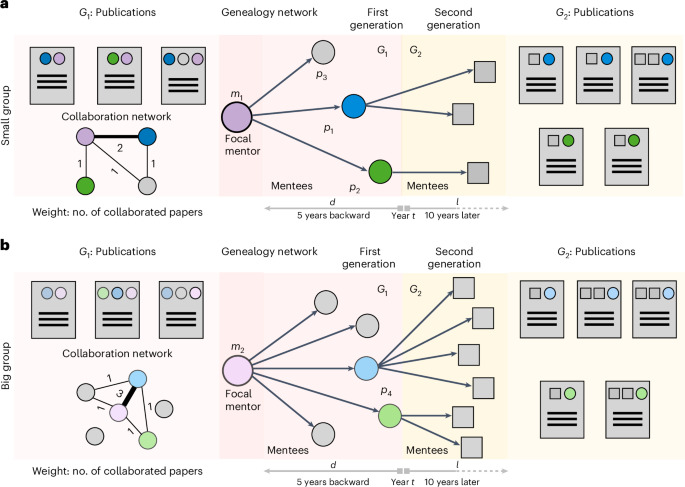
Mentoring is a key component of scientific achievements, contributing to overall measures of career success for mentees and mentors. Within the scientific community, possessing a large research group is often perceived as an indicator of exceptional mentorship and high-quality research. However, such large, competitive groups may also escalate dropout rates, particularly among early-career researchers. Overly high dropout rates of young researchers may lead to severe postdoc shortage and loss of top-tier academics in contemporary academia. In this context, we collect longitudinal genealogical data on mentor–mentee relations and their publications, and analyse the influence of a mentor’s group size on the future academic longevity and performance of their mentees. Our findings indicate that mentees trained in larger groups tend to exhibit superior academic performance compared with those from smaller groups, provided they remain in academia post graduation. However, we also observe two surprising patterns: academic survival rate is significantly lower for (1) mentees from larger groups and for (2) mentees with more productive mentors. The trend is verified in institutions of different prestige levels. These findings highlight a negative correlation between a mentor’s success and the academic survival rate of their mentees, prompting a rethinking of effective mentorship and offering actionable insights for career advancement.

Read the full article at: www.nature.com