
Binghamton Center of Complex Systems (CoCo) Seminar January 29, 2025 Robert Wagner (Mechanical Engineering, Binghamton University) “Inferring Local Interactions…
Read the full article at: vimeo.com
Networking the complexity community since 1999
Binghamton Center of Complex Systems (CoCo) Seminar January 29, 2025 Robert Wagner (Mechanical Engineering, Binghamton University) “Inferring Local Interactions…
Read the full article at: vimeo.com
Marina Dubova, et al.
PNAS 122 (5) e2401230121
The preference for simple explanations, known as the parsimony principle, has long guided the development of scientific theories, hypotheses, and models. Yet recent years have seen a number of successes in employing highly complex models for scientific inquiry (e.g., for 3D protein folding or climate forecasting). In this paper, we reexamine the parsimony principle in light of these scientific and technological advancements. We review recent developments, including the surprising benefits of modeling with more parameters than data, the increasing appreciation of the context-sensitivity of data and misspecification of scientific models, and the development of new modeling tools. By integrating these insights, we reassess the utility of parsimony as a proxy for desirable model traits, such as predictive accuracy, interpretability, effectiveness in guiding new research, and resource efficiency. We conclude that more complex models are sometimes essential for scientific progress, and discuss the ways in which parsimony and complexity can play complementary roles in scientific modeling practice.
Read the full article at: www.pnas.org
Ole Teutloff, Johanna Einsiedler, Otto Kässi, Fabian Braesemann, Pamela Mishkin, R. Maria del Rio-Chanona
Journal of Economic Behavior & Organization
We examine how ChatGPT has changed the demand for freelancers in jobs where generative AI tools can act as substitutes or complements to human labor. Using BERTopic we partition job postings from a leading online freelancing platform into 116 fine-grained skill clusters and with GPT-4o we classify them as substitutable, complementary or unaffected by LLMs. Our analysis reveals that labor demand increased after the launch of ChatGPT, but only in skill clusters that were complementary to or unaffected by the AI tool. In contrast, demand for substitutable skills, such as writing and translation, decreased by 20–50% relative to the counterfactual trend, with the sharpest decline observed for short-term (1-3 week) jobs. Within complementary skill clusters, the results are mixed: demand for machine learning programming grew by 24%, and demand for AI-powered chatbot development nearly tripled, while demand for novice workers declined in general. This result suggests a shift toward more specialized expertise for freelancers rather than uniform growth across all complementary areas.
Read the full article at: www.sciencedirect.com
The Complex Systems Seminar Series covers a wide range of topics, providing an opportunity for presenters to share and attendees to become exposed to the latest research from different fields and disciplines.
Agent-based simulation, artificial intelligence, artificial life, genetic algorithms, machine learning, neural networks, signal processing, social networks, system dynamics, and science itself are just a few of the many diverse topics that have been presented, all in an informal environment where questions and discussion are encouraged.
Schedule at: www.pdx.edu
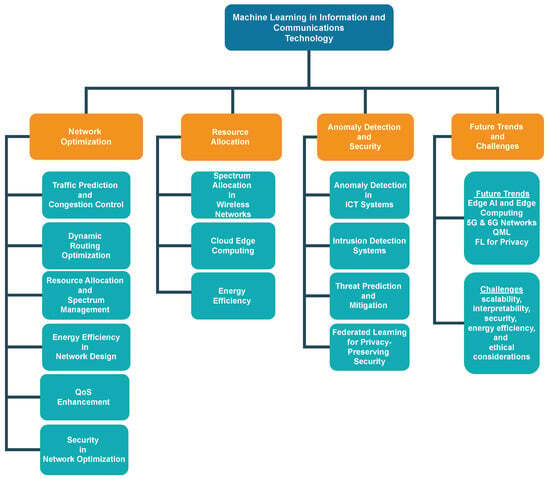
Elias Dritsas and Maria Trigka
Information 2025, 16(1), 8;
The rapid growth of data and the increasing complexity of modern networks have driven the demand for intelligent solutions in the information and communications technology (ICT) domain. Machine learning (ML) has emerged as a powerful tool, enabling more adaptive, efficient, and scalable systems in this field. This article presents a comprehensive survey on the application of ML techniques in ICT, covering key areas such as network optimization, resource allocation, anomaly detection, and security. Specifically, we review the effectiveness of different ML models across ICT subdomains and assess how ML integration enhances crucial performance metrics, including operational efficiency, scalability, and security. Lastly, we highlight the challenges and future directions that are critical for the continued advancement of ML-driven innovations in ICT.
Read the full article at: www.mdpi.com
 Complexity Digest