
Trends in urban flows: A transfer entropy approach

Roberto Murcio, Balamurugan Soundararaj

The accurate estimation of human activity in cities is one of the first steps towards understanding the structure of the urban environment. Human activities are highly granular and dynamic in spatial and temporal dimensions. Estimating confidence is crucial for decision-making in numerous applications such as urban management, retail, transport planning and emergency management. Detecting general trends in the flow of people between spatial locations is neither obvious nor easy due to the high cost of capturing these movements without compromising the privacy of those involved. This research intends to address this problem by examining the movement of people in a SmartStreetSensors network at a fine spatial and temporal resolution using a Transfer Entropy approach.

Read the full article at: arxiv.org
Effects of network connectivity and functional diversity distribution on human collective ideation

Yiding Cao, Yingjun Dong, Minjun Kim, Neil G. MacLaren, Sriniwas Pandey, Shelley D. Dionne, Francis J. Yammarino & Hiroki Sayama
npj Complexity

Human collective tasks in teams and organizations increasingly require participation of members with diverse backgrounds working in networked social environments. However, little is known about how network structure and the functional diversity of member backgrounds would interact with each other and affect collective processes. Here we conducted three sets of human-subject experiments which involved 617 university students who collaborated anonymously in a collective ideation task on a custom-made online social network platform. We found that spatially clustered collectives with assortative background distribution tended to explore more diverse ideas than in other conditions, whereas collectives with random background distribution consistently generated ideas with the highest utility. We also found that higher network connectivity may improve individuals’ overall experience but may not improve the collective performance regarding idea generation, idea diversity, and final idea quality.

Read the full article at: www.nature.com

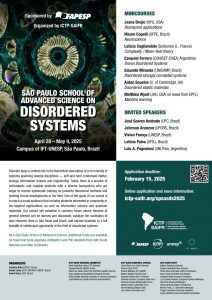
ICTP – SAIFR » São Paulo School of Advanced Science on Disordered Systems

Disorder plays a central role in the theoretical description of a rich variety of systems spanning several disciplines — soft and hard condensed matter, biology, information science and engineering. Today, there is a surplus of enthusiastic and capable students with a diverse background who are eager to receive systematic training on powerful theoretical methods and exciting recent developments in the field. One of the goals of our school is to reach a broad audience that includes students interested in complexity or bio-inspired applications, as well as information science and quantum materials. Our school will establish a common forum where theories of general interest can be learned and discussed, catalyze the nucleation of new research lines in São Paulo and Brazil, and expose students to a full breadth of intellectual opportunity in the field of disordered systems.

As a São Paulo School of Advanced Science, funds are available for travel and local expenses of Master’s and PhD students from not only South America but also from other continents.

Read the full article at: www.ictp-saifr.org

International Conference on  ANTICIPATORY SYSTEMS AND ROSENNEAN COMPLEXITY. May 22 – 23, 2025, UNAM, Mexico

The National Autonomous University of Mexico, via its Research Group on Philosophy of Computing, is proud to invite you to participate in the International Conference on Anticipatory Systems and Rosennean Complexity.

Inaugurated by Dr. Robert Rosen, Anticipatory Systems Theory deals with how systems with the ability to anticipate model and act on future states. This conference aims to address anticipation in its many forms, including its philosophical, biological, cognitive, and technological dimensions. This year (2025) will also mark the 40th anniversary of the original publication of Rosen’s “Anticipatory Systems: Philosophical, Mathematical, and Methodological Foundations”, an occasion that we shall celebrate in our conference.

This conference is focused on Robert Rosen’s ideary and notions of life, complexity, modeling, and mind.

More at: anticipation.philcomp.org