
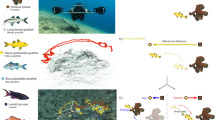
Information structure of heterogeneous criticality in a fish school

Takayuki Niizato, Kotaro Sakamoto, Yoh-ichi Mototake, Hisashi Murakami & Takenori Tomaru
Scientific Reports volume 14, Article number: 29758 (2024)

Integrated information theory (IIT) assesses the degree of consciousness in living organisms from an information-theoretic perspective. This theory can be generalised to other systems, including those exhibiting criticality. In this study, we applied IIT to the collective behaviour of Plecoglossus altivelis and observed that the group integrity (Φ) was maximised at the critical state. Multiple levels of criticality were identified within the group, existing as distinct subgroups. Moreover, these fragmented critical subgroups coexisted alongside the overall criticality of the group. The distribution of high-criticality subgroups was heterogeneous across both time and space. Notably, core fish in the high-criticality subgroups were less affected by internal and external stimuli compared to those in low-criticality subgroups. These findings are consistent with previous interpretations of critical phenomena and offer a new perspective on the dynamics of an empirical critical state.

Read the full article at: www.nature.com
Shannon information and integrated information: message and meaning

Alireza Zaeemzadeh, Giulio Tononi

Information theory, introduced by Shannon, has been extremely successful and influential as a mathematical theory of communication. Shannon’s notion of information does not consider the meaning of the messages being communicated but only their probability. Even so, computational approaches regularly appeal to “information processing” to study how meaning is encoded and decoded in natural and artificial systems. Here, we contrast Shannon information theory with integrated information theory (IIT), which was developed to account for the presence and properties of consciousness. IIT considers meaning as integrated information and characterizes it as a structure, rather than as a message or code. In principle, IIT’s axioms and postulates allow one to “unfold” a cause-effect structure from a substrate in a state, a structure that fully defines the intrinsic meaning of an experience and its contents. It follows that, for the communication of meaning, the cause-effect structures of sender and receiver must be similar.

Read the full article at: arxiv.org

Quantifying the Dynamics of Innovation Abandonment Across Scientific, Technological, Commercial, and Pharmacological Domains

Binglu Wang, Ching Jin, Chaoming Song, Johannes Bjelland, Brian Uzzi, Dashun Wang

Despite the vast literature on the diffusion of innovations that impacts a broad range of disciplines, our understanding of the abandonment of innovations remains limited yet is essential for a deeper understanding of the innovation lifecycle. Here, we analyze four large-scale datasets that capture the temporal and structural patterns of innovation abandonment across scientific, technological, commercial, and pharmacological domains. The paper makes three primary contributions. First, across these diverse domains, we uncover one simple pattern of preferential abandonment, whereby the probability for individuals or organizations to abandon an innovation increases with time and correlates with the number of network neighbors who have abandoned the innovation. Second, we find that the presence of preferential abandonment fundamentally alters the way in which the underlying ecosystem breaks down, inducing a novel structural collapse in networked systems commonly perceived as robust against abandonments. Third, we derive an analytical framework to systematically understand the impact of preferential abandonment on network dynamics, pinpointing specific conditions where it may accelerate, decelerate, or have an identical effect compared to random abandonment, depending on the network topology. Together, these results deepen our quantitative understanding of the abandonment of innovation within networked social systems, with implications for the robustness and functioning of innovation communities. Overall, they demonstrate that the dynamics of innovation abandonment follow simple yet reproducible patterns, suggesting that the uncovered preferential abandonment may be a generic property of the innovation lifecycle.

Read the full article at: arxiv.org

Domestic migration and city rank dynamics

Sandro M. Reia, P. Suresh C. Rao, Marc Barthelemy & Satish V. Ukkusuri
Nature Cities (2024)

Recent studies show that rare and extreme domestic migration flows influence both population growth and the rise and fall of cities in urbanized countries such as the USA, Canada, the UK and France. This study examines the relationship between domestic net flows (inflows minus outflows) and city rank volatility across countries over time. We find that approximately 95% of cities, representing up to 99% of a country’s population, exhibit rescaled net flows that conform to normal distributions, while about 5% experience migration shocks. Small cities are more susceptible to these shocks, often caused by net flows from larger, nearby cities, while in France, large cities also experience shocks from smaller ones. We also show that domestic migration is an important component of population growth in small cities, thus explaining their rank volatility, and that the rank stability of large cities is supported by international migration and natural increase.

Read the full article at: www.nature.com

Biological agency: a concept without a research program

James DiFrisco, Richard Gawne

Journal of Evolutionary Biology, voae153

This paper evaluates recent work purporting to show that the “agency” of organisms is an important phenomenon for evolutionary biology to study. Biological agency is understood as the capacity for goal-directed, self-determining activity—a capacity that is present in all organisms irrespective of their complexity and whether or not they have a nervous system. Proponents of the “agency perspective” on biological systems have claimed that agency is not explainable by physiological or developmental mechanisms, or by adaptation via natural selection. We show that this idea is theoretically unsound and unsupported by current biology. There is no empirical evidence that the agency perspective has the potential to advance experimental research in the life sciences. Instead, the phenomena that the agency perspective purports to make sense of are better explained using the well-established idea that complex multiscale feedback mechanisms evolve through natural selection.

Read the full article at: academic.oup.com