Month: August 2016

My Text in Your Handwriting

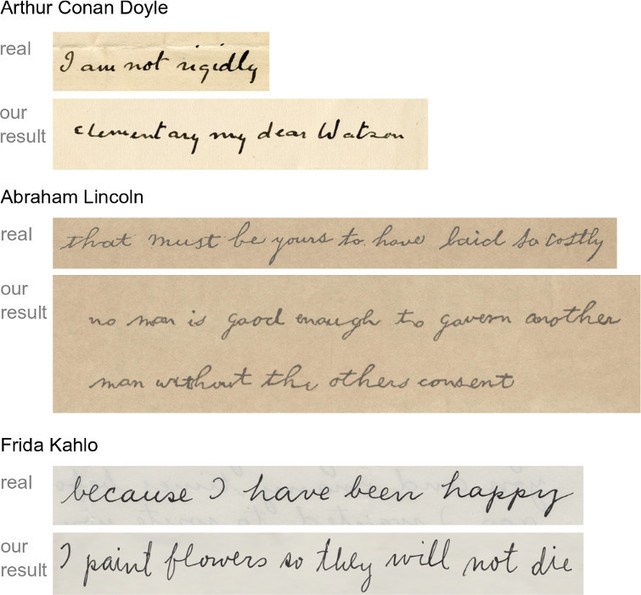
There are many scenarios where we wish to imitate a specific author’s pen-on-paper handwriting style. Rendering new text in someone’s handwriting is difficult because natural handwriting is highly variable, yet follows both intentional and involuntary structure that makes a person’s style self-consistent.
We present an algorithm that renders a desired input string in an author’s handwriting. An annotated sample of the author’s handwriting is required; the system is flexible enough that historical documents can usually be used with only a little extra effort. Experiments show that our glyph-centric approach, with learned parameters for spacing, line thickness, and pressure, produces novel images of handwriting that look hand-made to casual observers, even when printed on paper.


My Text in Your Handwriting
Tom S.F. Haines, Oisin Mac Aodha, and Gabriel J. Brostow
University College London
Transactions on Graphics 2016

Source: visual.cs.ucl.ac.uk

Enabling Persistent Autonomy for Underwater Gliders with Ocean Model Predictions and Terrain-Based Navigation

Effective study of ocean processes requires sampling over the duration of long (weeks to months) oscillation patterns. Such sampling requires persistent, autonomous underwater vehicles that have a similarly, long deployment duration. The spatiotemporal dynamics of the ocean environment, coupled with limited communication capabilities, make navigation and localization difficult, especially in coastal regions where the majority of interesting phenomena occur. In this paper, we consider the combination of two methods for reducing navigation and localization error: a predictive approach based on ocean model predictions and a prior information approach derived from terrain-based navigation. The motivation for this work is not only for real-time state estimation but also for accurately reconstructing the actual path that the vehicle traversed to contextualize the gathered data, with respect to the science question at hand. We present an application for the practical use of priors and predictions for large-scale ocean sampling. This combined approach builds upon previous works by the authors and accurately localizes the traversed path of an underwater glider over long-duration, ocean deployments. The proposed method takes advantage of the reliable, short-term predictions of an ocean model, and the utility of priors used in terrain-based navigation over areas of significant bathymetric relief to bound uncertainty error in dead-reckoning navigation. This method improves upon our previously published works by (1) demonstrating the utility of our terrain-based navigation method with multiple field trials and (2) presenting a hybrid algorithm that combines both approaches to bound navigational error and uncertainty for long-term deployments of underwater vehicles. We demonstrate the approach by examining data from actual field trials with autonomous underwater gliders and demonstrate an ability to estimate geographical location of an underwater glider to <100 m over paths of length >2 km. Utilizing the combined algorithm, we are able to prescribe an uncertainty bound for navigation and instruct the glider to surface if that bound is exceeded during a given mission.


Enabling Persistent Autonomy for Underwater Gliders with Ocean Model Predictions and Terrain-Based Navigation
Andrew Stuntz, Jonathan Scott Kelly and Ryan N. Smith

Front. Robot. AI, 29 April 2016 | http://dx.doi.org/10.3389/frobt.2016.00023

Source: journal.frontiersin.org

Demis Hassabis: Towards General Artificial Intelligence

Dr. Demis Hassabis is the Co-Founder and CEO of DeepMind, the world’s leading General Artificial Intelligence (AI) company, which was acquired by Google in 2014 in their largest ever European acquisition. Demis will draw on his eclectic experiences as an AI researcher, neuroscientist and video games designer to discuss what is happening at the cutting edge of AI research, including the recent historic AlphaGo match, and its future potential impact on fields such as science and healthcare, and how developing AI may help us better understand the human mind.

Source: www.youtube.com

From A to B: A new approach to the limits of predictability of human mobility patterns

Next place prediction algorithms are invaluable tools, capable of increasing the efficiency of a wide variety of tasks, ranging from reducing the spreading of diseases to better resource management in areas such as urban planning and communication networks. In this work we estimate upper and lower limits on the predictability of human mobility to help assess the performance of competing algorithms. We do this using GPS traces from 604 individuals participating in a multiyear long experiment, The Copenhagen Networks study. Earlier works, focusing on the prediction of a participants whereabouts in the next time bin, have found very high upper limits (> 90%). We show that these upper limits, at least for some spatiotemporal scales, are mainly driven by the fact that humans tend to stay in the same place for long periods of time. This leads us to propose a new approach, focusing on the prediction of the next Point of Interest. By removing the trivial parts of human mobility behaviour, we show that the predictability of human mobility is significantly lower than implied by earlier works.


From A to B: A new approach to the limits of predictability of human mobility patterns
Edin Lind Ikanovic, Anders Mollgaard

http://arxiv.org/abs/1608.06419

Source: arxiv.org

Instagram photos reveal predictive markers of depression

Using Instagram data from 166 individuals, we applied machine learning tools to successfully identify markers of depression. Statistical features were computationally extracted from 43,950 participant Instagram photos, using color analysis, metadata components, and algorithmic face detection. Resulting models outperformed general practitioners’ average diagnostic success rate for depression. These results held even when the analysis was restricted to posts made before depressed individuals were first diagnosed. Photos posted by depressed individuals were more likely to be bluer, grayer, and darker. Human ratings of photo attributes (happy, sad, etc.) were weaker predictors of depression, and were uncorrelated with computationally-generated features. These findings suggest new avenues for early screening and detection of mental illness.


Instagram photos reveal predictive markers of depression
Andrew G. Reece, Christopher M. Danforth

http://arxiv.org/abs/1608.03282

Source: arxiv.org