
Month: August 2016

The Complexity of Dynamics in Small Neural Circuits

The mesoscopic level of brain organization, describing the organization and dynamics of small circuits of neurons including from few tens to few thousands, has recently received considerable experimental attention. It is useful for describing small neural systems of invertebrates, and in mammalian neural systems it is often seen as a middle ground that is fundamental to link single neuron activity to complex functions and behavior. However, and somewhat counter-intuitively, the behavior of neural networks of small and intermediate size can be much more difficult to study mathematically than that of large networks, and appropriate mathematical methods to study the dynamics of such networks have not been developed yet. Here we consider a model of a network of firing-rate neurons with arbitrary finite size, and we study its local bifurcations using an analytical approach. This analysis, complemented by numerical studies for both the local and global bifurcations, shows the emergence of strong and previously unexplored finite-size effects that are particularly hard to detect in large networks. This study advances the tools available for the comprehension of finite-size neural circuits, going beyond the insights provided by the mean-field approximation and the current techniques for the quantification of finite-size effects.


Fasoli D, Cattani A, Panzeri S (2016) The Complexity of Dynamics in Small Neural Circuits. PLoS Comput Biol 12(8): e1004992. doi:10.1371/journal.pcbi.1004992

Source: journals.plos.org
Influence of selfish and polite behaviours on a pedestrian evacuation through a narrow exit: A quantitative characterisation

We study the influence of selfish vs. polite behaviours on the dynamics of a pedestrian evacuation through a narrow exit. To this end, experiments involving about 80 participants with distinct prescribed behaviours are performed; reinjection of participants into the setup allowed us to improve the statistics. Notwithstanding the fluctuations in the instantaneous flow rate, we find that a stationary regime is almost immediately reached. The average flow rate increases monotonically with the fraction c\_s of vying (selfish) pedestrians, which corresponds to a “faster-is-faster” effect in our experimental conditions; it is also positively correlated with the average density of pedestrians in front of the door, up to nearly close-packing. At large c\_s , the flow displays marked intermittency, with bursts of quasi-simultaneous escapes. In addition to these findings, we wonder whether the effect of cooperation is specific to systems of intelligent beings, or whether it can be reproduced by a purely mechanical surrogate. To this purpose, we consider a bidimensional granular flow through an orifice in which some grains are made “cooperative” by repulsive magnetic interactions which impede their mutual collisions.


Influence of selfish and polite behaviours on a pedestrian evacuation through a narrow exit: A quantitative characterisation
Alexandre Nicolas, Sebastián Bouzat, Marcelo Kuperman

http://arxiv.org/abs/1608.04863

Source: arxiv.org

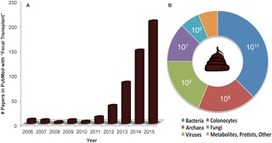
Fecal Transplants: What Is Being Transferred?

Fecal transplants are increasingly utilized for treatment of recurrent infections (i.e., Clostridium difficile) in the human gut and as a general research tool for gain-of-function experiments (i.e., gavage of fecal pellets) in animal models. Changes observed in the recipient’s biology are routinely attributed to bacterial cells in the donor feces (~10^11 per gram of human wet stool). Here, we examine the literature and summarize findings on the composition of fecal matter in order to raise cautiously the profile of its multipart nature. In addition to viable bacteria, which may make up a small fraction of total fecal matter, other components in unprocessed human feces include colonocytes (~10^7 per gram of wet stool), archaea (~10^8 per gram of wet stool), viruses (~10^8 per gram of wet stool), fungi (~10^6 per gram of wet stool), protists, and metabolites. Thus, while speculative at this point and contingent on the transplant procedure and study system, nonbacterial matter could contribute to changes in the recipient’s biology. There is a cautious need for continued reductionism to separate out the effects and interactions of each component.


Bojanova DP, Bordenstein SR (2016) Fecal Transplants: What Is Being Transferred? PLoS Biol 14(7): e1002503. doi:10.1371/journal.pbio.1002503

Source: journals.plos.org

Haploid-Diploid Algorithms

This short paper uses the recently presented idea that the fundamental haploid-diploid lifecycle of all eukaryote organisms exploits a rudimentary form of the Baldwin effect. The general approach presented here differs from all previous known work using diploid representations within evolutionary computation. The role of recombination is also changed from that previously considered in both natural and artificial evolution under the new theory. Using the NK model of fitness landscapes and the RBNK model of gene regulatory networks it is here shown that varying landscape ruggedness varies the benefit of a haploid-diploid approach in comparison to the traditional haploid representation in both cases.


Haploid-Diploid Algorithms
Larry Bull

http://arxiv.org/abs/1608.05578

Source: arxiv.org

Ten Simple Rules for Taking Advantage of Git and GitHub

Rule 1: Use GitHub to Track Your Projects
Rule 2: GitHub for Single Users, Teams, and Organizations
Rule 3: Developing and Collaborating on New Features: Branching and Forking
Rule 4: Naming Branches and Commits: Tags and Semantic Versions
Rule 5: Let GitHub Do Some Tasks for You: Integrate
Rule 6: Let GitHub Do More Tasks for You: Automate
Rule 7: Use GitHub to Openly and Collaboratively Discuss, Address, and Close Issues
Rule 8: Make Your Code Easily Citable, and Cite Source Code!
Rule 9: Promote and Discuss Your Projects: Web Page and More
Rule 10: Use GitHub to Be Social: Follow and Watch


Perez-Riverol Y, Gatto L, Wang R, Sachsenberg T, Uszkoreit J, Leprevost FdV, et al. (2016) Ten Simple Rules for Taking Advantage of Git and GitHub. PLoS Comput Biol 12(7): e1004947. doi:10.1371/journal.pcbi.1004947

Source: journals.plos.org