Month: October 2016

Azteca chess: Gamifying a complex ecological process of autonomous pest control in shade coffee

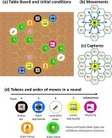
Science-based board games can help people grasp the ecological complexity of autonomous pest control (APC) in the shade-coffee agroecosystem. Azteca Chess is a board-game that captures in a stylized way the fascinating natural history and the dynamics of a complex network of direct, indirect and cascading trait-mediated interactions among five species of arthropods dwelling in shade coffee bushes (a coffee-scale, an ant, an adult and larval lady beetle, a parasitoid wasp and a parasitoid fly). In exchange for honey-dew, the Azteca ant protects scale-insects that help control the devastating coffee-rust disease. The ant repels the adult ladybeetle but inadvertently protects its larvae, which devour scales to local extinction. The head-hunting fly paralyzes Azteca and opens a window of opportunity for the adult beetle to oviposit under scales, but also for a parasitoid wasp to kill the beetle larvae. Interactions can cascade or not towards APC. Experimental test-driving shows Azteca Chess meets good modeling and game-design standards and is proved statistically to enhance understanding and application of relevant complex ecological processes.


Azteca chess: Gamifying a complex ecological process of autonomous pest control in shade coffee
Luis García-Barriosa, Ivette Perfecto, John Vandermeer

Agriculture, Ecosystems & Environment
Volume 232, 16 September 2016, Pages 190–198

Source: www.sciencedirect.com

What you need to know about CRISPR

Should we bring back the wooly mammoth? Or edit a human embryo? Or wipe out an entire species that we consider harmful? The genome-editing technology CRISPR has made extraordinary questions like these legitimate — but how does it work? Scientist and community lab advocate Ellen Jorgensen is on a mission to explain the myths and realities of CRISPR, hype-free, to the non-scientists among us.

Source: www.ted.com

Infostorms

INFOSTORMS
Vincent F. Hendricks & Pelle G. Hansen
The information society is upon us. New technologies have given us back-pocket libraries, online discussion forums, blogs, crowd-based opinion aggregators, social media and breaking news wherever, whenever. But are we more enlightened and rational because of it?

With points of departure in philosophy, logic, social psychology, economics and choice and game theory, Infostorms shows how information may be used to improve the quality of personal decision and group thinking but also warns against the informational pitfalls which modern information technology may amplify, from science to reality culture and from cyberbullying to what it really is, that makes you buy a book like this.

Source: infostorms.com

Invasive predators and global biodiversity loss

Invasive mammalian predators are arguably the most damaging group of alien animal species for global biodiversity. Thirty species of invasive predator are implicated in the extinction or endangerment of 738 vertebrate species—collectively contributing to 58% of all bird, mammal, and reptile extinctions. Cats, rodents, dogs, and pigs have the most pervasive impacts, and endemic island faunas are most vulnerable to invasive predators. That most impacted species are insular indicates that management of invasive predators on islands should be a global conservation priority. Understanding and mitigating the impact of invasive mammalian predators is essential for reducing the rate of global biodiversity loss.

Source: www.pnas.org

The 2016 Nobel Prize in Chemistry

The Royal Swedish Academy of Sciences has decided to award the Nobel Prize in Chemistry 2016 to Jean-Pierre Sauvage University of Strasbourg, France, Sir J. Fraser Stoddart Northwestern University, Evanston, IL, USA, and Bernard L. Feringa University of Groningen, the Netherlands “for the design and synthesis of molecular machines

They developed the world’s smallest machines
A tiny lift, artificial muscles and miniscule motors. The Nobel Prize in Chemistry 2016 is awarded to Jean-Pierre Sauvage, Sir J. Fraser Stoddart and Bernard L. Feringa for their design and production of molecular machines. They have developed molecules with controllable movements, which can perform a task when energy is added.

The development of computing demonstrates how the miniaturisation of technology can lead to a revolution. The 2016 Nobel Laureates in Chemistry have miniaturised machines and taken chemistry to a new dimension.

Source: www.nobelprize.org