Month: July 2017

The Fall of the Empire: The Americanization of English

As global political preeminence gradually shifted from the United Kingdom to the United States, so did the capacity to culturally influence the rest of the world. In this work, we analyze how the world-wide varieties of written English are evolving. We study both the spatial and temporal variations of vocabulary and spelling of English using a large corpus of geolocated tweets and the Google Books datasets corresponding to books published in the US and the UK. The advantage of our approach is that we can address both standard written language (Google Books) and the more colloquial forms of microblogging messages (Twitter). We find that American English is the dominant form of English outside the UK and that its influence is felt even within the UK borders. Finally, we analyze how this trend has evolved over time and the impact that some cultural events have had in shaping it.


The Fall of the Empire: The Americanization of English
Bruno Gonçalves, Lucía Loureiro-Porto, José J. Ramasco, David Sánchez

Source: arxiv.org

To slow, or not to slow? New science in sub-second networks

What happens when you slow down part of an ultrafast network that is operating quicker than the blink of an eye, e.g. electronic exchange network, navigational systems in driverless vehicles, or even neuronal processes in the brain? This question just adopted immediate commercial, legal and political importance following U.S. financial regulators’ decision to allow a new network node to intentionally introduce delays of microseconds. Though similar requests are set to follow, there is still no scientific understanding available to policymakers of the likely system-wide impact of such delays. Giving academic researchers access to (so far prohibitively expensive) microsecond exchange data would help rectify this situation. As a by-product, the lessons learned would deepen understanding of instabilities across myriad other networks, e.g. impact of millisecond delays on brain function and safety of driverless vehicle navigation systems beyond human response times.


To slow, or not to slow? New science in sub-second networks

Neil F. Johnson

Source: arxiv.org

[1707.01401] Optimal percolation on multiplex networks

Optimal percolation is the problem of finding the minimal set of nodes such that if the members of this set are removed from a network, the network is fragmented into non-extensive disconnected clusters. The solution of the optimal percolation problem has direct applicability in strategies of immunization in disease spreading processes, and influence maximization for certain classes of opinion dynamical models. In this paper, we consider the problem of optimal percolation on multiplex networks. The multiplex scenario serves to realistically model various technological, biological, and social networks. We find that the multilayer nature of these systems, and more precisely multiplex characteristics such as edge overlap and interlayer degree-degree correlation, profoundly changes the properties of the set of nodes identified as the solution of the optimal percolation problem.


Optimal percolation on multiplex networks
Saeed Osat, Ali Faqeeh, Filippo Radicchi

Source: arxiv.org

Development of structural correlations and synchronization from adaptive rewiring in networks of Kuramoto oscillators

Synchronization of non-identical oscillators coupled through complex networks is an important example of collective behavior. It is interesting to ask how the structural organization of network interactions influences this process. Several studies have uncovered optimal topologies for synchronization by making purposeful alterations to a network. Yet, the connectivity patterns of many natural systems are often not static, but are rather modulated over time according to their dynamics. This co-evolution – and the extent to which the dynamics of the individual units can shape the organization of the network itself – is not well understood. Here, we study initially randomly connected but locally adaptive networks of Kuramoto oscillators. The system employs a co-evolutionary rewiring strategy that depends only on instantaneous, pairwise phase differences of neighboring oscillators, and that conserves the total number of edges, allowing the effects of local reorganization to be isolated. We find that a simple regulatory rule – which preserves connections between more out-of-phase oscillators while rewiring connections between more in-phase oscillators – can cause initially disordered networks to organize into more structured topologies that support enhanced synchronization dynamics. We examine how this process unfolds over time, finding both a dependence on the intrinsic frequencies of the oscillators and the global coupling. For large enough coupling and after sufficient adaptation, the resulting networks exhibit degree – frequency and frequency – neighbor frequency correlations. These properties have previously been associated with optimal synchronization or explosive transitions. By considering a time-dependent interplay between structure and dynamics, this work offers a mechanism through which emergent phenomena can arise in complex systems utilizing local rules.


Development of structural correlations and synchronization from adaptive rewiring in networks of Kuramoto oscillators
Lia Papadopoulos, Jason Kim, Jurgen Kurths, Danielle S. Bassett

Source: arxiv.org

Dynamics of organizational culture: Individual beliefs vs. social conformity

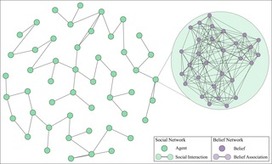
The complex nature of organizational culture challenges our ability to infer its underlying dynamics from observational studies. Recent computational studies have adopted a distinctly different view, where plausible mechanisms are proposed to describe a wide range of social phenomena, including the onset and evolution of organizational culture. In this spirit, this work introduces an empirically-grounded, agent-based model which relaxes a set of assumptions that describes past work–(a) omittance of an individual’s strive for achieving cognitive coherence; (b) limited integration of important contextual factors—by utilizing networks of beliefs and incorporating social rank into the dynamics. As a result, we illustrate that: (i) an organization may appear to be increasingly coherent in terms of its organizational culture, yet be composed of individuals with reduced levels of coherence; (ii) the components of social conformity—peer-pressure and social rank—are influential at different aggregation levels.


Ellinas C, Allan N, Johansson A (2017) Dynamics of organizational culture: Individual beliefs vs. social conformity. PLoS ONE 12(6): e0180193. https://doi.org/10.1371/journal.pone.0180193

Source: journals.plos.org