Month: August 2017

Explaining Top-Down Minds from the Bottom Up. Review of From Bacteria to Bach and Back: The Evolution of Minds by Daniel C. Dennett, 2017

The main topic of Dennett’s book is intelligent design and the design of intelligence, trying to make intuitive the processes of both, be it the top-down process of comprehension that designs with foresight and reasons or the bottom-up process of evolution that has, through blind trial and error, captured free-floating rationales and ultimately, through co-evolution (between memes and genes), achieved top-down intelligence, flipping its original design process upside down.


Delarivière S. (2017) Explaining top-down minds from the bottom up. Review of from bacteria to bach and back: The evolution of minds by daniel c. Dennett, 2017.. Constructivist Foundations 12(3): 369–372. http://constructivist.info/12/3/369

Source: www.univie.ac.at

To the Elites of the World

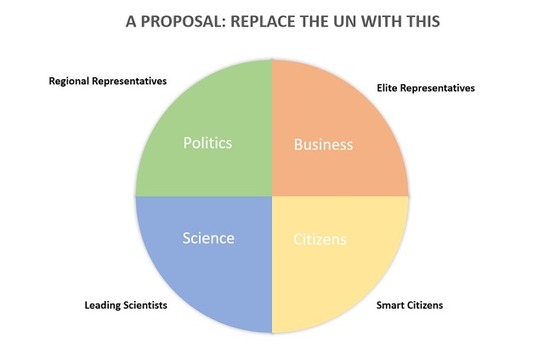
Faced with climate change, financial, economic and spending crisis, mass migration, terrorism, wars and cyber threats, it appears we are very close to global emergency. Given this state of affairs, we are running out of time to fix the problems of our planet. Here, we present what should be decided during the UN General Assembly on September 23 2017 and a reflexive preamble.

Source: futurict.blogspot.mx

When the Map Is Better Than the Territory

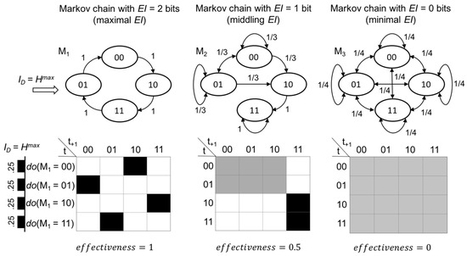
The causal structure of any system can be analyzed at a multitude of spatial and temporal scales. It has long been thought that while higher scale (macro) descriptions may be useful to observers, they are at best a compressed description and at worse leave out critical information and causal relationships. However, recent research applying information theory to causal analysis has shown that the causal structure of some systems can actually come into focus and be more informative at a macroscale. That is, a macroscale description of a system (a map) can be more informative than a fully detailed microscale description of the system (the territory). This has been called “causal emergence.” While causal emergence may at first seem counterintuitive, this paper grounds the phenomenon in a classic concept from information theory: Shannon’s discovery of the channel capacity. I argue that systems have a particular causal capacity, and that different descriptions of those systems take advantage of that capacity to various degrees. For some systems, only macroscale descriptions use the full causal capacity. These macroscales can either be coarse-grains, or may leave variables and states out of the model (exogenous, or “black boxed”) in various ways, which can improve the efficacy and informativeness via the same mathematical principles of how error-correcting codes take advantage of an information channel’s capacity. The causal capacity of a system can approach the channel capacity as more and different kinds of macroscales are considered. Ultimately, this provides a general framework for understanding how the causal structure of some systems cannot be fully captured by even the most detailed microscale description


When the Map Is Better Than the Territory
Erik P. Hoel

Entropy 2017, 19(5), 188; doi:10.3390/e19050188

Source: www.mdpi.com

Complexities of Time

This 7th Complexity Conference, organised by Para Limes​ attempts to unravel these mysteries. It will also touches on the nature of time and change, geographical, geophysical, cultural, the personal dimensions to time; how to deal with them and what they mean for analyzing and understanding our past, sensing and exploring our future and how to manage our lives, our systems, or the world we live in. Hear them out from top-notch speakers of prominent scientists and thinkers from this field

The conference will also host parallel & poster sessions and launch of the Asian Network of Complexity Scientists by the Complexity Institute. Thus is a partnership of the Para Limes and Complexity Institute.​


Complexity Conference 2018
Theme: Complexities of Time
​Date:     19-21 March 2018
Venue:   Nanyan​g Executive Centre, Singapore​​

Source: www.complexity.ntu.edu.sg