Month: August 2017

Thinking in Eigenbehaviors as a Transdisciplinary Approach

Context: By proposing to regard objects as “tokens for eigenbehavior,” von Foerster’s seminal paper opposes the intuitive subject-object dualism of traditional philosophy, which considers objects to be instances of an external world Problem: We argue that this proposal has two implications, one for epistemology and one for the demarcation between the natural sciences and the humanities. Method: Our arguments are based on insights gained in computational models and from reviewing the contributions to this special issue. Results: Epistemologically, von Foerster’s proposal suggests that what is called “reality” could be seen as an ensemble of eigenforms generated by the eigenbehavior that arises in the interaction of multiple dynamics. Regarding science, the contributions to this special issue demonstrate that the concept of eigenbehavior can be applied to a variety of disciplines from the formal and natural sciences to the humanities. Its universal applicability provides a strong argument for transdisciplinarity, and its emphasis on the observer points in the direction of an observer-inclusive science. Implications: Thinking in eigenbehavior may not only have implications for tearing down the barriers between sciences and humanities (although a common methodology based on von Foerster’s transdisciplinary approach is still to crystalize), a better understanding of eigenbehaviors may also have profound effects on our understanding of ourselves. This also opens the way to innovative behavior design/modification technologies.


Thinking in Eigenbehaviors as a Transdisciplinary Approach

Manfred Füllsack & Alexander Riegler

Constructivist Foundations 12(3): 239–245

Source: www.univie.ac.at
The evolution of the host microbiome as an ecosystem on a leash

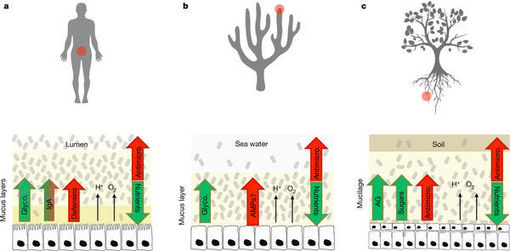
The human body carries vast communities of microbes that provide many benefits. Our microbiome is complex and challenging to understand, but evolutionary theory provides a universal framework with which to analyse its biology and health impacts. Here we argue that to understand a given microbiome feature, such as colonization resistance, host nutrition or immune development, we must consider how hosts and symbionts evolve. Symbionts commonly evolve to compete within the host ecosystem, while hosts evolve to keep the ecosystem on a leash. We suggest that the health benefits of the microbiome should be understood, and studied, as an interplay between microbial competition and host control.


The evolution of the host microbiome as an ecosystem on a leash
Kevin R. Foster, Jonas Schluter, Katharine Z. Coyte & Seth Rakoff-Nahoum
AffiliationsContributionsCorresponding authors
Nature 548, 43–51 (03 August 2017) doi:10.1038/nature23292

Source: www.nature.com

The scientists’ apprentice (How AI is transforming science)

Big data has met its match. In field after field, the ability to collect data has exploded, overwhelming human insight and analysis. But the computing advances that helped deliver the data have also conjured powerful new tools for making sense of it all. In a revolution that extends across much of science, researchers are unleashing artificial intelligence (AI), often in the form of artificial neural networks, on these mountains of data. Unlike earlier attempts at AI, such “deep learning” systems don’t need to be programmed with a human expert’s knowledge. Instead, they learn on their own, often from large training data sets, until they can see patterns and spot anomalies in data sets far larger and messier than human beings can cope with.


The scientists’ apprentice
Tim Appenzeller
Science  07 Jul 2017:
Vol. 357, Issue 6346, pp. 16-17
DOI: 10.1126/science.357.6346.16

Source: science.sciencemag.org

Citywide effects of high-occupancy vehicle restrictions: Evidence from “three-in-one” in Jakarta

Widespread use of single-occupancy cars often leads to traffic congestion. Using anonymized traffic speed data from Android phones collected through Google Maps, we investigated whether high-occupancy vehicle (HOV) policies can combat congestion. We studied Jakarta’s “three-in-one” policy, which required all private cars on two major roads to carry at least three passengers during peak hours. After the policy was abruptly abandoned in April 2016, delays rose from 2.1 to 3.1 minutes per kilometer (min/km) in the morning peak and from 2.8 to 5.3 min/km in the evening peak. The lifting of the policy led to worse traffic throughout the city, even on roads that had never been restricted or at times when restrictions had never been in place. In short, we find that HOV policies can greatly improve traffic conditions.


Citywide effects of high-occupancy vehicle restrictions: Evidence from “three-in-one” in Jakarta
Rema Hanna, Gabriel Kreindler, Benjamin A. Olken
Science  07 Jul 2017:
Vol. 357, Issue 6346, pp. 89-93
DOI: 10.1126/science.aan2747

Source: science.sciencemag.org