Month: November 2017

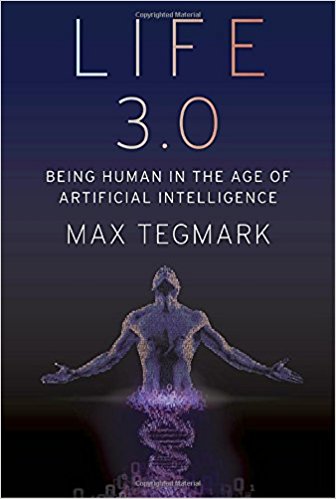
Life 3.0: Being Human in the Age of Artificial Intelligence (Max Tegmark)

How will Artificial Intelligence affect crime, war, justice, jobs, society and our very sense of being human? The rise of AI has the potential to transform our future more than any other technology—and there’s nobody better qualified or situated to explore that future than Max Tegmark, an MIT professor who’s helped mainstream research on how to keep AI beneficial.
 
How can we grow our prosperity through automation without leaving people lacking income or purpose? What career advice should we give today’s kids? How can we make future AI systems more robust, so that they do what we want without crashing, malfunctioning or getting hacked? Should we fear an arms race in lethal autonomous weapons? Will machines eventually outsmart us at all tasks, replacing humans on the job market and perhaps altogether? Will AI help life flourish like never before or give us more power than we can handle?
 
What sort of future do you want? This book empowers you to join what may be the most important conversation of our time. It doesn’t shy away from the full range of viewpoints or from the most controversial issues—from superintelligence to meaning, consciousness and the ultimate physical limits on life in the cosmos.

Source: www.amazon.com
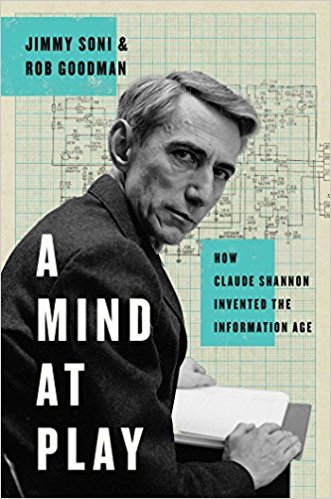
A Mind at Play: How Claude Shannon Invented the Information Age (Jimmy Soni & Rob Goodman)

In their second collaboration, biographers Jimmy Soni and Rob Goodman present the story of Claude Shannon—one of the foremost intellects of the twentieth century and the architect of the Information Age, whose insights stand behind every computer built, email sent, video streamed, and webpage loaded. Claude Shannon was a groundbreaking polymath, a brilliant tinkerer, and a digital pioneer. He constructed the first wearable computer, outfoxed Vegas casinos, and built juggling robots. He also wrote the seminal text of the digital revolution, which has been called “the Magna Carta of the Information Age.” In this elegantly written, exhaustively researched biography, Soni and Goodman reveal Claude Shannon’s full story for the first time. With unique access to Shannon’s family and friends, A Mind at Play brings this singular innovator and always playful genius to life.

Source: www.amazon.com

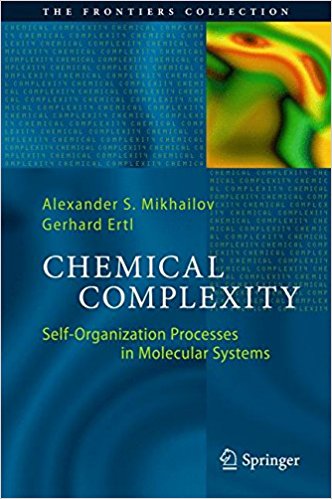
Chemical Complexity: Self-Organization Processes in Molecular Systems (A.S. Mikhailov & G. Ertl)

This book provides an outline of theoretical concepts and their experimental verification in studies of self-organization phenomena in chemical systems, as they emerged in the mid-20th century and have evolved since. Presenting essays on selected topics, it was prepared by authors who have made profound contributions to the field.


Traditionally, physical chemistry has been concerned with interactions between atoms and molecules that produce a variety of equilibrium structures – or the ‘dead’ order – in a stationary state. But biological cells exhibit a different ‘living’ kind of order, prompting E. Schrödinger to pose his famous question “What is life?” in 1943. Through an unprecedented theoretical and experimental development, it was later revealed that biological self-organization phenomena are in complete agreement with the laws of physics, once they are applied to a special class of thermodynamically open systems and non-equilibrium states. This knowledge has in turn led to the design and synthesis of simple inorganic systems capable of self-organization effects. These artificial ‘living organisms’ are able to operate on macroscopic to microscopic scales, even down to single-molecule machines.


In the future, such research could provide a basis for a technological breakthrough, comparable in its impact with the invention of lasers and semiconductors. Its results can be used to control natural chemical processes, and to design artificial complex chemical processes with various functionalities. The book offers an extensive discussion of the history of research on complex chemical systems and its future prospects.

Source: www.amazon.com

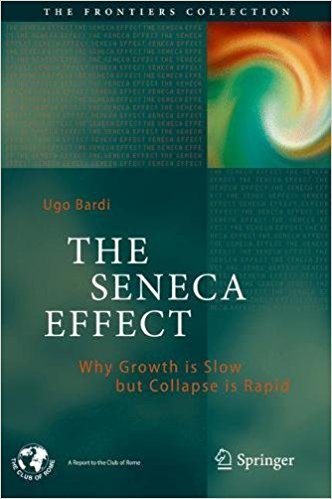
The Seneca Effect: Why Growth is Slow but Collapse is Rapid (Ugo Bardi)

The essence of this book can be found in a line written by the ancient Roman Stoic Philosopher Lucius Annaeus Seneca: “Fortune is of sluggish growth, but ruin is rapid”. This sentence summarizes the features of the phenomenon that we call “collapse,” which is typically sudden and often unexpected, like the proverbial “house of cards.” But why are such collapses so common, and what generates them? Several books have been published on the subject, including the well known “Collapse” by Jared Diamond (2005), “The collapse of complex societies” by Joseph Tainter (1998) and “The Tipping Point,” by Malcom Gladwell (2000). Why The Seneca Effect? This book is an ambitious attempt to pull these various strands together by describing collapse from a multi-disciplinary viewpoint. The reader will discover how collapse is a collective phenomenon that occurs in what we call today “complex systems,” with a special emphasis on system dynamics and the concept of “feedback.” From this foundation, Bardi applies the theory to real-world systems, from the mechanics of fracture and the collapse of large structures to financial collapses, famines and population collapses, the fall of entire civilzations, and the most dreadful collapse we can imagine: that of the planetary ecosystem generated by overexploitation and climate change. The final objective of the book is to describe a conclusion that the ancient stoic philosophers had already discovered long ago, but that modern system science has rediscovered today. If you want to avoid collapse you need to embrace change, not fight it. Neither a book about doom and gloom nor a cornucopianist’s dream, The Seneca Effect goes to the heart of the challenges that we are facing today, helping us to manage our future rather than be managed by it.

Source: www.amazon.com

The Trouble With Scientists

Sometimes it seems surprising that science functions at all. In 2005, medical science was shaken by a paper with the provocative title “Why most published research findings are false.” Written by John Ioannidis, a professor of medicine at Stanford University, it didn’t actually show that any particular result was wrong. Instead, it showed that the statistics of reported positive findings was not consistent with how often one should expect to find them. As Ioannidis concluded more recently, “many published research findings are false or exaggerated, and an estimated 85 percent of research resources are wasted.”

Source: nautil.us