Month: May 2018

Logic and connectivity jointly determine criticality in biological gene regulatory networks

The complex dynamics of gene expression in living cells can be well-approximated using Boolean networks. The average sensitivity is a natural measure of stability in these systems: values below one indicate typically stable dynamics associated with an ordered phase, whereas values above one indicate chaotic dynamics. This yields a theoretically motivated adaptive advantage to being near the critical value of one, at the boundary between order and chaos. Here, we measure average sensitivity for 66 publicly available Boolean network models describing the function of gene regulatory circuits across diverse living processes. We find the average sensitivity values for these networks are clustered around unity, indicating they are near critical. In many types of random networks, mean connectivity <K> and the average activity bias of the logic functions <p> have been found to be the most important network properties in determining average sensitivity, and by extension a network’s criticality. Surprisingly, many of these gene regulatory networks achieve the near-critical state with <K> and <p> far from that predicted for critical systems: randomized networks sharing the local causal structure and local logic of biological networks better reproduce their critical behavior than controlling for macroscale properties such as <K> and <p> alone. This suggests the local properties of genes interacting within regulatory networks are selected to collectively be near-critical, and this non-local property of gene regulatory network dynamics cannot be predicted using the density of interactions alone.

Logic and connectivity jointly determine criticality in biological gene regulatory networks
Bryan C. Daniels, Hyunju Kim, Douglas Moore, Siyu Zhou, Harrison Smith, Bradley Karas, Stuart A. Kauffman, Sara I. Walker

Source: arxiv.org

The evolutions of the rich get richer and the fit get richer phenomena in scholarly networks: the case of the strategic management journal

Understanding how a scientist develops new scientific collaborations or how their papers receive new citations is a major challenge in scientometrics. The approach being proposed simultaneously examines the growth processes of the co-authorship and citation networks by analyzing the evolutions of the rich get richer and the fit get richer phenomena. In particular, the preferential attachment function and author fitnesses, which govern the two phenomena, are estimated non-parametrically in each network. The approach is applied to the co-authorship and citation networks of the flagship journal of the strategic management scientific community, namely the Strategic Management Journal. The results suggest that the abovementioned phenomena have been consistently governing both temporal networks. The average of the attachment exponents in the co-authorship network is 0.30 while it is 0.29 in the citation network. This suggests that the rich get richer phenomenon has been weak in both networks. The right tails of the distributions of author fitness in both networks are heavy, which imply that the intrinsic scientific quality of each author has been playing a crucial role in getting new citations and new co-authorships. Since the total competitiveness in each temporal network is founded to be rising with time, it is getting harder to receive a new citation or to develop a new collaboration. Analyzing the average competency, it was found that on average, while the veterans tend to be more competent at developing new collaborations, the newcomers are likely better at acquiring new citations. Furthermore, the author fitness in both networks has been consistent with the history of the strategic management scientific community. This suggests that coupling node fitnesses throughout different networks might be a promising new direction in analyzing simultaneously multiple networks.


The evolutions of the rich get richer and the fit get richer phenomena in scholarly networks: the case of the strategic management journal

Guillermo Armando Ronda-Pupo, Thong Pham

Scientometrics pp 1–21

Source: link.springer.com

Automation Of Road Intersections Using Consensus-based Auction Algorithms

This paper investigates a consensus-based auction algorithm in the context of decentralized traffic control. In particular, we study the automation of a road intersection, where a set of vehicles is required to cross without collisions. The crossing order will be negotiated in a decentralized fashion. An on-board model predictive controller (MPC) will compute an optimal trajectory which avoids collisions with higher priority vehicles, thus retaining convex safety constraints. Simulations are then performed in a time-variant traffic environment.


Automation Of Road Intersections Using Consensus-based Auction Algorithms
Fabio Molinari, Jörg Raisch

Source: arxiv.org

New online class offers tools for tackling fundamental questions

New course online:

Algorithmic Information Dynamics: A Computational Approach to Causality and Living Systems From Networks to Cells

The course will introduce students to tools that allow them to explore causal relationships in complex datasets. Presented by the Santa Fe Institute to start in June.


Enrol online: https://santafe.edu/news-center/news/new-online-class-offers-tools-tackling-fundamental-questions


The course runs June 11 through September 3, 2018. Register online through Complexity Explorer.

Source: santafe.edu

Sensitive Dependence on Network Structure: Analog of Chaos and Opportunity for Control

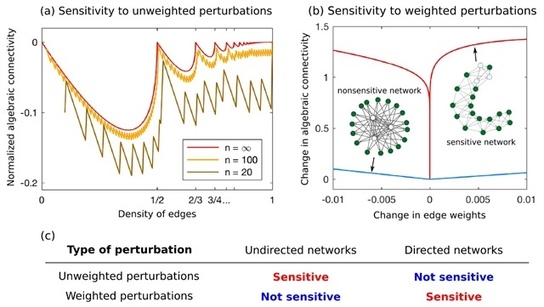
The advancement of network science over the past 20 years has created the expectation that we will soon be able to systematically control the behavior of complex network systems and in turn address numerous outstanding scientific problems, from cell reprogramming and drug target identification to cascade control and self-healing infrastructure development [4]. This expectation is not without reason, given that control technologies have been part of human development for over 2,000 years [1].

While significant progress has been made, our current ability to control is still limited in many systems. This is not so much from lack of available technologies to actuate specific network elements as from challenges imposed by unique characteristics of large real networks to designing system-level control actions [4]. These limiting characteristics include the combination of high dimensionality, nonlinearity, and constraints on the interventions, which set networks apart from other systems to which control has been traditionally applied [1]. Recent progress on developing control techniques scalable to large networks has been driven by the design of new approaches.


Sensitive Dependence on Network Structure: Analog of Chaos and Opportunity for Control
By Adilson E. Motter and Takashi Nishikawa

Source: sinews.siam.org