Month: May 2018

The topology of evolutionary novelty and innovation in macroevolution

Sewall Wright’s fitness landscape introduced the concept of evolutionary spaces in 1932. George Gaylord Simpson modified this to an adaptive, phenotypic landscape in 1944 and since then evolutionary spaces have played an important role in evolutionary theory through fitness and adaptive landscapes, phenotypic and functional trait spaces, morphospaces and related concepts. Although the topology of such spaces is highly variable, from locally Euclidean to pre-topological, evolutionary change has often been interpreted as a search through a pre-existing space of possibilities, with novelty arising by accessing previously inaccessible or difficult to reach regions of a space. Here I discuss the nature of evolutionary novelty and innovation within the context of evolutionary spaces, and argue that the primacy of search as a conceptual metaphor ignores the generation of new spaces as well as other changes that have played important evolutionary roles.


The topology of evolutionary novelty and innovation in macroevolution
Douglas H. Erwin

Phil. Trans. Roy. Soc. B Volume 372, issue 1735

Source: rstb.royalsocietypublishing.org

The free energy principle for action and perception: A mathematical review

The ‘free energy principle’ (FEP) has been suggested to provide a unified theory of the brain, integrating data and theory relating to action, perception, and learning. The theory and implementation of the FEP combines insights from Helmholtzian ‘perception as inference’, machine learning theory, and statistical thermodynamics. Here, we provide a detailed mathematical evaluation of a suggested biologically plausible implementation of the FEP that has been widely used to develop the theory. Our objectives are (i) to describe within a single article the mathematical structure of this implementation of the FEP; (ii) provide a simple but complete agent-based model utilising the FEP and (iii) to disclose the assumption structure of this implementation of the FEP to help elucidate its significance for the brain sciences.


The free energy principle for action and perception: A mathematical review
Christopher L. Buckley, Chang Sub Kim, Simon McGregor, Anil K. Seth

Journal of Mathematical Psychology
Volume 81, December 2017, Pages 55-79

Source: www.sciencedirect.com

Complexity and Data Analytics Summer Courses @NECSI

The NECSI Summer School offers two intensive week-long courses on complexity science, modeling and networks, and data analytics. The format of the courses is modular and you may register for either or both of the weeks. Each week also includes a one-day lab session. If desired, arrangements for credit at a home institution may be made in advance.

The first week offers an introduction to complex systems concepts and modeling. The second week will cover networks and data analytics. Participants will learn how to handle large datasets using academy- and industry-standard toolboxes, how to integrate data into the construction of models and analysis relevant to research and industry applications, and a variety of visualization techniques.

The courses are intended for faculty, graduate students, post-doctoral fellows, professionals and others who would like to gain an understanding of complexity science and data analytics for their respective fields, new research directions, or industry applications.

The schedule for the summer school is as follows:
• Lab 1: June 3 CX102: Computer Programming for Complex Systems
• Week 1: June 4-8 CX201: Concepts and Modeling
• Lab 2: June 10 CX103: Setting up for Data Analytics
• Week 2: June 11-15 CX202: Networks and Data Analytics

Source: necsi.edu

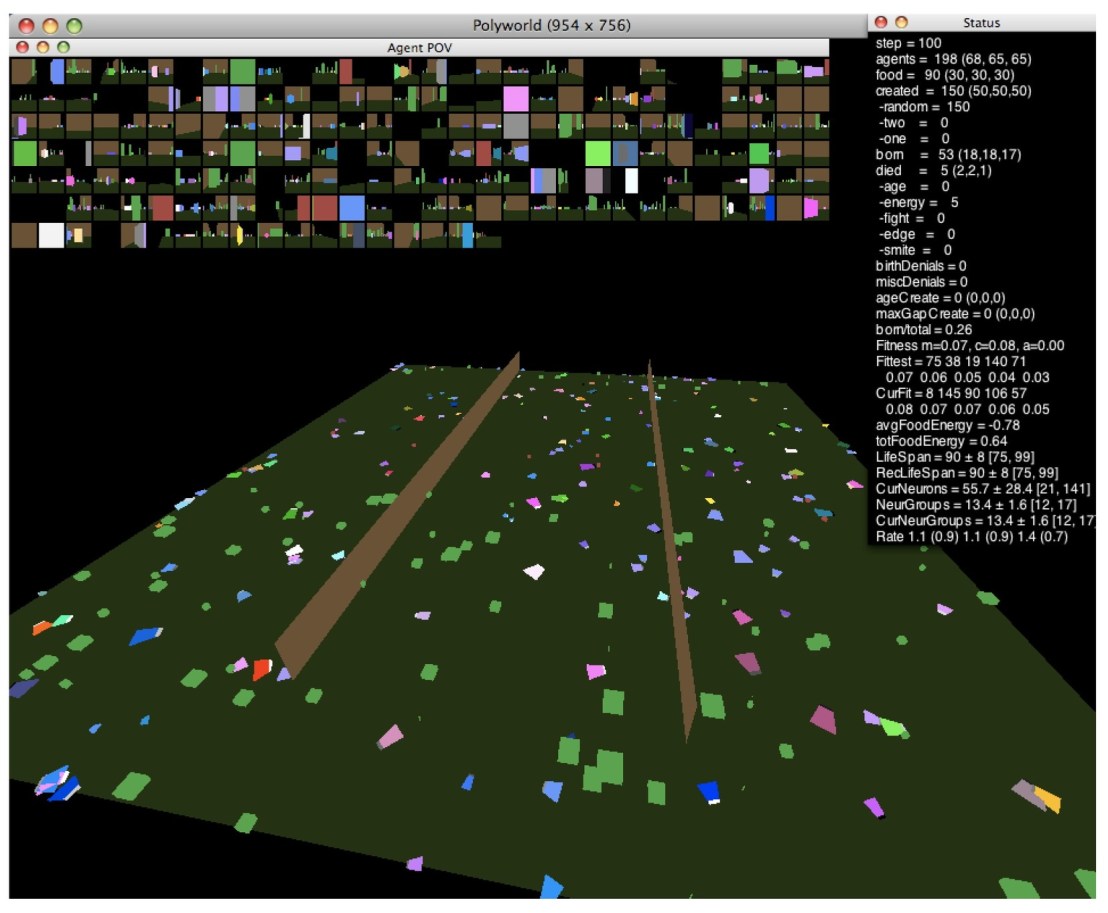
Evolution of Neural Dynamics in an Ecological Model

What is the optimal level of chaos in a computational system? If a system is too chaotic, it cannot reliably store information. If it is too ordered, it cannot transmit information. A variety of computational systems exhibit dynamics at the “edge of chaos”, the transition between the ordered and chaotic regimes. In this work, we examine the evolved neural networks of Polyworld, an artificial life model consisting of a simulated ecology populated with biologically inspired agents. As these agents adapt to their environment, their initially simple neural networks become increasingly capable of exhibiting rich dynamics. Dynamical systems analysis reveals that natural selection drives these networks toward the edge of chaos until the agent population is able to sustain itself. After this point, the evolutionary trend stabilizes, with neural dynamics remaining on average significantly far from the transition to chaos.


Evolution of Neural Dynamics in an Ecological Model
Steven Williams and Larry Yaeger

Geosciences 2017, 7(3), 49; https://doi.org/10.3390/geosciences7030049

Source: www.mdpi.com