Month: May 2020

The transsortative structure of networks

Shin-Chieng Ngo, Allon G. Percus, Keith Burghardt and Kristina Lerman

Proceedings of the Royal Society A: Mathematical, Physical and Engineering Sciences

Volume 476 Issue 2237


Network topologies can be highly non-trivial, due to the complex underlying behaviours that form them. While past research has shown that some processes on networks may be characterized by local statistics describing nodes and their neighbours, such as degree assortativity, these quantities fail to capture important sources of variation in network structure. We define a property called transsortativity that describes correlations among a node’s neighbours. Transsortativity can be systematically varied, independently of the network’s degree distribution and assortativity. Moreover, it can significantly impact the spread of contagions as well as the perceptions of neighbours, known as the majority illusion. Our work improves our ability to create and analyse more realistic models of complex networks.

Source: royalsocietypublishing.org
Evolution of cooperation on temporal networks

Aming Li, Lei Zhou, Qi Su, Sean P. Cornelius, Yang-Yu Liu, Long Wang & Simon A. Levin 
Nature Communications volume 11, Article number: 2259 (2020)


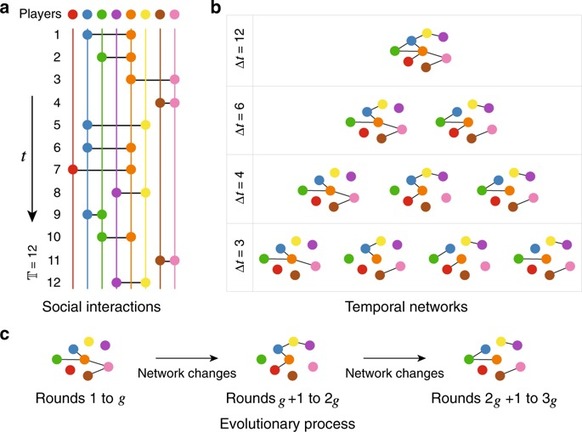
Population structure is a key determinant in fostering cooperation among naturally self-interested individuals in microbial populations, social insect groups, and human societies. Traditional research has focused on static structures, and yet most real interactions are finite in duration and changing in time, forming a temporal network. This raises the question of whether cooperation can emerge and persist despite an intrinsically fragmented population structure. Here we develop a framework to study the evolution of cooperation on temporal networks. Surprisingly, we find that network temporality actually enhances the evolution of cooperation relative to comparable static networks, despite the fact that bursty interaction patterns generally impede cooperation. We resolve this tension by proposing a measure to quantify the amount of temporality in a network, revealing an intermediate level that maximally boosts cooperation. Our results open a new avenue for investigating the evolution of cooperation and other emergent behaviours in more realistic structured populations.

Source: www.nature.com

The online competition between pro- and anti-vaccination views

Neil F. Johnson, Nicolas Velásquez, Nicholas Johnson Restrepo, Rhys Leahy, Nicholas Gabriel, Sara El Oud, Minzhang Zheng, Pedro Manrique, Stefan Wuchty & Yonatan Lupu 
Nature (2020)


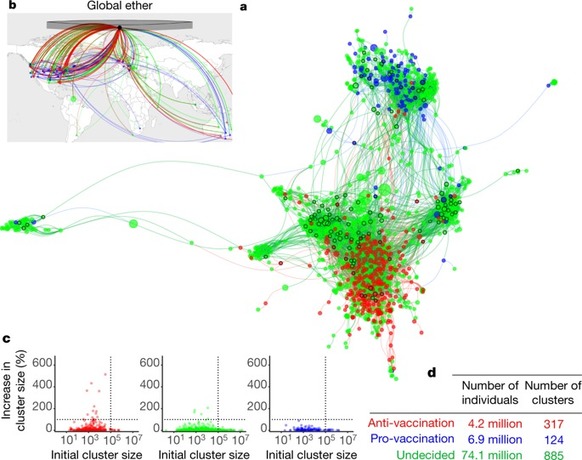
Distrust in scientific expertise1,2,3,4,5,6,7,8,9,10,11,12,13,14 is dangerous. Opposition to vaccination with a future vaccine against SARS-CoV-2, the causal agent of COVID-19, for example, could amplify outbreaks2,3,4, as happened for measles in 20195,6. Homemade remedies7,8 and falsehoods are being shared widely on the Internet, as well as dismissals of expert advice9,10,11. There is a lack of understanding about how this distrust evolves at the system level13,14. Here we provide a map of the contention surrounding vaccines that has emerged from the global pool of around three billion Facebook users. Its core reveals a multi-sided landscape of unprecedented intricacy that involves nearly 100 million individuals partitioned into highly dynamic, interconnected clusters across cities, countries, continents and languages. Although smaller in overall size, anti-vaccination clusters manage to become highly entangled with undecided clusters in the main online network, whereas pro-vaccination clusters are more peripheral. Our theoretical framework reproduces the recent explosive growth in anti-vaccination views, and predicts that these views will dominate in a decade. Insights provided by this framework can inform new policies and approaches to interrupt this shift to negative views. Our results challenge the conventional thinking about undecided individuals in issues of contention surrounding health, shed light on other issues of contention such as climate change11, and highlight the key role of network cluster dynamics in multi-species ecologies15.

Source: www.nature.com

When All Products Are Digital: Complexity and Intangible Value in the Ecosystem of Digitizing Firms 

Pouya Rahmati, Ali R. Tafti, J. Christopher Westland, César Hidalgo 


During the last four decades, digital technologies have disrupted many industries. Car control systems have gone from mechanical to digital. Telephones have changed from sound boxes to portable computers. But have the firms that digitized their products and services become more valuable than firms that didn’t? Here we introduce the construct of digital proximity, which considers the interdependent activities of firms linked in an economic network. We then explore how the digitization of products and services affects a company’s Tobin’s q—the ratio of market value over assets—a measure of the intangible value of a firm. Our panel regression methods and robustness tests suggest the positive influence of a firm’s digital proximity on its Tobin’s q. This implies that firms able to come closer to the digital sector have increased their intangible value compared to those that have failed to do so. These findings contribute a new way of measuring digitization and its impact on firm performance that is complementary to traditional measures of information technology (IT) intensity.

Source: papers.ssrn.com

Evolution is exponentially more powerful with frequency-dependent selection

Valiant (2009) proposed to treat Darwinian evolution as a special kind of computational learning from statistical queries. The statistical queries represent a genotype’s fitness over a distribution of challenges. And this distribution of challenges along with the best response to them specify a given abiotic environment or static fitness landscape. Valiant’s model distinguished families of environments that are “adaptable-to” from those that are not. But this model of evolution omits the vital ecological interactions between different evolving agents – it neglects the rich biotic environment that is central to the struggle for existence.


In this article, I extend algorithmic Darwinism to include the ecological dynamics of frequency-dependent selection as a population-dependent bias to the distribution of challenges that specify an environment. This extended algorithmic Darwinism replaces simple invasion of wild-type by a mutant-type of higher scalar fitness with an evolutionary game between wild-type and mutant-type based on their frequency-dependent fitness function. To analyze this model, I develop a game landscape view of evolution, as a generalization of the classic fitness landscape approach that is popular in biology.


I show that this model of eco-evo dynamics on game landscapes can provide an exponential speed-up over the purely evolutionary dynamics of the strict algorithmic Darwinism proposed by Valiant. In particular, I prove that the noisy-Parity environment – which is known to be not adaptable-to under strict algorithmic Darwinism (and conjectured to be not PAC-learnable) – is adaptable-to by eco-evo dynamics. Thus, the ecology of frequency-dependent selection does not just increase the tempo of evolution, but fundamentally transforms its mode.


The eco-evo dynamic for adapting to the noisy-Parity environment proceeds by two stages: (1) a quick stage of point-mutations that moves the population to one of exponentially many local fitness peaks; followed by (2) a slower stage where each ‘step’ follows a double-mutation by a point-mutation. This second stage allows the population to hop between local fitness peaks to reach the unique global fitness peak in polynomial time. The evolutionary game dynamics of finite populations are essential for finding a short adaptive path to the global fitness peak during the second stage of the adaptation process. This highlights the rich interface between computational learning theory, evolutionary games, and long-term evolution.

Source: www.biorxiv.org