Month: May 2020

Scaling and criticality in a phenomenological renormalization group

We present a systematic study to test a recently introduced phenomenological renormalization group, proposed to coarse-grain data of neural activity from their correlation matrix. The approach allows, at least in principle, to establish whether the collective behavior of the network of spiking neurons is described by a non-Gaussian critical fixed point. We test this renormalization procedure in a variety of models focusing in particular on the contact process, which displays an absorbing phase transition at λ = λ c between a silent and an active state. We find that the results of the coarse graining do not depend on the presence of long-range interactions and, overall, the method proves to be able to distinguish the critical regime from the supercritical one. However, some scaling features persist in the supercritical regime, at least for a finite system, as we see in a contact process above λ c . Our results provide both a systematic test of the method and insights on the possible subtleties that one needs to consider when applying such phenomenological approaches directly to data to infer signatures of criticality.

Source: link.aps.org
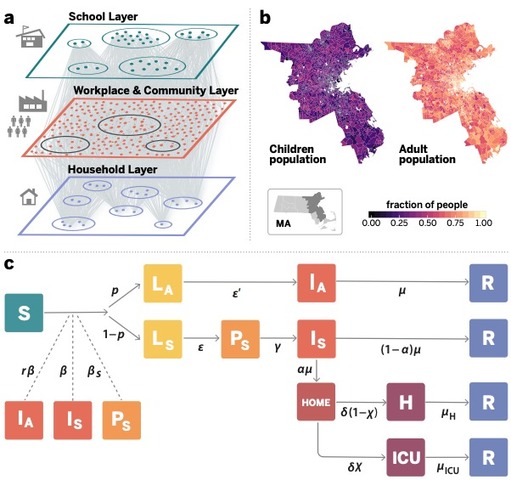
Modeling the impact of social distancing, testing, contact tracing and household quarantine on second-wave scenarios of the COVID-19 epidemic

Alberto Aleta, David Martín-Corral, Ana Pastore y Piontti, Marco Ajelli, Maria Litvinova, Matteo Chinazzi, Natalie E. Dean, M. Elizabeth Halloran, Ira M. Longini, Jr., Stefano Merler, Alex Pentland, Alessandro Vespignani, Esteban Moro, Yamir Moreno


The new coronavirus disease 2019 (COVID-19) has required the implementation of severe mobility restrictions and social distancing measures worldwide. While these measures have been proven effective in abating the epidemic in several countries, it is important to estimate the effectiveness of testing and tracing strategies to avoid a potential second wave of the COVID-19 epidemic. We integrate highly detailed (anonymized, privacy-enhanced) mobility data from mobile devices, with census and demographic data to build a detailed agent-based model to describe the transmission dynamics of SARS-CoV-2 in the Boston metropolitan area. We find that enforcing strict social distancing followed by a policy based on a robust level of testing, contact-tracing and household quarantine, could keep the disease at a level that does not exceed the capacity of the health care system. Assuming the identification of 50% of the symptomatic infections, and the tracing of 40% of their contacts and households, which corresponds to about 9% of individuals quarantined, the ensuing reduction in transmission allows the reopening of economic activities while attaining a manageable impact on the health care system. Our results show that a response system based on enhanced testing and contact tracing can play a major role in relaxing social distancing interventions in the absence of herd immunity against SARS-CoV-2.

Source: www.cidid.org

Cumulative effects of triadic closure and homophily in social networks

Social network structure has often been attributed to two network evolution mechanisms—triadic closure and choice homophily—which are commonly considered independently or with static models. However, empirical studies suggest that their dynamic interplay generates the observed homophily of real-world social networks. By combining these mechanisms in a dynamic model, we confirm the longheld hypothesis that choice homophily and triadic closure cause induced homophily. We estimate how much observed homophily in friendship and communication networks is amplified due to triadic closure. We find that cumulative effects of homophily amplification can also lead to the widely documented core-periphery structure of networks, and to memory of homophilic constraints (equivalent to hysteresis in physics). The model shows that even small individual bias may prompt network-level changes such as segregation or core group dominance. Our results highlight that individual-level mechanisms should not be analyzed separately without considering the dynamics of society as a whole.


Aili Asikainen, Gerardo Iñiguez, Javier Ureña-Carrión, Kimmo Kaski and Mikko Kivelä

Science Advances  08 May 2020:
Vol. 6, no. 19, eaax7310
DOI: 10.1126/sciadv.aax7310

Source: advances.sciencemag.org

Ninth International Conference on Complex Networks & Their Applications Madrid, Spain December 1- 3, 2020

The International Conference on Complex Networks and their Applications aims at bringing together researchers from different scientific communities working on areas related to complex networks. Two types of contributions are welcome: theoretical developments arising from practical problems, and case studies where methodologies are applied. Both contributions are aimed at stimulating the interaction between theoreticians and practitioners.

Source: complexnetworks.org

Modelling COVID-19

Alessandro Vespignani, Huaiyu Tian, Christopher Dye, James O. Lloyd-Smith, Rosalind M. Eggo, Munik Shrestha, Samuel V. Scarpino, Bernardo Gutierrez, Moritz U. G. Kraemer, Joseph Wu, Kathy Leung & Gabriel M. Leung 
Nature Reviews Physics (2020)


As the COVID-19 pandemic continues, mathematical epidemiologists share their views on what models reveal about how the disease has spread, the current state of play and what work still needs to be done.

Source: www.nature.com