Month: May 2020

A Class of Models with the Potential to Represent Fundamental Physics

Stephen Wolfram


A class of models intended to be as minimal and structureless as possible is introduced. Even in cases with simple rules, rich and complex behavior is found to emerge, and striking correspondences to some important core known features of fundamental physics are seen, suggesting the possibility that the models may provide a new approach to finding a fundamental theory of physics.

Source: arxiv.org

The race for coronavirus vaccines – a graphical guide

More than 90 vaccines are being developed against SARS-CoV-2 by research teams in companies and universities across the world. Researchers are trialling different technologies, some of which haven’t been used in a licensed vaccine before. At least six groups have already begun injecting formulations into volunteers in safety trials; others have started testing in animals. Nature’s graphical guide explains each vaccine design.

Source: www.nature.com

How Coronavirus Mutates and Spreads

The virus has mutated. But that doesn’t mean it’s getting deadlier.


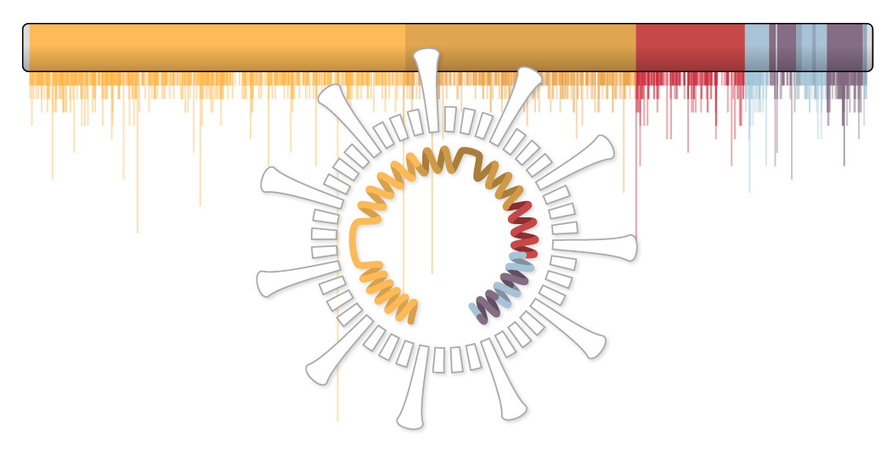
At this point in the pandemic, coronavirus genomes with 10 or fewer mutations are common, and only a small number have over 20 mutations — which is still less than a tenth of a percent of the genome.


Over time, viruses can evolve into new strains — in other words, viral lineages that are significantly different from each other. Since January, researchers have sequenced many thousands of SARS-CoV-2 genomes and tracked all the mutations that have arisen. So far, they haven’t found compelling evidence that the mutations have had a significant change in how the virus affects us.

Source: www.nytimes.com

US Coronavirus Death Toll Is Far Higher Than Reported, CDC Data Suggests

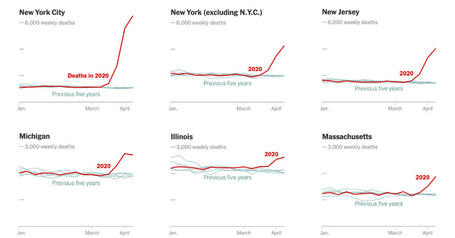
Total deaths in seven states that have been hard hit by the coronavirus pandemic are nearly 50 percent higher than normal for the five weeks from March 8 through April 11 2020, according to new death statistics from the Centers for Disease Control and Prevention. That is 9,000 more deaths than were reported as of April 11 in official counts of deaths from the coronavirus.


The new data is partial and most likely undercounts the recent death toll significantly. But it still illustrates how the coronavirus is causing a surge in deaths in the places it has struck, probably killing more people than the reported statistics capture. These increases belie arguments that the virus is only killing people who would have died anyway from other causes. Instead, the virus has brought a pattern of deaths unlike anything seen in recent years.


If you look at the provisional deaths from all causes, death counts in New York, New Jersey, Michigan, Massachusetts, Illinois, Maryland and Colorado have spiked far above their normal levels for the period. In New York City, the home of the biggest outbreak, the number of deaths over this period is more than three times the normal number. Recent data suggests it could have reached six times higher than normal.

Source: www.nytimes.com

Towards Social Capital in a Network Organization: A Conceptual Model and an Empirical Approach

 Saad Alqithami, Rahmat Budiarto, Musaad Alzahrani and Henry Hexmoor

Entropy 2020, 22(5), 519


Due to the complexity of an open multi-agent system, agents’ interactions are instantiated spontaneously, resulting in beneficent collaborations with one another for mutual actions that are beyond one’s current capabilities. Repeated patterns of interactions shape a feature of their organizational structure when those agents self-organize themselves for a long-term objective. This paper, therefore, aims to provide an understanding of social capital in organizations that are open membership multi-agent systems with an emphasis in our formulation on the dynamic network of social interactions that, in part, elucidate evolving structures and impromptu topologies of networks. We model an open source project as an organizational network and provide definitions and formulations to correlate the proposed mechanism of social capital with the achievement of an organizational charter, for example, optimized productivity. To empirically evaluate our model, we conducted a case study of an open source software project to demonstrate how social capital can be created and measured within this type of organization. The results indicate that the values of social capital are positively proportional towards optimizing agents’ productivity into successful completion of the project.

Source: www.mdpi.com