Month: September 2020

Bending the curve of terrestrial biodiversity needs an integrated strategy

David Leclère, Michael Obersteiner, […]Lucy Young 
Nature (2020)


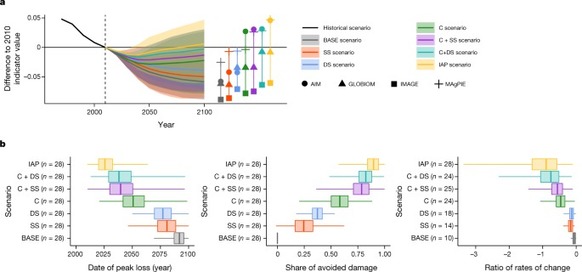
Increased efforts are required to prevent further losses to terrestrial biodiversity and the ecosystem services that it provides. Ambitious targets have been proposed, such as reversing the declining trends in biodiversity; however, just feeding the growing human population will make this a challenge. Here we use an ensemble of land-use and biodiversity models to assess whether—and how—humanity can reverse the declines in terrestrial biodiversity caused by habitat conversion, which is a major threat to biodiversity. We show that immediate efforts, consistent with the broader sustainability agenda but of unprecedented ambition and coordination, could enable the provision of food for the growing human population while reversing the global terrestrial biodiversity trends caused by habitat conversion. If we decide to increase the extent of land under conservation management, restore degraded land and generalize landscape-level conservation planning, biodiversity trends from habitat conversion could become positive by the mid-twenty-first century on average across models (confidence interval, 2042–2061), but this was not the case for all models. Food prices could increase and, on average across models, almost half (confidence interval, 34–50%) of the future biodiversity losses could not be avoided. However, additionally tackling the drivers of land-use change could avoid conflict with affordable food provision and reduces the environmental effects of the food-provision system. Through further sustainable intensification and trade, reduced food waste and more plant-based human diets, more than two thirds of future biodiversity losses are avoided and the biodiversity trends from habitat conversion are reversed by 2050 for almost all of the models. Although limiting further loss will remain challenging in several biodiversity-rich regions, and other threats—such as climate change—must be addressed to truly reverse the declines in biodiversity, our results show that ambitious conservation efforts and food system transformation are central to an effective post-2020 biodiversity strategy.

Source: www.nature.com
Global quieting of high-frequency seismic noise due to COVID-19 pandemic lockdown measures

Thomas Lecocq, et al. 
Science  11 Sep 2020:
Vol. 369, Issue 6509, pp. 1338-1343
DOI: 10.1126/science.abd2438


Human activity causes vibrations that propagate into the ground as high-frequency seismic waves. Measures to mitigate the coronavirus disease 2019 (COVID-19) pandemic caused widespread changes in human activity, leading to a months-long reduction in seismic noise of up to 50%. The 2020 seismic noise quiet period is the longest and most prominent global anthropogenic seismic noise reduction on record. Although the reduction is strongest at surface seismometers in populated areas, this seismic quiescence extends for many kilometers radially and hundreds of meters in depth. This quiet period provides an opportunity to detect subtle signals from subsurface seismic sources that would have been concealed in noisier times and to benchmark sources of anthropogenic noise. A strong correlation between seismic noise and independent measurements of human mobility suggests that seismology provides an absolute, real-time estimate of human activities.

Source: science.sciencemag.org

Complexity Weekend. October 16-18, 2020

Meet new collaborators and learn Complexity Science by doing

Complexity Science is an interdisciplinary and inclusive framework for studying, designing, and controlling Complex system behavior, such as global pandemics, extreme weather events, electoral politics, economic recovery and poverty, and much more. Over the course of one weekend, you will experience Complexity from a variety of perspectives, while developing solutions to real-world problems in a team setting, such as:


  • Information flow in a time of global connectivity
  • Adaptive planning for communities amidst turbulence and uncertainty
  • Addressing climate change and extreme weather events
  • Ensuring fair and accurate elections
  • Evaluating shelter-in-place policy efficacy during a pandemic
  • Building resiliency into businesses, governments, and families
  • Healthcare policy and efficacy
  • Mental health and wellness
  • Any other difficult and ongoing problems you can identify

Source: www.complexityweekend.com