Month: May 2021

Complexity Science – From philosophical foundations to applications in climate and social science. Karoline Wiesner

Many people might not bother to define complexity, thinking that we know it when we see it. Scientists should not afford such luxury. I will provide a compact but comprehensive overview of the different ways that systems can be complex, offering an aggregate definition. I will discuss the role of complexity measures, and why complexity cannot be captured by a single number. This work was done in collaboration with James Ladyman, published with Yale University Press in 2020. At the other end of the spectrum of complexity science is the application to real-world problems. I will present two examples from recent work. The project ‘Aiding the mitigation of and adaptation to climate change using the tools of complexity science’ was done in collaboration with the Green Climate Fund, founded by the UN members in 2014. Equally, political systems are more and more focus of computational and mathematical investigations. I will present conceptual work on the stability of democracy, a collaboration with an international and interdisciplinary group of scientists.

Watch at: www.youtube.com

Mind, Brain and Body: An evolutionary perspective on the human condition

Francis Heylighen

The present course intends to answer the question of what it means to be human. This question has traditionally been the subject of a domain known as “philosophical anthropology”. Anthropology is the science that studies humans—just as entomology studies insects, and herpetology studies reptiles. It does this by carefully observing the physical, social and cultural properties that characterize human beings. This includes the evolution of humans out of their ape-like ancestors. It also includes the behaviors that different groups of humans exhibit in their more “natural state”, for example as hunter-gatherers living in the rainforest as yet unaffected by our highly technological civilization. Philosophical anthropology complements these concrete observations and the resulting theories by studying what has been called the “human condition”. This concerns more existential questions about the meaning of human life:
Ø Who are we?
Ø What are we living for?
Ø What is our fundamental human nature?
Ø What are human values?
Ø What sets humans apart from other beings?

Read the full book at: researchportal.vub.be

Too Lazy to Read the Paper: Episode 6 with Gourab Ghoshal and Petter Holme

I’ve got a treat for you today. Today’s author’s are Gourab Ghoshal and Petter Holme, who are here to talk about a classic paper. A paper they co-authored and published in PRL in 2006. The paper has a fantastic title, which is basically also a mini abstract. It is called “Dynamics of Networking Agents Competing for High Centrality and Low Degree” (1). In the podcast we get into it!

Gourab is at at Rochester University, where he is an Associate Professor of Physics and Astronomy with joint appointments at the departments of Computer Science and Mathematics. He works in the field of Complex Systems. His research interests are in the theory and applications of Complex Networks as well as Non-equilibrium Statistical Physics, Game theory, Econophysics, Dynamical Systems and the Origins of Life.

Petter is Swedish scientist living and working in Japan, where he is a Specially Appointed Professor at the Institute of Innovative Research at the Tokyo Institute of Technology. His research focuses on large-scale structures in society, technology and biology; mostly trying to understand them as networks.

Read the full article at: toolazy.buzzsprout.com

Emergence in artificial life

Carlos Gershenson
Concepts similar to emergence have been used since antiquity, but we lack an agreed definition of emergence. Still, emergence has been identified as one of the features of complex systems. Most would agree on the statement “life is complex”. Thus, understanding emergence and complexity should benefit the study of living systems. It can be said that life emerges from the interactions of complex molecules. But how useful is this to understand living systems? Artificial life (ALife) has been developed in recent decades to study life using a synthetic approach: build it to understand it. ALife systems are not so complex, be them soft (simulations), hard (robots), or wet (protocells). Then, we can aim at first understanding emergence in ALife, for then using this knowledge in biology. I argue that to understand emergence and life, it becomes useful to use information as a framework. In a general sense, emergence can be defined as information that is not present at one scale but is present at another scale. This perspective avoids problems of studying emergence from a materialistic framework, and can be useful to study self-organization and complexity.

Read the full article at: arxiv.org

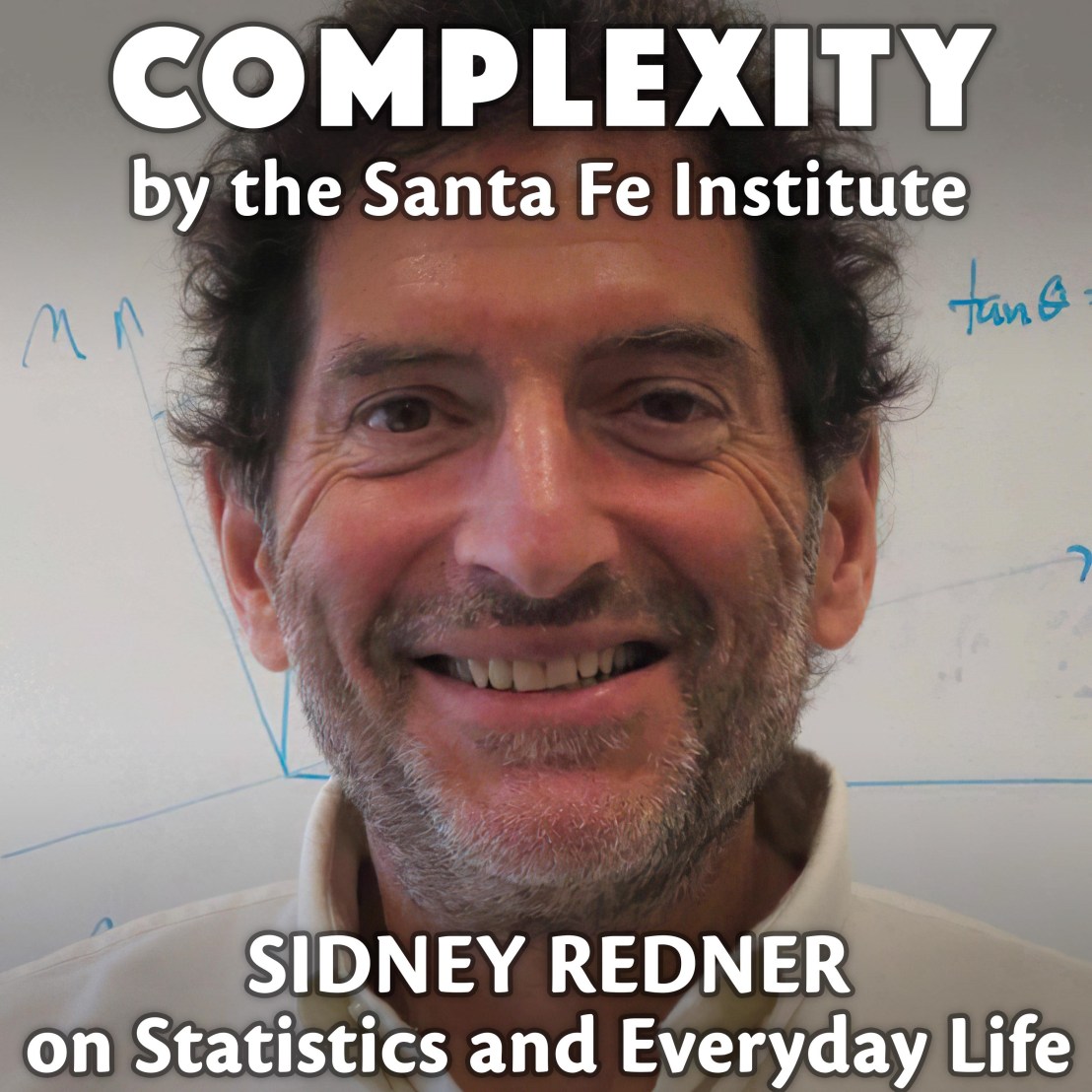
Sidney Redner on Statistics and Everyday Life

In this episode, we speak to SFI Resident Professor Sidney Redner, author of A Guide to First-Passage Processes, about how he finds inspiration for his complex systems research in the everyday — and how he uses math and physics to explore hot hands, heat waves, parking lots, and more…

Listen at: complexity.simplecast.com