Month: May 2021

Perverse Downstream Consequences of Debunking: Being Corrected by Another User for Posting False Political News Increases Subsequent Sharing of Low Quality, Partisan, and Toxic Content in a Twitter…

Mohsen Mosleh, Cameron Martel, Dean Eckles, David Rand

A prominent approach to combating online misinformation is to debunk false content. Here we investigate downstream consequences of social corrections on users’ subsequent sharing of other content. Being corrected might make users more attentive to accuracy, thus improving their subsequent sharing. Alternatively, corrections might not improve subsequent sharing – or even backfire – by making users feel defensive, or by shifting their attention away from accuracy (e.g., towards various social factors). We identified N=2,000 users who shared false political news on Twitter, and replied to their false tweets with links to fact-checking websites. We find causal evidence that being corrected decreases the quality, and increases the partisan slant and language toxicity, of the users’ subsequent retweets (but has no significant effect on primary tweets). This suggests that being publicly corrected by another user shifts one’s attention away from accuracy – presenting an important challenge for social correction approaches.

https://dl.acm.org/doi/10.1145/3411764.3445642
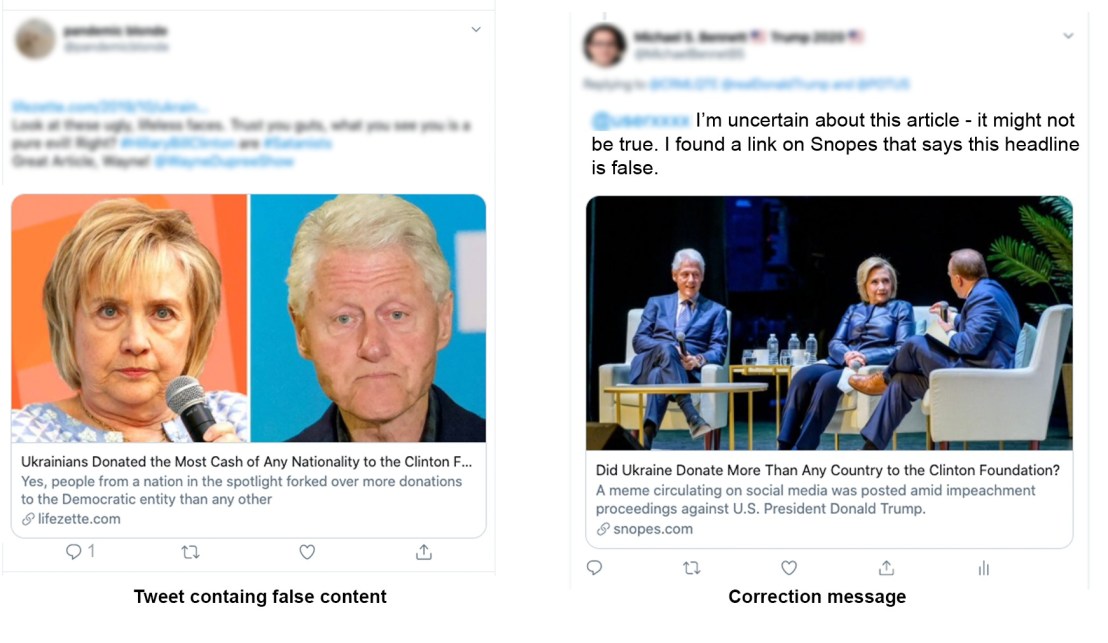
Figure 1

Finance 4.0 – Towards a Socio-Ecological Finance System – A Participatory Framework to Promote Sustainability

Dapp, Marcus M., Helbing, Dirk, Klauser, Stefan (Eds.)

This Open Access book outlines ideas for a novel, scalable and, above all, sustainable financial system.

We all know that today’s global markets are unsustainable and global governance is not effective enough. Given this situation, could one boost smart human coordination, sustainability and resilience by tweaking society at its core: the monetary system? A Computational Social Science team at ETH Zürich has indeed worked on a concept and little demonstrator for a new financial system, called “Finance 4.0” or just “FIN4”, which combines blockchain technology with the Internet of Things (“IoT”).

What if communities could reward sustainable actions by issuing their own money (“tokens”)? Would people behave differently, when various externalities became visible and were actionable through cryptographic tokens? Could a novel, participatory, multi-dimensional financial system be created? Could it be run by the people for the people and lead to more societal resilience than today’s financial system (which is effectively one-dimensional due to its almost frictionless exchange)? How could one manage such a system in an ethical and democratic way?

This book presents some early attempts in a nascent field, but provides a fresh view on what cryptoeconomic systems could do for us, for a circular economy, and for scalable, sustainable action.

Read the full book at: www.springer.com

Network medicine framework for identifying drug-repurposing opportunities for COVID-19 | PNAS

Deisy Morselli Gysi, Ítalo do Valle, Marinka Zitnik, Asher Ameli, Xiao Gan, Onur Varol, Susan Dina Ghiassian, J. J. Patten, Robert A. Davey, Joseph Loscalzo, and Albert-László Barabási

PNAS May 11, 2021 118 (19) e2025581118;

The COVID-19 pandemic has highlighted the importance of prioritizing approved drugs to treat severe acute respiratory syndrome coronavirus 2 (SARS-CoV-2) infections. Here, we deployed algorithms relying on artificial intelligence, network diffusion, and network proximity to rank 6,340 drugs for their expected efficacy against SARS-CoV-2. We experimentally screened 918 drugs, allowing us to evaluate the performance of the existing drug-repurposing methodologies, and used a consensus algorithm to increase the accuracy of the predictions. Finally, we screened in human cells the top-ranked drugs, identifying six drugs that reduced viral infection, four of which could be repurposed to treat COVID-19. The developed strategy has significance beyond COVID-19, allowing us to identify drug-repurposing candidates for neglected diseases.

Read the full article at: www.pnas.org

CSS Senior Scientific Award 2021

The CSS promotes the Senior Scientific Award to recognize the scientific career of Complex Systems scholars. It is awarded once a year to members who have achieved outstanding results in complexity science in any of the areas representative of the CSS.

Read the full article at: cssociety.org

CSS Junior Scientific Award 2021

The CSS promotes the Junior Scientific Award to recognize the excellence in the scientific career of young researchers in Complex Systems. It is awarded once a year to a maximum of two young researchers (up to ten years after PhD completion) who have achieved outstanding results in complexity science in any of the areas representative of the CSS.

Read the full article at: cssociety.org