
Month: June 2021

Too Lazy to Read the Paper: Episode 9 with Marta Sales-Pardo and Roger Guimera

Today on the pod is Marta Sales-Pardo & Roger Guimera.
What a great talk. We could have gone on for hours. Peer review, power-laws, becoming scientists, Bayesian statistics, and much, much more.
Marta and Roger study fundamental problems in all areas of science including natural, social and economic sciences. They have expertise in a broad set of tools from statistical physics, network science, statistics and computer science.
Both were many years at Northwestern before starting a group at URV in Catalonia. They are authors of many classic papers in Network Science, lots of important work, e.g. on community detection. 
We talk about their paper “A Bayesian machine scientist to aid in the solution of challenging scientific problems”

Listen at: toolazy.buzzsprout.com
Uncovering Coordinated Networks on Social Media: Methods and Case Studies

Coordinated campaigns are used to manipulate social media platforms and influence their users, a critical challenge to the free exchange of information. Our paper introduces a general, unsupervised, network-based methodology to uncover groups of accounts that are likely coordinated. The proposed method constructs coordination networks based on arbitrary behavioral traces shared among accounts. We present five case studies of influence campaigns, four of which in the diverse contexts of U.S. elections, Hong Kong protests, the Syrian civil war, and cryptocurrency manipulation. In each of these cases, we detect networks of coordinated Twitter accounts by examining their identities, images, hashtag sequences, retweets, or temporal patterns. The proposed approach proves to be broadly applicable to uncover different kinds of coordination across information warfare scenarios.

By Diogo Pacheco, Pik-Mai Hui, Chris Torres, Bao Truong, Sandro Flammini & Fil Menczer

Read the full open-access article from the Proceedings ICWSM2021

The Impossibility of Automating Ambiguity

Abeba Birhane

Artificial Life

On the one hand, complexity science and enactive and embodied cognitive science approaches emphasize that people, as complex adaptive systems, are ambiguous, indeterminable, and inherently unpredictable. On the other, Machine Learning (ML) systems that claim to predict human behaviour are becoming ubiquitous in all spheres of social life. I contend that ubiquitous Artificial Intelligence (AI) and ML systems are close descendants of the Cartesian and Newtonian worldview in so far as they are tools that fundamentally sort, categorize, and classify the world, and forecast the future. Through the practice of clustering, sorting, and predicting human behaviour and action, these systems impose order, equilibrium, and stability to the active, fluid, messy, and unpredictable nature of human behaviour and the social world at large. Grounded in complexity science and enactive and embodied cognitive science approaches, this article emphasizes why people, embedded in social systems, are indeterminable and unpredictable. When ML systems “pick up” patterns and clusters, this often amounts to identifying historically and socially held norms, conventions, and stereotypes. Machine prediction of social behaviour, I argue, is not only erroneous but also presents real harm to those at the margins of society.

Read the full article at: direct.mit.edu

Bad machines corrupt good morals

Nils Köbis, Jean-François Bonnefon & Iyad Rahwan 
Nature Human Behaviour (2021)

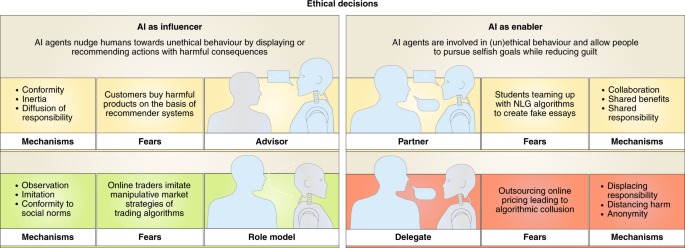
As machines powered by artificial intelligence (AI) influence humans’ behaviour in ways that are both like and unlike the ways humans influence each other, worry emerges about the corrupting power of AI agents. To estimate the empirical validity of these fears, we review the available evidence from behavioural science, human–computer interaction and AI research. We propose four main social roles through which both humans and machines can influence ethical behaviour. These are: role model, advisor, partner and delegate. When AI agents become influencers (role models or advisors), their corrupting power may not exceed the corrupting power of humans (yet). However, AI agents acting as enablers of unethical behaviour (partners or delegates) have many characteristics that may let people reap unethical benefits while feeling good about themselves, a potentially perilous interaction. On the basis of these insights, we outline a research agenda to gain behavioural insights for better AI oversight.

Read the full article at: www.nature.com

Evolution of Autopoiesis and Multicellularity in the Game of Life

Peter D. Turney

Artificial Life

Recently we introduced a model of symbiosis, Model-S, based on the evolution of seed patterns in Conway’s Game of Life. In the model, the fitness of a seed pattern is measured by one-on-one competitions in the Immigration Game, a two-player variation of the Game of Life. Our previous article showed that Model-S can serve as a highly abstract, simplified model of biological life: (1) The initial seed pattern is analogous to a genome. (2) The changes as the game runs are analogous to the development of the phenome. (3) Tournament selection in Model-S is analogous to natural selection in biology. (4) The Immigration Game in Model-S is analogous to competition in biology. (5) The first three layers in Model-S are analogous to biological reproduction. (6) The fusion of seed patterns in Model-S is analogous to symbiosis. The current article takes this analogy two steps further: (7) Autopoietic structures in the Game of Life (still lifes, oscillators, and spaceships—collectively known as ashes) are analogous to cells in biology. (8) The seed patterns in the Game of Life give rise to multiple, diverse, cooperating autopoietic structures, analogous to multicellular biological life. We use the apgsearch software (Ash Pattern Generator Search), developed by Adam Goucher for the study of ashes, to analyze autopoiesis and multicellularity in Model-S. We find that the fitness of evolved seed patterns in Model-S is highly correlated with the diversity and quantity of multicellular autopoietic structures.

Read the full article at: direct.mit.edu