
Month: June 2021

Revealing Consensus and Dissensus between Network Partitions

Tiago P. Peixoto
Phys. Rev. X 11, 021003

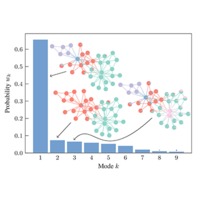
Community detection methods attempt to divide a network into groups of nodes that share similar properties, thus revealing its large-scale structure. A major challenge when employing such methods is that they are often degenerate, typically yielding a complex landscape of competing answers. As an attempt to extract understanding from a population of alternative solutions, many methods exist to establish a consensus among them in the form of a single partition “point estimate” that summarizes the whole distribution. Here, we show that it is, in general, not possible to obtain a consistent answer from such point estimates when the underlying distribution is too heterogeneous. As an alternative, we provide a comprehensive set of methods designed to characterize and summarize complex populations of partitions in a manner that captures not only the existing consensus but also the dissensus between elements of the population. Our approach is able to model mixed populations of partitions, where multiple consensuses can coexist, representing different competing hypotheses for the network structure. We also show how our methods can be used to compare pairs of partitions, how they can be generalized to hierarchical divisions, and how they can be used to perform statistical model selection between competing hypotheses.

Read the full article at: link.aps.org
The universal visitation law of human mobility

Markus Schläpfer, Lei Dong, Kevin O’Keeffe, Paolo Santi, Michael Szell, Hadrien Salat, Samuel Anklesaria, Mohammad Vazifeh, Carlo Ratti & Geoffrey B. West
Nature volume 593, pages 522–527 (2021)

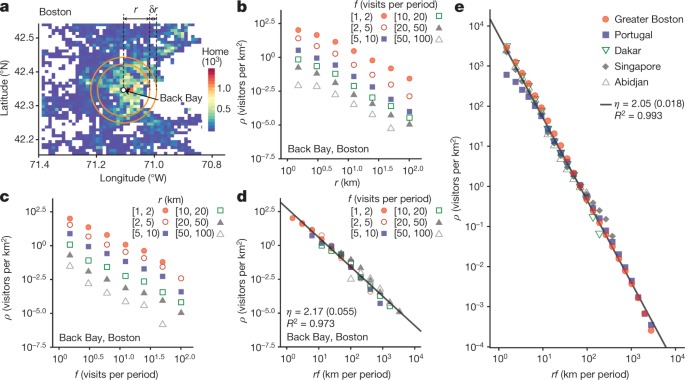
Human mobility impacts many aspects of a city, from its spatial structure to its response to an epidemic. It is also ultimately key to social interactions, innovation and productivity. However, our quantitative understanding of the aggregate movements of individuals remains incomplete. Existing models—such as the gravity law or the radiation model—concentrate on the purely spatial dependence of mobility flows and do not capture the varying frequencies of recurrent visits to the same locations. Here we reveal a simple and robust scaling law that captures the temporal and spatial spectrum of population movement on the basis of large-scale mobility data from diverse cities around the globe. According to this law, the number of visitors to any location decreases as the inverse square of the product of their visiting frequency and travel distance. We further show that the spatio-temporal flows to different locations give rise to prominent spatial clusters with an area distribution that follows Zipf’s law. Finally, we build an individual mobility model based on exploration and preferential return to provide a mechanistic explanation for the discovered scaling law and the emerging spatial structure. Our findings corroborate long-standing conjectures in human geography (such as central place theory and Weber’s theory of emergent optimality) and allow for predictions of recurrent flows, providing a basis for applications in urban planning, traffic engineering and the mitigation of epidemic diseases.

Read the full article at: www.nature.com

Why AI is harder than we think. Melanie Mitchell. Santa Fe Institute


//

Since its beginning in the 1950s, the field of artificial intelligence has cycled several times between periods of optimistic predictions and massive investment (“AI Spring”) and periods of disappointment, loss of confidence, and reduced funding (“AI Winter”). Even with today’s seemingly fast pace of AI breakthroughs, the development of long-promised technologies such as self-driving cars and housekeeping robots has turned out to be much harder than we thought.

One reason for these repeating cycles is a lack of understanding of the nature and complexity of intelligence itself. In this talk I will discuss some fallacies in common assumptions made by AI researchers, which can lead to overconfident predictions about the field. I will also speculate on what is needed for the grand challenge of making AI systems more robust, general, and adaptable—in short, more intelligent.

Speaker Bio: Melanie Mitchell is the Davis Professor of Complexity at the Santa Fe Institute, and Professor of Computer Science (currently on leave) at Portland State University. Her current research focuses on conceptual abstraction, analogy-making, and visual recognition in artificial intelligence systems. Melanie is the author or editor of six books and numerous scholarly papers in the fields of artificial intelligence, cognitive science, and complex systems. Her book Complexity: A Guided Tour (Oxford University Press) won the 2010 Phi Beta Kappa Science Book Award and was named by Amazon.com as one of the ten best science books of 2009. Her latest book is Artificial Intelligence: A Guide for Thinking Humans (Farrar, Straus, and Giroux).

Watch at: www.youtube.com