
Month: July 2021

Measuring algorithmically infused societies

Claudia Wagner, Markus Strohmaier, Alexandra Olteanu, Emre Kıcıman, Noshir Contractor & Tina Eliassi-Rad 
Nature (2021)

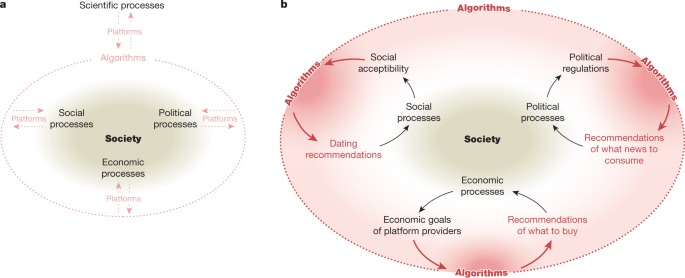
It has been the historic responsibility of the social sciences to investigate human societies. Fulfilling this responsibility requires social theories, measurement models and social data. Most existing theories and measurement models in the social sciences were not developed with the deep societal reach of algorithms in mind. The emergence of ‘algorithmically infused societies’—societies whose very fabric is co-shaped by algorithmic and human behaviour—raises three key challenges: the insufficient quality of measurements, the complex consequences of (mis)measurements, and the limits of existing social theories. Here we argue that tackling these challenges requires new social theories that account for the impact of algorithmic systems on social realities. To develop such theories, we need new methodologies for integrating data and measurements into theory construction. Given the scale at which measurements can be applied, we believe measurement models should be trustworthy, auditable and just. To achieve this, the development of measurements should be transparent and participatory, and include mechanisms to ensure measurement quality and identify possible harms. We argue that computational social scientists should rethink what aspects of algorithmically infused societies should be measured, how they should be measured, and the consequences of doing so.

Read the full article at: www.nature.com
High-frequency trading and networked markets

Federico Musciotto, Jyrki Piilo, and Rosario N. Mantegna

PNAS June 29, 2021 118 (26) e2015573118

Financial markets have undergone a deep reorganization during the last 20 y. A mixture of technological innovation and regulatory constraints has promoted the diffusion of market fragmentation and high-frequency trading. The new stock market has changed the traditional ecology of market participants and market professionals, and financial markets have evolved into complex sociotechnical institutions characterized by a great heterogeneity in the time scales of market members’ interactions that cover more than eight orders of magnitude. We analyze three different datasets for two highly studied market venues recorded in 2004 to 2006, 2010 to 2011, and 2018. Using methods of complex network theory, we show that transactions between specific couples of market members are systematically and persistently overexpressed or underexpressed. Contemporary stock markets are therefore networked markets where liquidity provision of market members has statistically detectable preferences or avoidances with respect to some market members over time with a degree of persistence that can cover several months. We show a sizable increase in both the number and persistence of networked relationships between market members in most recent years and how technological and regulatory innovations affect the networked nature of the markets. Our study also shows that the portfolio of strategic trading decisions of high-frequency traders has evolved over the years, adding to the liquidity provision other market activities that consume market liquidity.

Read the full article at: www.pnas.org

Mitigation strategies against cascading failures within a project activity network

Christos Ellinas, Christos Nicolaides & Naoki Masuda 
Journal of Computational Social Science (2021)

Successful on-time delivery of projects is a key enabler in resolving major societal challenges, such as wasted resources and stagnated economic growth. However, projects are notoriously hard to deliver successfully, partly due to their interconnected and temporal complexity which makes them prone to cascading failures. Here, we develop a cascading failure model and test it on a temporal activity network, extracted from a large-scale engineering project. We evaluate the effectiveness of six mitigation strategies, in terms of the impact of task failure cascading throughout the project. In contrast to theoretical arguments, our results indicate that in the majority of cases, the temporal properties of the activities are more relevant than their structural properties in preventing large-scale cascading failures. In practice, these findings could stimulate new pathways for designing and scheduling projects that naturally limit the extent of cascading failures.

Read the full article at: link.springer.com

Early lock-in of structured and specialised information flows during neural development

David P. Shorten, Viola Priesemann, Michael Wibral, Joseph T. Lizier

The brains of many organisms are capable of complicated distributed computation underpinned by a highly advanced information processing capacity. Although substantial progress has been made towards characterising the information flow component of this capacity in mature brains, there is a distinct lack of work characterising its emergence during neural development. This lack of progress has been largely driven by the lack of effective estimators of information processing operations for the spiking data available for developing neural networks. Here, we leverage recent advances in this estimation task in order to quantify the changes in information flow during development. We find that the quantity of information flowing across these networks undergoes a dramatic increase across development. Moreover, the spatial structure of these flows is locked-in during early development, after which there is a substantial temporal correlation in the information flows across recording days. We analyse the flow of information during the crucial periods of population bursts. We find that, during these bursts, nodes undertake specialised computational roles as either transmitters, mediators or receivers of information, with these roles tending to align with their spike ordering either early, mid or late in the bursts. That the nodes identified as information flow mediators tend to spike mid burst aligns with conjecture that nodes spiking in this position play an important role as brokers of neuronal communication. Finally, it was found that the specialised computational roles occupied by nodes during bursts tend to be locked-in early.

Read the full article at: www.biorxiv.org

Genomic windows into ancient epidemics

Ornob Alam

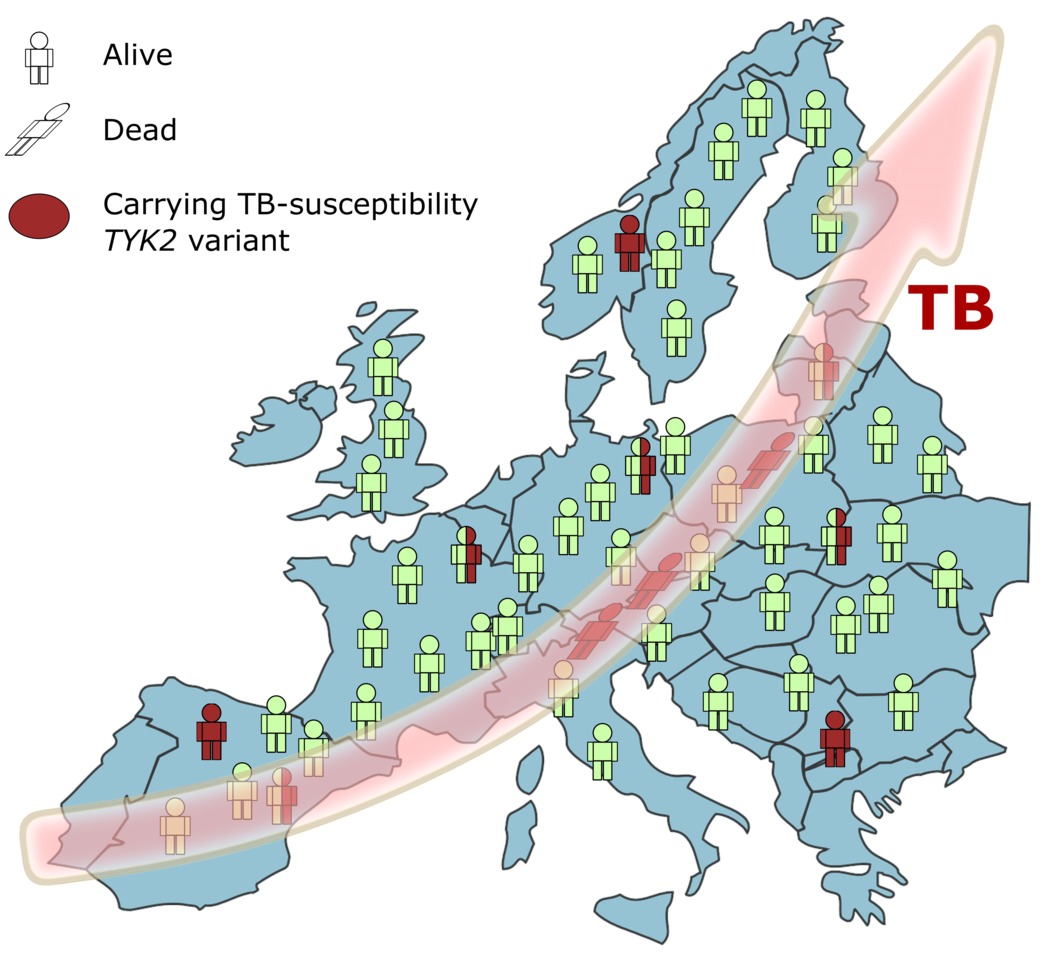
Population genomic analyses of ancient and modern individuals are providing unprecedented resolution in our view of past human demography and adaptive episodes. Here, I highlight three recent studies in the field that investigated ancient human encounters with major pathogens.

Read the full article at: natureecoevocommunity.nature.com