
Author: cxdig

EPS Grand Challenges: Physics for Society in the Horizon 2050, edited by Carlos Hidalgo

There are many images of science and the activities of scientists. Some would imply that science will eventually reach the limits of knowledge while others create an expectation of endless horizons. Some people would believe that science has or will provide the answers to key open questions that lie ahead, while others experience fear regarding its development. In this book, we will look at all these aspects, going from particles, via atoms, cells, stars, galaxies, our place in the universe, to explore what makes us, human beings, really unique in nature: our ability to imagine and shape the future by making use of the scientific method. The book is an EPS action designed to address the social dimension of science and the grand challenges in physics that will bring radical change to developed societies, raise standards of living at the global scale, and provide basic understanding of nature on the horizon 2050.

Read the full book at: iopscience.iop.org
NERCCS 2025: Eighth Northeast Regional Conference on Complex Systems.  April 9-11, 2025. Binghamton, NY, USA & Online

NERCCS 2025: The Eighth Northeast Regional Conference on Complex Systems will follow the success of the previous NERCCS conferences to promote the emerging venue of interdisciplinary scholarly exchange for complex systems researchers in the Northeast U.S. region (and beyond) to share their research outcomes through presentations and online publications, network with their peers, and promote interdisciplinary collaboration and the growth of the research community.

NERCCS will particularly focus on facilitating the professional growth of early career faculty, postdocs, and students in the region who will likely play a leading role in the field of complex systems science and engineering in the coming years.

The 2025 conference will be held primarily in person in the Innovative Technologies Complex at Binghamton University, with an online participation option via Zoom.

More at: nerccs2025.github.io

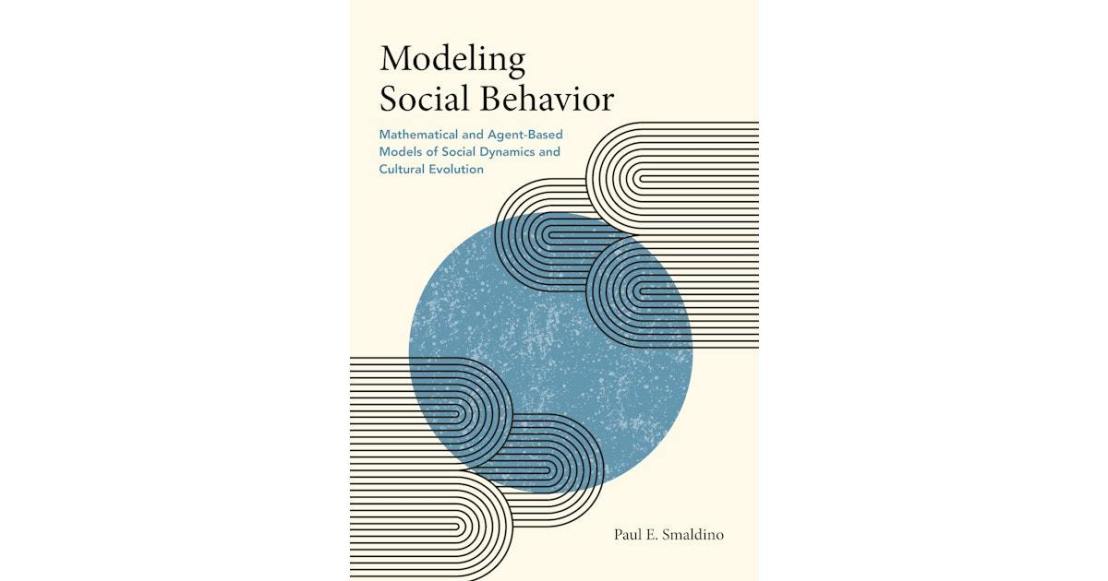
Modeling Social Behavior: Mathematical and Agent-Based Models of Social Dynamics and Cultural Evolution, by Paul E. Smaldino

This book provides a unified, theory-driven introduction to key mathematical and agent-based models of social dynamics and cultural evolution, teaching readers how to build their own models, analyze them, and integrate them with empirical research programs. It covers a variety of modeling topics, each exemplified by one or more archetypal models, and helps readers to develop strong theoretical foundations for understanding social behavior. Modeling Social Behavior equips social, behavioral, and cognitive scientists with an essential tool kit for thinking about and studying complex social systems using mathematical and computational models.

More at: press.princeton.edu

Persistent interaction patterns across social media platforms and over time

Michele Avalle, Niccolò Di Marco, Gabriele Etta, Emanuele Sangiorgio, Shayan Alipour, Anita Bonetti, Lorenzo Alvisi, Antonio Scala, Andrea Baronchelli, Matteo Cinelli & Walter Quattrociocchi 
Nature (2024)

Growing concern surrounds the impact of social media platforms on public discourse1,2,3,4 and their influence on social dynamics5,6,7,8,9, especially in the context of toxicity10,11,12. Here, to better understand these phenomena, we use a comparative approach to isolate human behavioural patterns across multiple social media platforms. In particular, we analyse conversations in different online communities, focusing on identifying consistent patterns of toxic content. Drawing from an extensive dataset that spans eight platforms over 34 years—from Usenet to contemporary social media—our findings show consistent conversation patterns and user behaviour, irrespective of the platform, topic or time. Notably, although long conversations consistently exhibit higher toxicity, toxic language does not invariably discourage people from participating in a conversation, and toxicity does not necessarily escalate as discussions evolve. Our analysis suggests that debates and contrasting sentiments among users significantly contribute to more intense and hostile discussions. Moreover, the persistence of these patterns across three decades, despite changes in platforms and societal norms, underscores the pivotal role of human behaviour in shaping online discourse.

Read the full article at: www.nature.com

The ABC of mobility

Rafael Prieto-Curiel, Juan P. Ospina

Environment International

Volume 185, March 2024, 108541

The use of cars in cities has many negative impacts, including pollution, noise and the use of space. Yet, detecting factors that reduce the use of cars is a serious challenge, particularly across different regions. Here, we model the use of various modes of transport in a city by aggregating Active mobility (A), Public Transport (B) and Cars (C), expressing the modal share of a city by its ABC triplet. Data for nearly 800 cities across 61 countries is used to model car use and its relationship with city size and income. Our findings suggest that with longer distances and the congestion experienced in large cities, Active mobility and journeys by Car are less frequent, but Public Transport is more prominent. Further, income is strongly related to the use of cars. Results show that a city with twice the income has 37% more journeys by Car. Yet, there are significant differences across regions. For cities in Asia, Public Transport contributes to a substantial share of their journeys. For cities in the US, Canada, Australia, and New Zealand, most of their mobility depends on Cars, regardless of city size. In Europe, there are vast heterogeneities in their modal share, from cities with mostly Active mobility (like Utrecht) to cities where Public Transport is crucial (like Paris or London) and cities where more than two out of three of their journeys are by Car (like Rome and Manchester).

Read the full article at: www.sciencedirect.com