
Author: cxdig

Full Professor in Simulation of Complex Adaptive Systems, University of Amsterdam

The Informatics Institute of the University of Amsterdam is looking for an internationally visible and recognized researcher in Complex Adaptive Systems. The emphasis should be on novel computational methods to study the spatio-temporal evolution of emergent properties in a variety of interdisciplinary application domains.

The research will be driven by deep insights in (the theory of) Complex Adaptive Systems and novel computational methods to simulate the dynamics and emergent properties of such complex systems. Research that addresses computational challenges may include methods for simulating, calibrating, and validating large scale models of complex systems. The research will have a strong application pull, for instance in the realms of socio-economic systems or health and health care. Candidates that address interdisciplinary application domains and whose research contributes to the UN Sustainable Development Goals, will be preferred.

The informatics institute pursues research in five main themes: (1) Artificial Intelligence, (2) Computational Science, (3) Data Science, (4) People, Society, Technology, and (5) Systems and Security, embedded in 15 research groups. The professor will be positioned within the Computational Science Lab of the Institute for Informatics. The Computational Science Lab currently has two other full professors, one professor by special appointment, two associate professors, seven assistant professors, and one lecturer. It is expected that the candidate will proactively collaborate with colleagues in the lab and play a central role in mentoring junior staff, PhD candidates and postdocs.

Details at: vacatures.uva.nl
Deep Reinforcement Meta-Learning and Self-Organization in Complex Systems: Applications to Traffic Signal Control

Marcin Korecki

Entropy 2023, 25(7), 982

We studied the ability of deep reinforcement learning and self-organizing approaches to adapt to dynamic complex systems, using the applied example of traffic signal control in a simulated urban environment. We highlight the general limitations of deep learning for control in complex systems, even when employing state-of-the-art meta-learning methods, and contrast it with self-organization-based methods. Accordingly, we argue that complex systems are a good and challenging study environment for developing and improving meta-learning approaches. At the same time, we point to the importance of baselines to which meta-learning methods can be compared and present a self-organizing analytic traffic signal control that outperforms state-of-the-art meta-learning in some scenarios. We also show that meta-learning methods outperform classical learning methods in our simulated environment (around 1.5–2× improvement, in most scenarios). Our conclusions are that, in order to develop effective meta-learning methods that are able to adapt to a variety of conditions, it is necessary to test them in demanding, complex settings (such as, for example, urban traffic control) and compare them against established methods.

Read the full article at: www.mdpi.com

Programmable self-organization of heterogeneous microrobot collectives

Steven Ceron, Gaurav Gardi, Kirstin Petersen, and Metin Sitti
PNAS 120 (24) e2221913120

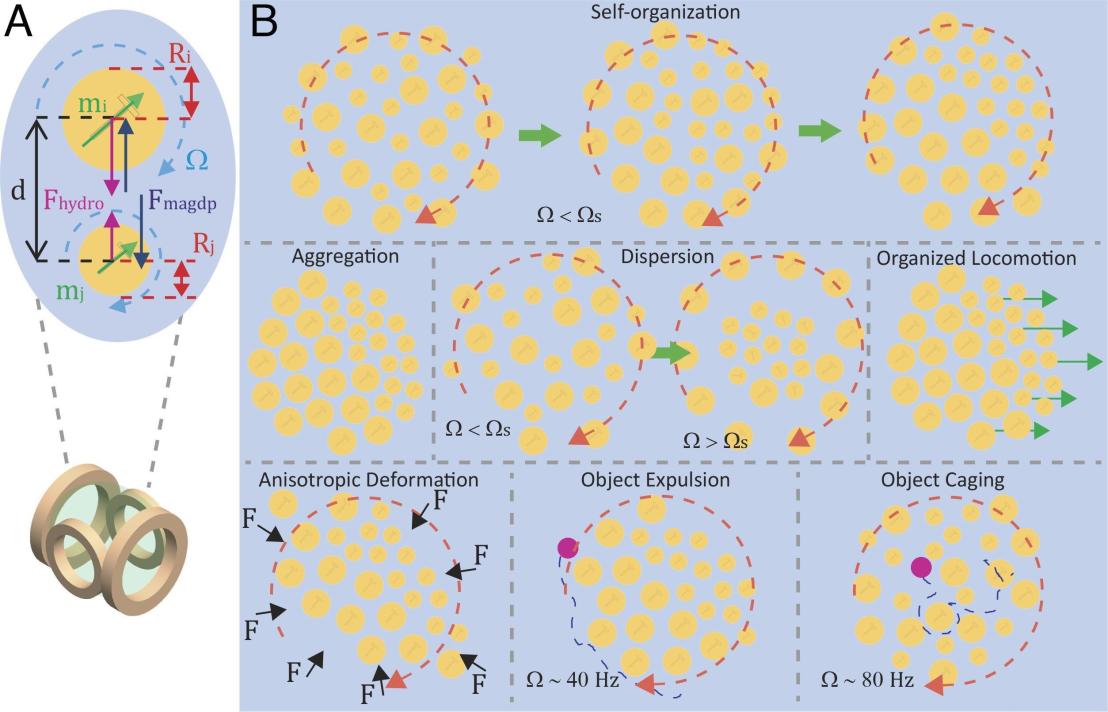
Microscale collectives composed of simple, locally reactive constituents can harness the effects of self-organization to enable diverse global behaviors. While phase separation of homogeneous collectives is well studied, heterogeneous collectives are relatively unexplored. This study focuses on a collective of magnetic microdisks of different sizes and examines how the group can self-organize into homogeneous subgroups using an external magnetic field. We find that heterogeneity enables collective behaviors including morphology reconfiguration, organized aggregation, dispersion, and locomotion, and caging and expulsion of external objects. Our work furthers insights into self-organization of heterogeneous microrobot collectives and may provide useful insights into the future of active matter.

Read the full article at: www.pnas.org

Multi pathways temporal distance unravels the hidden geometry of network-driven processes

Sebastiano Bontorin & Manlio De Domenico 
Communications Physics volume 6, Article number: 129 (2023)

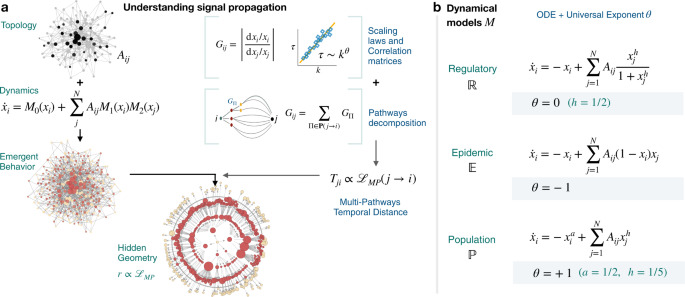
Network-based interactions allow one to model many technological and natural systems, where understanding information flow between nodes is important to predict their functioning. The complex interplay between network connectivity and dynamics can be captured by scaling laws overcoming the paradigm of information spread being solely dependent on network structure. Here, we capitalize on this paradigm to identify the relevant paths for perturbation propagation. We introduce a multi-pathways temporal distance between nodes that overcomes the limitation of focussing only on the shortest path. This metric predicts the latent geometry induced by the dynamics in which the signal propagation resembles the traveling wave solution of reaction-diffusion systems. We validate the framework on a set of synthetic dynamical models, showing that it outperforms existing approaches in predicting arrival times. On a set of empirical contact-based social systems, we show that it can be reliably used also for models of infectious diseases spread – such as the Susceptible-Infected-Susceptible – with remarkable accuracy in predicting the observed timing of infections. Our framework naturally encodes the concerted behavior of the ensemble of paths connecting two nodes in conveying perturbations, with applications ranging from regulatory dynamics within cells to epidemic spreading in social networks.

Read the full article at: www.nature.com