
Author: cxdig

Correlated Impact Dynamics in Science

Jiazhen Liu, Tamang Kunal, Dashun Wang, Chaoming Song

Science progresses by building upon previous discoveries. It is commonly believed that the impact of scientific papers, as measured by citations, is positively correlated with the impact of past discoveries built upon. However, analyzing over 30 million papers and nearly a billion citations across multiple disciplines, we find that there is a long-term positive citation correlation, but a negative short-term correlation. We demonstrate that the key to resolving this paradox lies in a new concept, called “capacity”, which captures the amount of originality remaining for a paper. We find there is an intimate link between capacity and impact dynamics that appears universal across the diverse fields we studied. The uncovered capacity measure not only explains the correlated impact dynamics across the sciences but also improves our understanding and predictions of high-impact discoveries.

Read the full article at: arxiv.org
Trustworthy Network Science – Tina Eliassi-Rad – Network Science Society Colloquium


loadYouTubePlayer(‘yt_video_Tafm_AXWi1Q_LZCNSJaOcFiaycQA’);

Abstract

As the use of machine learning (ML) algorithms in network science increases, so do the problems related to explainability, transparency, fairness, privacy, and robustness, to name a few. In this talk, I will give a brief overview of the field and present recent work from my lab on the (in)stability and explainability of node embeddings, attacks on ML algorithms for graphs, and equality in complex networks.

Bio
Tina Eliassi-Rad is a professor of computer science at Northeastern University and an external faculty member at Santa Fe Institute. She works at the intersection of AI and Network Science and cares about the impact of science and technology on the disadvantaged members of society.

Watch at: www.youtube.com

MODELING SOCIAL RESILIENCE: QUESTIONS, ANSWERS, OPEN PROBLEMS

FRANK SCHWEITZER, GEORGES ANDRES, GIONA CASIRAGHI, CHRISTOPH GOTE, RAMONA ROLLER, INGO SCHOLTES, GIACOMO VACCARIO, and CHRISTIAN ZINGG

Advances in Complex SystemsVol. 25, No. 08, 2250014

Resilience denotes the capacity of a system to withstand shocks and its ability to recover from them. We develop a framework to quantify the resilience of highly volatile, non-equilibrium social organizations, such as collectives or collaborating teams. It consists of four steps: (i) delimitation, i.e. narrowing down the target systems, (ii) conceptualization, i.e. identifying how to approach social organizations, (iii) formal representation using a combination of agent-based and network models, (iv) operationalization, i.e. specifying measures and demonstrating how they enter the calculation of resilience. Our framework quantifies two dimensions of resilience, the robustness of social organizations and their adaptivity, and combines them in a novel resilience measure. It allows monitoring resilience instantaneously using longitudinal data instead of an ex-post evaluation.

Read the full article at: www.worldscientific.com

Universal bounds and thermodynamic tradeoffs in nonequilibrium energy harvesting

Jordi Piñero, Ricard Solé, Artemy Kolchinsky

Many molecular systems operate by harvesting and storing energy from their environments. However, the maintenance of a nonequilibrium state necessary to support energy harvesting itself carries thermodynamic costs. We consider the optimal tradeoff between costs and benefits of energy harvesting in a nonequilibrium steady state, for a system that may be in contact with a fluctuating environment. We find a universal bound on this tradeoff, which leads to closed-form expressions for optimal power output and optimal steady-state distributions for three physically meaningful regimes. Our results are illustrated using a model of a unicyclic network, which is inspired by the logic of biomolecular cycles.

Read the full article at: arxiv.org

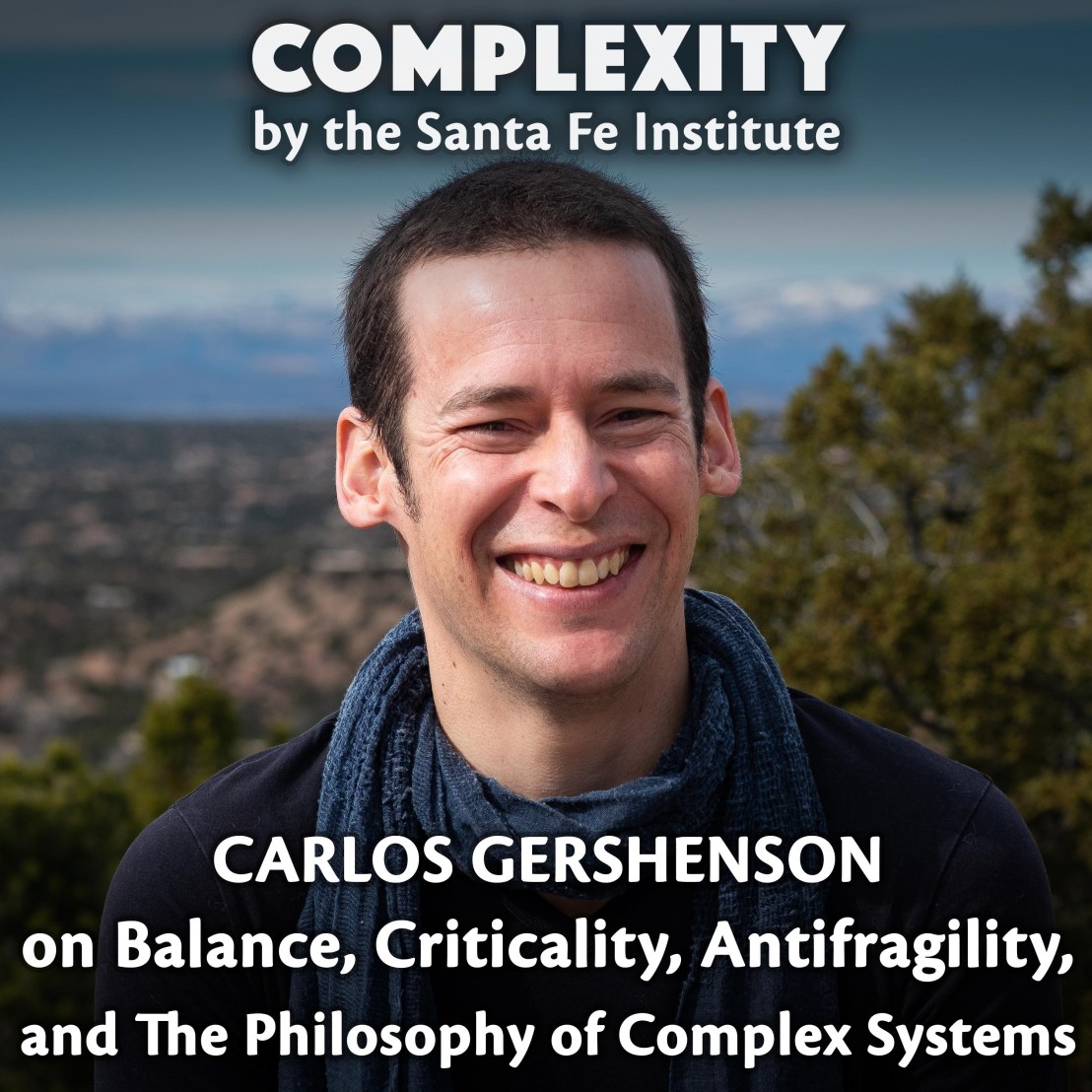
Carlos Gershenson on Balance, Criticality, Antifragility, and The Philosophy of Complex Systems

In this episode we speak with Carlos Gershenson, SFI Sabbatical Visitor and professor of computer science at the Universidad Nacional Autónoma de México, where he leads the Self-organizing Systems Lab, among many other titles you can find in our show notes. For the next hour, we’ll discuss his decades of research and writing on a vast array of core complex systems concepts and their intersections with both Western and Eastern philosophical traditions — a first for this podcast.

Listen at: complexity.simplecast.com