
Author: cxdig

A Relational Macrostate Theory Guides Artificial Intelligence to Learn Macro and Design Micro

Yanbo Zhang, Sara Imari Walker
The high-dimesionality, non-linearity and emergent properties of complex systems pose a challenge to identifying general laws in the same manner that has been so successful in simpler physical systems. In Anderson’s seminal work on why “more is different” he pointed to how emergent, macroscale patterns break symmetries of the underlying microscale laws. Yet, less recognized is that these large-scale, emergent patterns must also retain some symmetries of the microscale rules. Here we introduce a new, relational macrostate theory (RMT) that defines macrostates in terms of symmetries between two mutually predictive observations, and develop a machine learning architecture, MacroNet, that identifies macrostates. Using this framework, we show how macrostates can be identifed across systems ranging in complexity from the simplicity of the simple harmonic oscillator to the much more complex spatial patterning characteristic of Turing instabilities. Furthermore, we show how our framework can be used for the inverse design of microstates consistent with a given macroscopic property — in Turing patterns this allows us to design underlying rule with a given specification of spatial patterning, and to identify which rule parameters most control these patterns. By demonstrating a general theory for how macroscopic properties emerge from conservation of symmetries in the mapping between observations, we provide a machine learning framework that allows a unified approach to identifying macrostates in systems from the simple to complex, and allows the design of new examples consistent with a given macroscopic property.

Read the full article at: arxiv.org
Fostering coherence in EU health research

European Parliament, Directorate-General for Parliamentary Research Services, Sipido, K., Fajardo-Ortiz, D., Vercruysse, T., et al., Fostering coherence in EU health research : strengthening EU research for better health, European Parliament, 2022,

The COVID 19 pandemic prompted reinforced investment in health research, to support rapid research and innovation for vaccine development and health care measures. The European Union response highlighted strengths and weaknesses in EU research organisation and funding. Over time, EU investment in health research has been aimed at increasing knowledge and transfer of knowledge into innovation, for better health. To this end, several instruments have been developed, but the impact of these efforts is hampered by fragmentation and a lack of synergy between strategies at different levels. Inequalities in health and research across Member States need further measures. Policies can take inspiration from successful health research organisation and policies inside and outside the EU, for more coherence and throughput to implementation. Health research needs strong leadership to engage in global health and to tackle the challenges of the interconnectedness of health with environmental and climate challenges, and durable economic development. Stakeholder involvement in a formal structure will secure permanent dialogue for fruitful research and development.

Read the full article at: op.europa.eu

Socioeconomic roots of academic faculty

Allison C. Morgan, Nicholas LaBerge, Daniel B. Larremore, Mirta Galesic, Jennie E. Brand & Aaron Clauset
Nature Human Behaviour (2022)

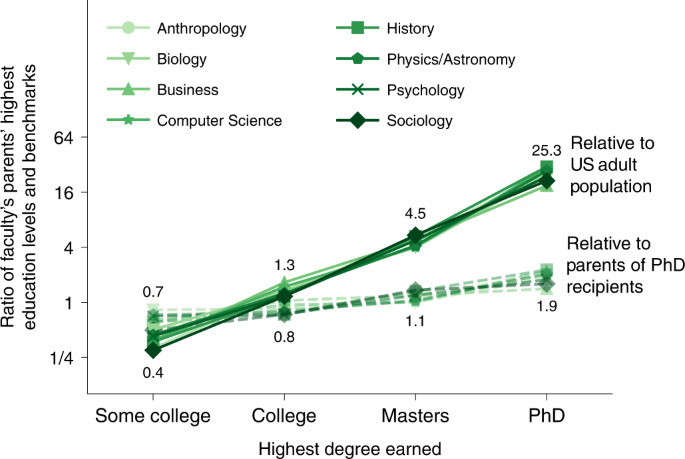
Despite the special role of tenure-track faculty in society, training future researchers and producing scholarship that drives scientific and technological innovation, the sociodemographic characteristics of the professoriate have never been representative of the general population. Here we systematically investigate the indicators of faculty childhood socioeconomic status and consider how they may limit efforts to diversify the professoriate. Combining national-level data on education, income and university rankings with a 2017–2020 survey of 7,204 US-based tenure-track faculty across eight disciplines in STEM, social science and the humanities, we show that faculty are up to 25 times more likely to have a parent with a Ph.D. Moreover, this rate nearly doubles at prestigious universities and is stable across the past 50 years. Our results suggest that the professoriate is, and has remained, accessible disproportionately to the socioeconomically privileged, which is likely to deeply shape their scholarship and their reproduction.

Read the full article at: www.nature.com

Modeling Autopoiesis and Cognition with Reaction Networks

Francis Heylighen, Evo Busseniers

Maturana and Varela defined an autopoietic system as a self-regenerating network of processes. We reinterpret and elaborate this conception starting from a process ontology and its formalization in terms of reaction networks and chemical organization theory. An autopoietic organization can be modelled as a network of “molecules” (components) undergoing reactions, which is (operationally) closed and self-maintaining. Such organizations, being attractors of a dynamic system, tend to self-organize—thus providing a model for the origin of life. However, in order to survive in a variable environment, they must also be resilient, i.e. able to recover from perturbations. According to the cybernetic law of requisite variety, this requires cognition, i.e. the ability to recognize and compensate perturbations. Such cognition becomes more effective as it learns to accurately anticipate perturbations by discovering invariant patterns in its interactions with the environment. Nevertheless, the resulting predictive model remains a subjective construction. Such implicit model cannot be interpreted as an objective representation of external reality, because the autopoietic system does not have direct access to that reality, and there is in general no isomorphism between internal and external processes.

Read the full article at: researchportal.vub.be

Provenance of life: Chemical autonomous agents surviving through associative learning

Stuart Bartlett and David Louapre
Phys. Rev. E 106, 034401

We present a benchmark study of autonomous, chemical agents exhibiting associative learning of an environmental feature. Associative learning systems have been widely studied in cognitive science and artificial intelligence but are most commonly implemented in highly complex or carefully engineered systems, such as animal brains, artificial neural networks, DNA computing systems, and gene regulatory networks, among others. The ability to encode environmental information and use it to make simple predictions is a benchmark of biological resilience and underpins a plethora of adaptive responses in the living hierarchy, spanning prey animal species anticipating the arrival of predators to epigenetic systems in microorganisms learning environmental correlations. Given the ubiquitous and essential presence of learning behaviors in the biosphere, we aimed to explore whether simple, nonliving dissipative structures could also exhibit associative learning. Inspired by previous modeling of associative learning in chemical networks, we simulated simple systems composed of long- and short-term memory chemical species that could encode the presence or absence of temporal correlations between two external species. The ability to learn this association was implemented in Gray-Scott reaction-diffusion spots, emergent chemical patterns that exhibit self-replication and homeostasis. With the novel ability of associative learning, we demonstrate that simple chemical patterns can exhibit a broad repertoire of lifelike behavior, paving the way for in vitro studies of autonomous chemical learning systems, with potential relevance to artificial life, origins of life, and systems chemistry. The experimental realization of these learning behaviors in protocell or coacervate systems could advance a new research direction in astrobiology, since our system significantly reduces the lower bound on the required complexity for autonomous chemical learning.

Read the full article at: link.aps.org