
Author: cxdig

Ecological complexity and the biosphere: the next 30 years

Ricard Solé and Simon Levin

Phil. Trans. of the Roy. Soc. B Volume 377 Issue 1857

Global warming, habitat loss and overexploitation of limited resources are leading to alarming biodiversity declines. Ecosystems are complex adaptive systems that display multiple alternative states and can shift from one to another in abrupt ways. Some of these tipping points have been identified and predicted by mathematical and computational models. Moreover, multiple scales are involved and potential mitigation or intervention scenarios are tied to particular levels of complexity, from cells to human–environment coupled systems. In dealing with a biosphere where humans are part of a complex, endangered ecological network, novel theoretical and engineering approaches need to be considered. At the centre of most research efforts is biodiversity, which is essential to maintain community resilience and ecosystem services. What can be done to mitigate, counterbalance or prevent tipping points? Using a 30-year window, we explore recent approaches to sense, preserve and restore ecosystem resilience as well as a number of proposed interventions (from afforestation to bioengineering) directed to mitigate or reverse ecosystem collapse. The year 2050 is taken as a representative future horizon that combines a time scale where deep ecological changes will occur and proposed solutions might be effective.

Read the full article at: royalsocietypublishing.org
Computer Simulations as Scientific Instruments

Ramón Alvarado
Foundations of Science volume 27, pages 1183–1205 (2022)

Computer simulations have conventionally been understood to be either extensions of formal methods such as mathematical models or as special cases of empirical practices such as experiments. Here, I argue that computer simulations are best understood as instruments. Understanding them as such can better elucidate their actual role as well as their potential epistemic standing in relation to science and other scientific methods, practices and devices.

Read the full article at: link.springer.com

EXTRACTING REAL SOCIAL INTERACTIONS FROM A DEBATE OF COVID-19 POLICIES ON TWITTER: THE CASE OF MEXICO

ALBERTO GARCÍA-RODRÍGUEZ, TZIPE GOVEZENSKY, CARLOS GERSHENSON, GERARDO G. NAUMIS and RAFAEL A. BARRIO

Advances in Complex Systems Vol. 24, No. 07n08, 2150017

Twitter is a popular social medium for sharing opinions and engaging in topical debates, yet presents a wide spread of misinformation, especially in political debates, from bots and adversarial attacks. The current state-of-the-art methods for detecting humans and bots in Twitter often lack generalizability beyond English. Here, a language-agnostic method to detect real users and their interactions by leveraging network topology from retweets is presented. To that end, the chosen topic is COVID-19 policies in Mexico, which has been considered by users as polemic. Two kinds of network are built: a directed network of retweets; and the co-event network, where a non-directed link between two users exists if they have retweeted the same post in a given time window (projection of a bipartite network). Then, single node properties of these networks, such as the clustering coefficient and the degree, are studied. Three kinds of users are observed: some with a high clustering coefficient but a very small degree, a second group with zero clustering coefficient and a variable degree, and a third group in which the clustering coefficient as a function of the degree decays as a power law. This third group represents ∼2% of the users and is characteristic of dynamical networks with feedback. The latter seems to represent strongly interacting followers/followed in a real social network as confirmed by an inspection of such nodes. A percolation analysis of the resulting co-retweet and co-hashtag network reveals the relevance of such weak links, typical of real social human networks. The presented methods are simple to implement in other social media platforms and can be used to mitigate misinformation and conflicts.

Read the full article at: www.worldscientific.com

A general theory for temperature dependence in biology

José Ignacio Arroyo, Beatriz Díez, Christopher P. Kempes, Geoffrey B. West, and Pablo A. Marquet

PNAS 119 (30) e2119872119

One of the most fundamental physical constraints on living systems is temperature. Despite its importance, a simple, mechanistic, and general theory that fully predicts the response to temperature across all scales has not yet been derived. Here we develop such a theory based on the fundamental chemical kinetics and statistical physics governing the biochemical reactions that support life. Our mathematical framework includes an explanation for why temperature response curves have a maximum or minimum value and the derivation of a single universal curve onto which data for the temperature dependence of diverse biological quantities covering all levels of organization, collapse. The theory has multiple potential applications including predicting responses to global warming, yields of industrial processes, and epidemic outbreaks.

Read the full article at: www.pnas.org

Network structural origin of instabilities in large complex systems

CHAO DUAN, TAKASHI NISHIKAWA, DENIZ EROGLU, AND ADILSON E. MOTTER 
SCIENCE ADVANCES 15 Jul 2022 Vol 8, Issue 28

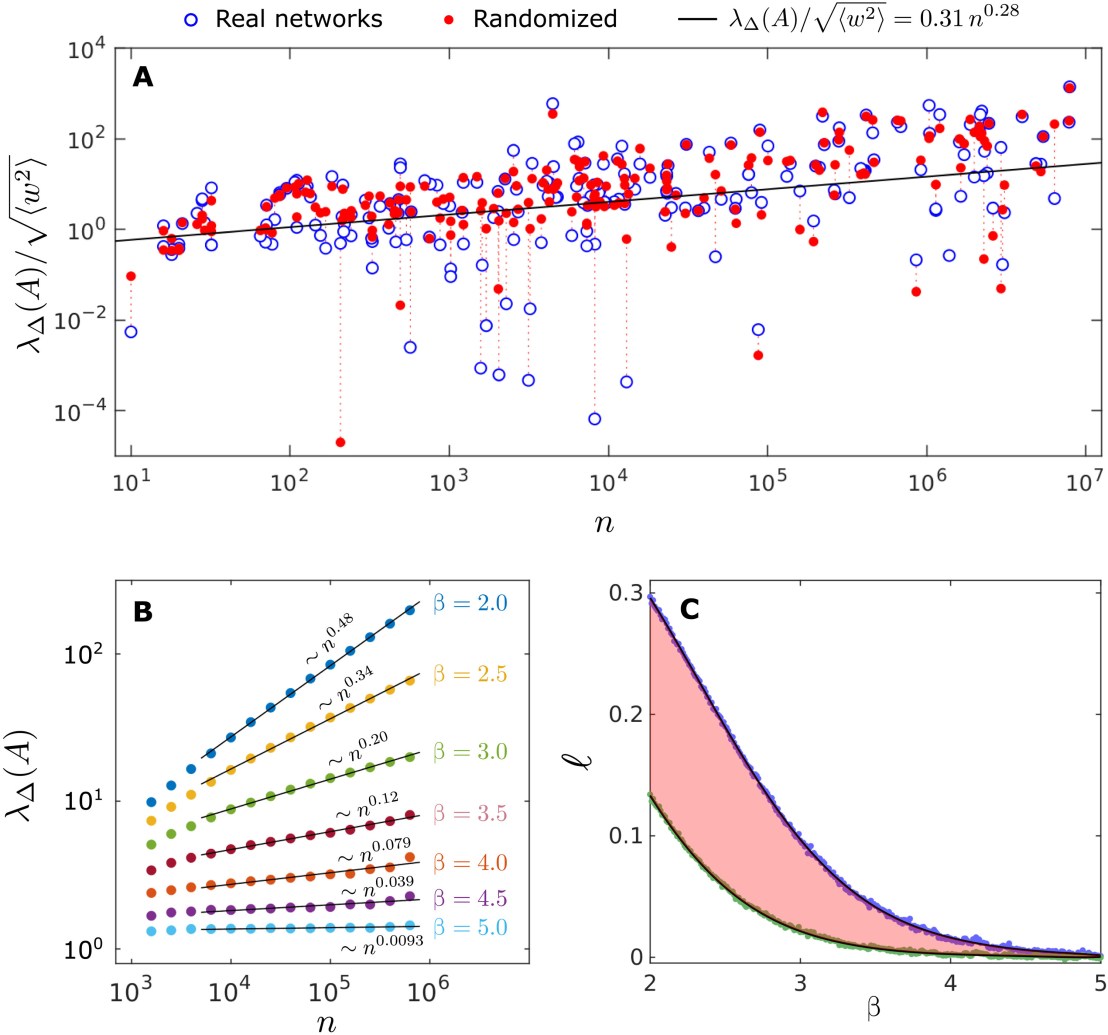
A central issue in the study of large complex network systems, such as power grids, financial networks, and ecological systems, is to understand their response to dynamical perturbations. Recent studies recognize that many real networks show nonnormality and that nonnormality can give rise to reactivity—the capacity of a linearly stable system to amplify its response to perturbations, oftentimes exciting nonlinear instabilities. Here, we identify network structural properties underlying the pervasiveness of nonnormality and reactivity in real directed networks, which we establish using the most extensive dataset of such networks studied in this context to date. The identified properties are imbalances between incoming and outgoing network links and paths at each node. On the basis of this characterization, we develop a theory that quantitatively predicts nonnormality and reactivity and explains the observed pervasiveness. We suggest that these results can be used to design, upgrade, control, and manage networks to avoid or promote network instabilities.

Read the full article at: www.science.org