
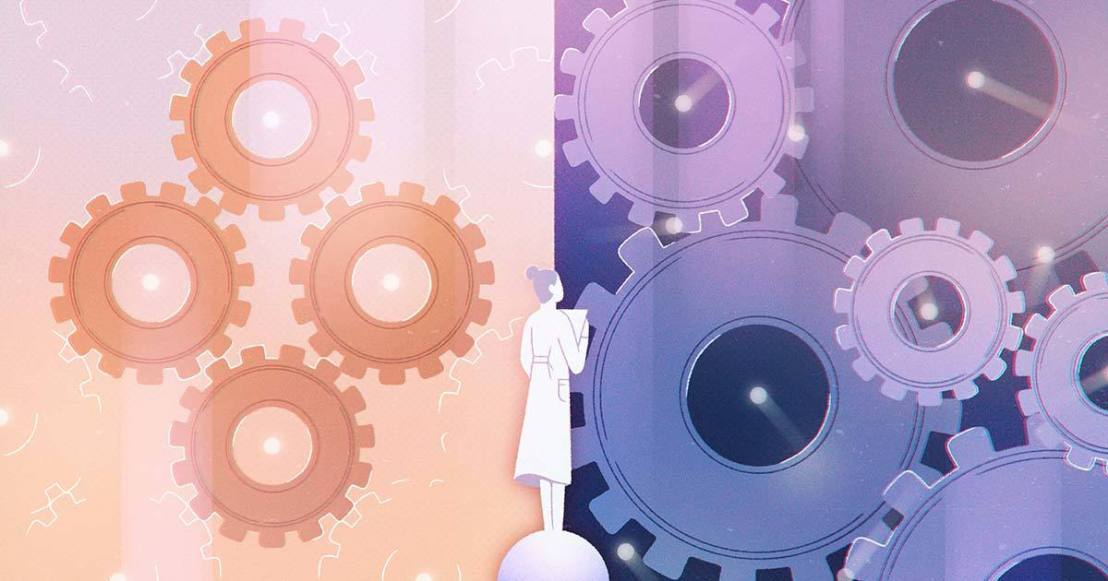
Thanks to the power of fluctuation relations, physicists are taking the second law of thermodynamics to settings once thought impossible.
Read the full article at: www.quantamagazine.org
Networking the complexity community since 1999
Author: cxdig
Thanks to the power of fluctuation relations, physicists are taking the second law of thermodynamics to settings once thought impossible.
Read the full article at: www.quantamagazine.org

With self-generated gradients of chemicals and physical tension, cells in the body steer themselves to vital destinations.
Read the full article at: www.quantamagazine.org
The idea of creating artifacts that evolve by themselves has been at the heart of the Artificial Life research, dating back to the early motives of John von Neumann’s monumental work on self-reproducing automata in the 1940’s. This vein of research is unique and fundamentally different from other more widely studied evolutionary computation research, because basic processes of evolution (heredity, variation, selection) are not given a priori as built-in mechanisms but they need to emerge as a result of interactions among microscopic components. In this talk, I will provide a brief review of how this problem has been approached in ALife using various kinds of methodologies, including classic frameworks (e.g., cellular automata, evolving programs) and more modern ones (e.g., artificial chemistry, AI/ML). I aim to highlight several key ingredients in order for complex systems to show spontaneous evolutionary behaviors by themselves and, in particular, to exhibit open-ended exploration of the possibility space.
Watch at: www.youtube.com
Oscar Fontanelli, Plinio Guzmán, Amílcar Meneses, Alfredo Hernández, Marisol Flores-Garrido, Maribel Hernández-Rosales, Guillermo de Anda-Jáuregui
We present a collection of networks that describe the travel patterns between municipalities in Mexico between 2020 and 2021. Using anonymized mobile device geo-location data we constructed directed, weighted networks representing the (normalized) volume of travels between municipalities. We analysed changes in global (graph total weight sum), local (centrality measures), and mesoscale (community structure) network features. We observe that changes in these features are associated with factors such as Covid-19 restrictions and population size. In general, events in early 2020 (when initial Covid-19 restrictions were implemented) induced more intense changes in network features, whereas later events had a less notable impact in network features. We believe these networks will be useful for researchers and decision makers in the areas of transportation, infrastructure planning, epidemic control and network science at large.
Read the full article at: arxiv.org
April 22-24, 2022
“Learn Complexity by Doing” with a diverse cohort of global Participants. Guidance from world-class Facilitators, in a community of practice that meets monthly. Meet future collaborations from all countries, fields, domains, backgrounds, perspectives, and levels of familiarity with Complexity Science – everyone here shares a desire to learn about Complex System behavior by helping to solve the world’s toughest problems together. Your perspective is needed!
More at: www.complexityweekend.com

