Author: cxdig

The Complex Alternative: Complexity Scientists on the COVID-19 Pandemic

COVID-19 is the virus that proved the fragility of the world. It took only the simplest form of life to shake the connectivity and dependency of society. This book is a real-time record and recommendation from a community of complexity scientists reacting to the pandemic. Through nontechnical articles, interviews, and discussions spanning the early days of the pandemic through the fall of 2021, researchers seek ways to stay responsive to complexity when every force conspires toward simplicity. The Complex Alternative encompasses immunology, epidemiology, psychology, inequality, and collapse. It is an effort to preserve perspective at a time when partiality seeks dominion.

Edited by David C. Krakauer and Geoffrey West, this book features the thoughts of more than sixty members of the Santa Fe Institute’s research community on the future of complexity science and the broader significance of science in the twenty-first century.

More at: www.sfipress.org

Work, Entropy Production, and Thermodynamics of Information under Protocol Constraints

Artemy Kolchinsky and David H. Wolpert
Phys. Rev. X 11, 041024

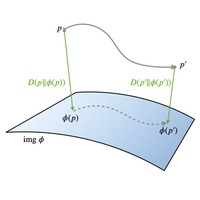
In many real-world situations, there are constraints on the ways in which a physical system can be manipulated. We investigate the entropy production (EP) and extractable work involved in bringing a system from some initial distribution p to some final distribution p′, given that the set of master equations available to the driving protocol obeys some constraints. We first derive general bounds on EP and extractable work, as well as a decomposition of the nonequilibrium free energy into an “accessible free energy” (which can be extracted as work, given a set of constraints) and an “inaccessible free energy” (which must be dissipated as EP). In a similar vein, we consider the thermodynamics of information in the presence of constraints and decompose the information acquired in a measurement into “accessible” and “inaccessible” components. This decomposition allows us to consider the thermodynamic efficiency of different measurements of the same system, given a set of constraints. We use our framework to analyze protocols subject to symmetry, modularity, and coarse-grained constraints and consider various examples including the Szilard box, the 2D Ising model, and a multiparticle flashing ratchet.

Read the full article at: link.aps.org

Basins with Tentacles

Yuanzhao Zhang and Steven H. Strogatz
Phys. Rev. Lett. 127, 194101

To explore basin geometry in high-dimensional dynamical systems, we consider a ring of identical Kuramoto oscillators. Many attractors coexist in this system; each is a twisted periodic orbit characterized by a winding number q, with basin size proportional to e^−(kq^2). We uncover the geometry behind this size distribution and find the basins are octopuslike, with nearly all their volume in the tentacles, not the head of the octopus (the ball-like region close to the attractor). We present a simple geometrical reason why basins with tentacles should be common in high-dimensional systems.

Read the full article at: link.aps.org