
Rodney Brooks
IEEE Spectrum
I’m just going to come out and say it: Human cognition might have nothing whatsoever to do with computation.
Read the full article at: spectrum.ieee.org
Networking the complexity community since 1999
Author: cxdig
Rodney Brooks
IEEE Spectrum
I’m just going to come out and say it: Human cognition might have nothing whatsoever to do with computation.
Read the full article at: spectrum.ieee.org
Fiona Spooner, et al.
Social Science & Medicine Volume 291, December 2021, 114461
• A microsimulation framework for modelling disease transmission within communities.
• Integration of data from multiple, diverse sources to estimate exposure and risk.
• Computationally efficient implementation allows rapid assessment of scenarios.
• Allows the effects of different non-pharmaceutical interventions to be assessed.
• Results show substantial reduction in infections associated with earlier UK lockdown.
Read the full article at: www.sciencedirect.com
Federico Battiston, Enrico Amico, Alain Barrat, Ginestra Bianconi, Guilherme Ferraz de Arruda, Benedetta Franceschiello, Iacopo Iacopini, Sonia Kéfi, Vito Latora, Yamir Moreno, Micah M. Murray, Tiago P. Peixoto, Francesco Vaccarino & Giovanni Petri
Nature Physics volume 17, pages1093–1098 (2021)
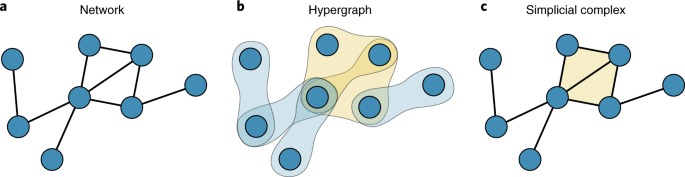
Complex networks have become the main paradigm for modelling the dynamics of interacting systems. However, networks are intrinsically limited to describing pairwise interactions, whereas real-world systems are often characterized by higher-order interactions involving groups of three or more units. Higher-order structures, such as hypergraphs and simplicial complexes, are therefore a better tool to map the real organization of many social, biological and man-made systems. Here, we highlight recent evidence of collective behaviours induced by higher-order interactions, and we outline three key challenges for the physics of higher-order systems.
Read the full article at: www.nature.com
Jian Gao, Yian Yin, Kyle R. Myers, Karim R. Lakhani & Dashun Wang
Nature Communications volume 12, Article number: 6188 (2021)
Mass communication over social media can drive rapid changes in our sense of collective identity. Hashtags in particular have acted as powerful social coordinators[1], playing a key role in organizing social movements like the Gezi park protests, Occupy Wall Street, #metoo, and #blacklivesmatter[2, 3, 4]. Here we quantify collective identity from the use of hashtags as self-labels in over 85,000 actively-maintained Twitter user profiles spanning 2017-2019. Collective identities emerge from a graph model of individuals’ overlapping self-labels, producing a hierarchy of graph clusters. Each cluster is bound together and characterized semantically by specific hashtags key to its formation. We define and apply two information-theoretic measures to quantify the strength of identities in the hierarchy. First we measure collective identity coherence to determine how integrated any identity is from local to global scales. Second, we consider the conspicuousness of any identity given its vocabulary versus the global identity map. Our work reveals a rich landscape of online identity emerging from the hierarchical alignment of uncoordinated self-labeling actions.
Read the full article at: www.nature.com

The COVID-19 pandemic has cost more than 4 million lives, left millions of people with persistent symptoms (ie, long COVID), and has devastated societies, with already disadvantaged communities being hit hardest. The tragedy is that much of this harm was preventable, as shown early on by many Asia-Pacific countries that pursued elimination of COVID-19 and protected both their public health and economies. The rest of the world can still work towards elimination. The World Health Network (WHN) is a coalition of citizens and experts who are committed to global action to protect public health through progressive elimination of COVID-19.
Yaneer Bar-Yam, Deepti Gurdasani, Michael G Baker, Gabriel Scally, Simone George, Amanda Kvalsvig, Sinéad Ní Fhaoláin, Shu-Ti Chiou, John Drury, Stephen Duckett, Eric L Ding, Carlos Gershenson, Christine Gibson, Trisha Greenhalgh, Adam Hamdy, Zoë Hyde, Tiffany James, Jose L Jimenez, Martin McKee, Susan Michie, Christina Pagel, Cecile Philippe, Kim Prather, Sunil K Raina, Walter Ricciardi, Meir Rubin, Tomás Ryan, Matthias F Schneider, Anthony Staines, Robert West, Hisham Ziauddeen
The Lancet VOLUME 398, ISSUE 10311, P1567-1568, OCTOBER 30, 2021
Read the full article at: www.thelancet.com

