

How does consciousness arise in mere flesh and blood? To the neuroscientist Anil Seth, our organic bodies are the key to the experience.
Read the full article at: www.quantamagazine.org
Networking the complexity community since 1999
Author: cxdig
How does consciousness arise in mere flesh and blood? To the neuroscientist Anil Seth, our organic bodies are the key to the experience.
Read the full article at: www.quantamagazine.org
From the spreading of diseases and memes to the development of
opinions and social influence, dynamical processes are influenced heavily
by the networks on which they occur. In this talk, I’ll discuss social
influence and opinion models on networks. I’ll present a few types of
models — including threshold models of social contagions, voter models
that coevolve with network structure, and bounded-confidence models with
continuous opinions — and illustrate how such processes are affected by
the networks on which they occur. I’ll also connect these models to
opinion polarization and the development of echo chambers in online social
networks.
Watch at: www.youtube.com

Luís F. Seoane
Phys. Rev. X 11, 031058 (2021)
Multiple aspects of an economy can be regulated, tampered with, or left to chance. Economic actors can exploit these degrees of freedom, at a cost, to bend the flow of wealth in their favor. If intervention becomes widespread, microeconomic strategies of different actors can build into emergent macroeconomic effects. How viable is a “rigged” economy? How do growing economic complexity and wealth affect it? We study rigged economies with a toy model. In it, economic degrees of freedom progress from minority to coordination games as intervention increases. Growing economic complexity spontaneously defuses cartels. But excessive complexity leads to large-fluctuations regimes, threatening the system’s stability. Simulations suggest that wealth must grow faster than linearly with economic complexity to avoid this regime and keep economies viable in the long run. We discuss a real-case scenario of multiple economic actors coordinated to result in an emergent upset of the stock market.
Read the full article at: link.aps.org
Rodney A. Brooks
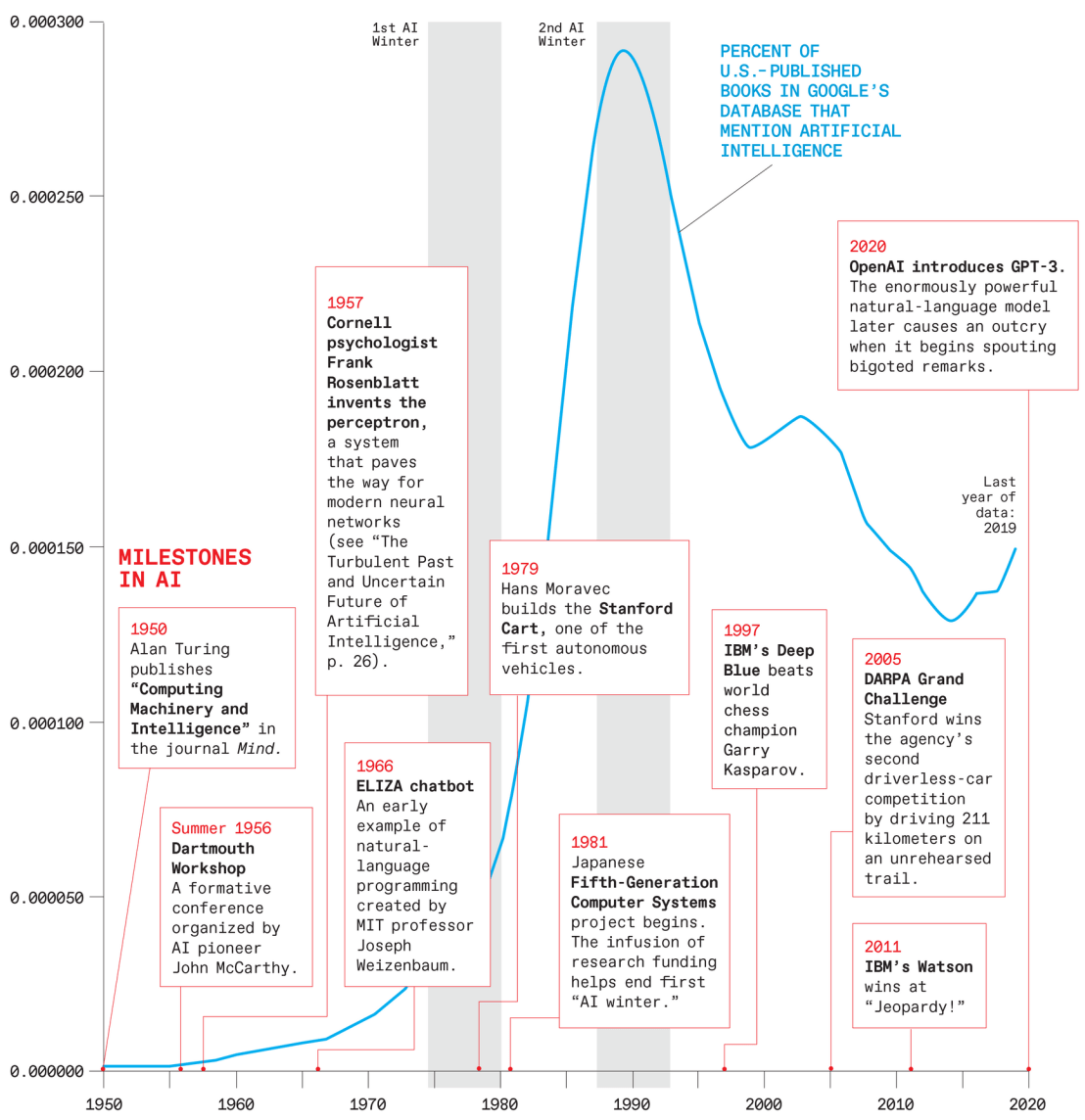
AI won’t surpass human intelligence anytime soon
Just about every successful deployment of AI has either one of two expedients: It has a person somewhere in the loop, or the cost of failure, should the system blunder, is very low.
Read the full article at: spectrum.ieee.org

Ed Yong
This one is far from over, but the window to prepare for future threats is closing fast.
Read the full article at: www.theatlantic.com

