
//
View at: www.youtube.com
Networking the complexity community since 1999
Author: cxdig
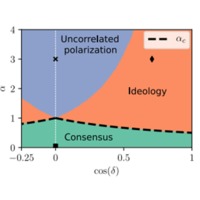
Fabian Baumann, Philipp Lorenz-Spreen, Igor M. Sokolov, and Michele Starnini
Phys. Rev. X 11, 011012 (2021)
By embedding opinions in a nonorthogonal topic space, a new model shows that a reinforcement mechanism driven by homophilic social interactions reproduces extreme and correlated opinion states found in surveys.
Read the full article at: link.aps.org
Mario Franco, Octavio Zapata, David A. Rosenblueth, and Carlos Gershenson
Mathematics 2021, 9(8), 792
We propose quantum Boolean networks, which can be classified as deterministic reversible asynchronous Boolean networks. This model is based on the previously developed concept of quantum Boolean functions. A quantum Boolean network is a Boolean network where the functions associated with the nodes are quantum Boolean functions. We study some properties of this novel model and, using a quantum simulator, we study how the dynamics change in function of connectivity of the network and the set of operators we allow. For some configurations, this model resembles the behavior of reversible Boolean networks, while for other configurations a more complex dynamic can emerge. For example, cycles larger than 2N were observed. Additionally, using a scheme akin to one used previously with random Boolean networks, we computed the average entropy and complexity of the networks. As opposed to classic random Boolean networks, where “complex” dynamics are restricted mainly to a connectivity close to a phase transition, quantum Boolean networks can exhibit stable, complex, and unstable dynamics independently of their connectivity.
Read the full article at: www.mdpi.com
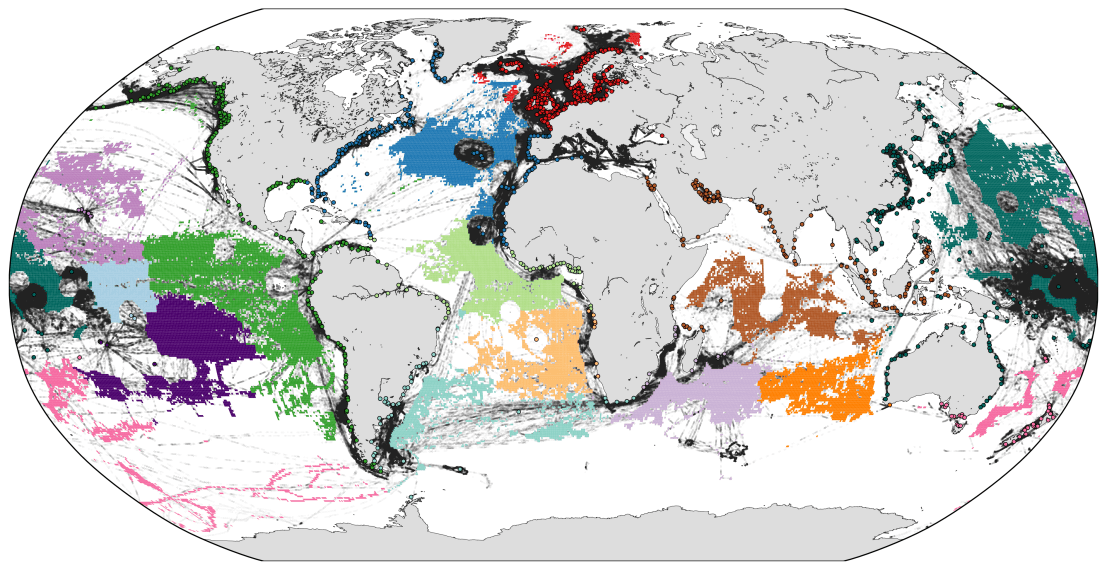
Jorge P. Rodríguez, Juan Fernández-Gracia, Carlos M. Duarte, Xabier Irigoien, and Víctor M. Eguíluz
Science Advances 26 Feb 2021:
Vol. 7, no. 9, eabe3470
Fisheries in waters beyond national jurisdiction (“high seas”) are difficult to monitor and manage. Their regulation for sustainability requires critical information on how fishing effort is distributed across fishing and landing areas, including possible border effects at the exclusive economic zone (EEZ) limits. We infer the global network linking harbors supporting fishing vessels to fishing areas in high seas from automatic identification system tracking data in 2014, observing a modular structure, with vessels departing from a given harbor fishing mostly in a single province. The top 16% of these harbors support 84% of fishing effort in high seas, with harbors in low- and middle-income countries ranked among the top supporters. Fishing effort concentrates along narrow strips attached to the boundaries of EEZs with productive fisheries, identifying a free-riding behavior that jeopardizes efforts by nations to sustainably manage their fisheries, perpetuating the tragedy of the commons affecting global fishery resources.
Read the full article at: advances.sciencemag.org
Gianluca D’Addese, Laura Sani, Luca La Rocca, Roberto Serra, and Marco Villani
Entropy 2021, 23(4), 398;
The identification of emergent structures in complex dynamical systems is a formidable challenge. We propose a computationally efficient methodology to address such a challenge, based on modeling the state of the system as a set of random variables. Specifically, we present a sieving algorithm to navigate the huge space of all subsets of variables and compare them in terms of a simple index that can be computed without resorting to simulations. We obtain such a simple index by studying the asymptotic distribution of an information-theoretic measure of coordination among variables, when there is no coordination at all, which allows us to fairly compare subsets of variables having different cardinalities. We show that increasing the number of observations allows the identification of larger and larger subsets. As an example of relevant application, we make use of a paradigmatic case regarding the identification of groups in autocatalytic sets of reactions, a chemical situation related to the origin of life problem.
Read the full article at: www.mdpi.com

