
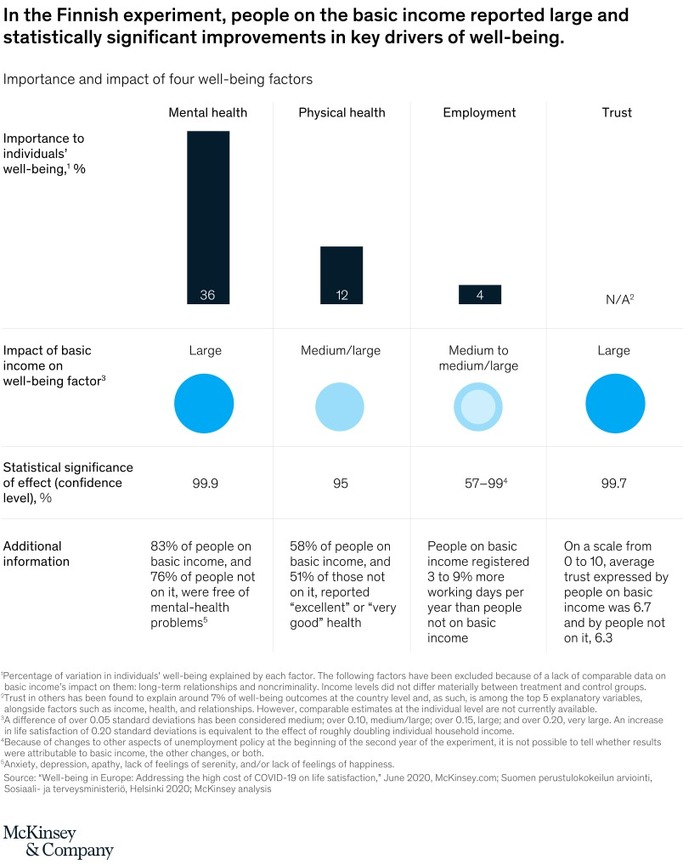
As income inequality and economic upheaval take center stage, is a guaranteed minimum income worth considering? Results from a two-year experiment in Finland offer clues.
Source: www.mckinsey.com
Networking the complexity community since 1999
Author: cxdig
As income inequality and economic upheaval take center stage, is a guaranteed minimum income worth considering? Results from a two-year experiment in Finland offer clues.
Source: www.mckinsey.com
Networks 2021: A Joint Sunbelt and NetSci Conference will take place in Washington D.C. on July 6-11, 2021. We expect this to be the largest networks conference ever held. It will combine the annual meeting of the International Network for Social Network Analysis (Sunbelt XLI), and the annual meeting of the Network Science Society (NetSci 2021).
Source: networks2021.net

In Rise of the Self-Replicators we delve into the deep history of thought about machines, AI and robots that can reproduce and evolve. Although these might seem like very modern concepts, we show that people were thinking about them as far back as the mid-1600s and that the discussion gathered pace in the 1800s following the British Industrial Revolution and the publication of Darwin’s On The Origin of Species.
Behind all of the work we discuss lie two central questions:
Source: www.tim-taylor.com
Alexis Robert
The Lancet
In the absence of a vaccine for severe acute respiratory syndrome coronavirus 2 (SARS-CoV-2), or of highly effective pharmaceutical treatments for COVID-19, countries have implemented a large range of non-pharmaceutical interventions to control the spread of the virus.1 These interventions differ in their level of stringency (ie, the severity of the measures) and their ultimate objective (eg, prevent health systems being overwhelmed, suppress incidence to low levels, or reduce incidence to zero and keep it there). With many countries facing epidemic resurgence, evaluating the impact of different strategies implemented in the early phases of the pandemic is crucial for developing an effective long-term response.
New Zealand adopted a set of non-pharmaceutical interventions aiming to bring COVID-19 incidence to zero
Source: www.thelancet.com

Andrea Roli and Stuart A. Kauffman
Entropy 2020, 22(10), 1163
Since early cybernetics studies by Wiener, Pask, and Ashby, the properties of living systems are subject to deep investigations. The goals of this endeavour are both understanding and building: abstract models and general principles are sought for describing organisms, their dynamics and their ability to produce adaptive behavior. This research has achieved prominent results in fields such as artificial intelligence and artificial life. For example, today we have robots capable of exploring hostile environments with high level of self-sufficiency, planning capabilities and able to learn. Nevertheless, the discrepancy between the emergence and evolution of life and artificial systems is still huge. In this paper, we identify the fundamental elements that characterize the evolution of the biosphere and open-ended evolution, and we illustrate their implications for the evolution of artificial systems. Subsequently, we discuss the most relevant issues and questions that this viewpoint poses both for biological and artificial systems.
Source: www.mdpi.com

