
Author: cxdig

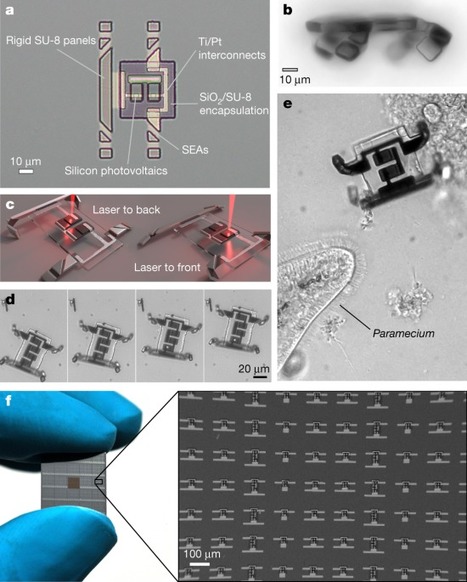
Electronically integrated, mass-manufactured, microscopic robots

Marc Z. Miskin, Alejandro J. Cortese, Kyle Dorsey, Edward P. Esposito, Michael F. Reynolds, Qingkun Liu, Michael Cao, David A. Muller, Paul L. McEuen & Itai Cohen 
Nature volume 584, pages557–561(2020)


Fifty years of Moore’s law scaling in microelectronics have brought remarkable opportunities for the rapidly evolving field of microscopic robotics1,2,3,4,5. Electronic, magnetic and optical systems now offer an unprecedented combination of complexity, small size and low cost6,7, and could be readily appropriated for robots that are smaller than the resolution limit of human vision (less than a hundred micrometres)8,9,10,11. However, a major roadblock exists: there is no micrometre-scale actuator system that seamlessly integrates with semiconductor processing and responds to standard electronic control signals. Here we overcome this barrier by developing a new class of voltage-controllable electrochemical actuators that operate at low voltages (200 microvolts), low power (10 nanowatts) and are completely compatible with silicon processing. To demonstrate their potential, we develop lithographic fabrication-and-release protocols to prototype sub-hundred-micrometre walking robots. Every step in this process is performed in parallel, allowing us to produce over one million robots per four-inch wafer. These results are an important advance towards mass-manufactured, silicon-based, functional robots that are too small to be resolved by the naked eye.

Source: www.nature.com

Towards a general theory of the major cooperative evolutionary transitions

Towards a general theory of the major cooperative evolutionary transitions
John E.Stewart

Biosystems
Volume 198, December 2020, 104237


Major Cooperative Evolutionary Transitions occur when smaller-scale entities cooperate together to give rise to larger-scale entities that evolve and adapt as coherent wholes. Key examples of cooperative transitions are the emergence of the complex eukaryote cell from communities of simpler cells, the transition from eukaryote cells to multicellular organisms, and the organization of humans into complex, modern societies. A number of attempts have been made to develop a general theory of the major cooperative transitions. This paper begins by critiquing key aspects of these previous attempts. Largely, these attempts comprise poorly-integrated collections of separate models that were each originally developed to explain particular transitions. In contrast, this paper sets out to identify processes that are common to all cooperative transitions. It develops an alternative theoretical framework known as Management Theory. This general framework suggests that all major cooperative transitions are the result of the emergence of powerful, evolvable ‘managers’ that derive benefit from using their power to organize smaller-scale entities into larger-scale cooperatives. Management Theory is a contribution to the development of a general, “all levels” understanding of major cooperative transitions that is capable of identifying those features that are level-specific, those that are common across levels and those that are involved in trends across levels.

Source: www.sciencedirect.com

Full professor in Theoretical Computer Science at the informatics institute @UvA

Do you have the ambition to develop world class research in Theoretical Computer Science at the Informatics Institute, and together with the other new chair Theoretical Computer Science at the Institute for Logic, Language, and Computation form a strong and visible nucleus Theoretical Computer Science in our University? Are you willing to collaborate with other research groups, also within other faculties of the University, to seek relations with public or private partners, to be visible in the broader academic community, to teach theoretical computer Science in our bachelor/master programs and to take responsibility for all theory of computer science aspects of our educational programs?

We offer a position of full professor in Theoretical Computer Science in the Informatics Institute of the University of Amsterdam. This new chair is embedded in the Informatics Institute of the University of Amsterdam and will lead the Theory of Computer Science group. The chair holder should develop a unique profile within the Informatics Institute while interacting with one of more research groups within the Institute. The Institute for Logic, Language, and Computation of the University of Amsterdam will also establish a new chair in Theoretical Computer science, and both chair holders should build links and create a visible nucleus of Theoretical Computer science in Amsterdam, also together with VU and CWI.

Source: www.uva.nl

A minority of self-organizing autonomous vehicles significantly increase freeway traffic flow

Amir Goldental and Ido Kanter

Journal of Physics A: Mathematical and Theoretical


This study investigates the dynamics of traffic containing human-driven vehicles along with a fraction of self-organized artificial intelligence (AI) autonomous vehicles (AVs) on multilane freeways. We propose guidelines for the development of AI agents, such that a small fraction of AVs forms local constellations that significantly accelerate the entire traffic flow while reducing fuel consumption and increasing safety. Specifically, we report a 40% enhancement in traffic flow efficiency and up to 27% reduction in fuel consumption even when only 5% of vehicles are autonomous. This scenario does not require changes to current infrastructure or communication between vehicles; it only requires proper regulations. The results indicate that more efficient, safer, faster, and greener traffic flow can be realized in the near future.

Source: iopscience.iop.org

SICC Talks on Complexity

The Italian Society for Chaos and Complexity (SICC) is proud to introduce the SICC Talks on Complexity a series of online lectures on hot topics on complexity at large.

Each seminar will be given by two prominent scholars and followed by a short debate and Q&A session. Upon free registration, participants will receive instructions on how to connect to attend the lecture.

Each year, the Italian Society for Chaos and Complexity organizes the SICC International Tutorial Workshop TOPICS IN NONLINEAR DYNAMICS, an event where PhD students, young researchers and leading speakers coming from diverse disciplines meet each other to spend a week talking about science, engineering and complexity. As this year we cannot meet in presence, the 15th edition of the yearly SICC workshop will take the form of a series of online lectures.


INVITED SPEAKERS
Iain Couzin, Max Plank Institute and University of Konstanz, Germany
Raissa M. D’Souza, UC Davis, CA, USA
Tina Eliassi-Rad, Network Science Institute Northeastern University, Boston, MA, USA
Naomi Ehrich Leonard, Princeton University, NJ, USA
Hinke M. Osinga, University of Auckland, NZ
Andrey Shilnikov, Georgia State University, GA, USA
Julien Clinton Sprott, University of Wisconsin, WI, USA
Iryna Sushko, Institute of Mathematics National Academy of Sciences of Ukraine, Kyiv, UA

Source: www.sicc-it.org