
Author: cxdig

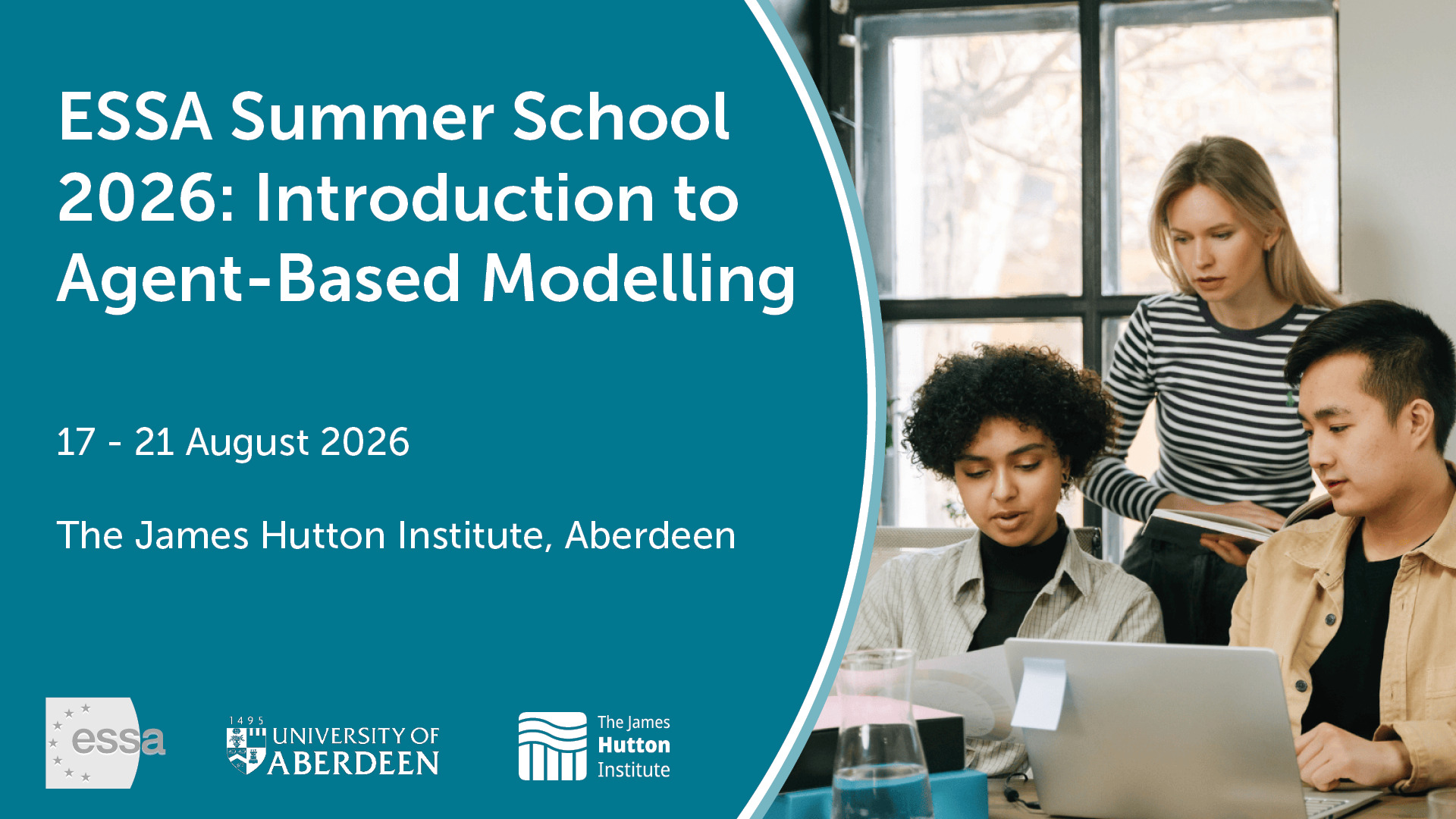
ESSA Summer School 2026: Introduction to Agent-Based Modelling | Integrated socio-environmental modelling of policy scenarios for Scotland

As part of the European Social Simulation Association‘s life-long learning strategy, the ESSA Summer School 2026 will take place from Monday 17 to Friday 21 August 2026 at the James Hutton Institute, Aberdeen. Led by Gary Polhill, this one-week intensive course offers an introduction to agent-based modelling (ABM), connecting theories of complex systems with practical model design, programming, and experimentation in NetLogo.

Participants will learn how agent-based models can represent heterogeneous actors, dynamic environments, and emergent socio-ecological patterns. The course combines conceptual theory, coding exercises, and group projects to help participants understand the purpose, design, and implementation of ABMs for socio-environmental systems.


Key themes include:

  • Complex systems thinking and agent-based theory
  • Translating conceptual systems into computational models
  • Programming ABMs in NetLogo and developing clear model structures
  • Setting up experiments, analysing results, and communicating model findings

The summer school is designed for PhD students, researchers, and practitioners interested in modelling socio-ecological systems, environmental policy, behavioural dynamics, and other complex adaptive systems.

More at: large-scale-modelling.hutton.ac.uk

Complex Networks Theory, Methods, and Applications

10th edition
May 18-22, 2026
Villa del Grumello,
Como, Italy
Many real systems can be modeled as networks, where the elements of the system are nodes and interactions between elements are edges. An even larger set of systems can be modeled using dynamical processes on networks, which are in turn affected by the dynamics. Networks thus represent the backbone of many complex systems, and their theoretical and computational analysis makes it possible to gain insights into numerous applications. Networks permeate almost every conceivable discipline – including sociology, transportation, economics and finance, biology, and myriad others – and the study of “network science” has thus become a crucial component of modern scientific education.

The school “Complex Networks: Theory, Methods, and Applications” offers a succinct education in network science. It is open to all aspiring scholars in any area of science or engineering who wish to study networks of any kind (whether theoretical or applied), and it is especially addressed to doctoral students and young postdoctoral scholars. The aim of the school is to deepen into both theoretical developments and applications in targeted fields.

Read the full article at: ntml.lakecomoschool.org

Complexity72h 2026 – Call for Participants

Complexity72h is a cross-disciplinary workshop where young researchers work in small interdisciplinary teams on a real research project in complex systems over 72 intense hours.

📍 June 21–26, 2026 | Northeastern University London
👩‍🔬 Open to Master’s students, PhD students, and postdocs
📌 Application deadline: February 28th, 2026

Registration fee: €710 (includes 5 nights accommodation, workshop facilities, coffee breaks, lunches, invited lectures, and social events).

More information and applications: https://complexity72h.com