
Author: cxdig

Eros and Logos

Stuart Kauffman
Angelaki. Journal of the Theoretical Humanities
Volume 25, 2020 – Issue 3: special issue: ontogenesis beyond complexity. Pages 9-23


For the ancient Greeks, the world was both Eros, the god of chaos and creativity, and Logos, the regularity of the heavens as law. From chaos the world came forth. The world was home to ultimate creativity. Two thousand years later Kepler, Galileo, and then mighty Newton created deterministic classical physics in which all that happens in the universe is determined by the laws of motion, initial and boundary conditions. The Theistic God who worked miracles became the Deistic God who set up the universe and let Newton’s laws take over. Eros, raw creativity, is dead, all is Logos.

Quantum mechanics replaced the determinism of classical physics with fundamental indeterminism. This was a major crisis in physics, but remained entirely within the Newtonian paradigm of laws, here the Schrödinger equation, initial and boundary conditions. The Schrödinger equation entails the deterministic propagation of a probability distribution. The probabilities concern the indeterminate outcomes of quantum measurement events.

The central issue of this article is to show that no laws at all determine or entail the becoming of our biosphere or any other among the 1022 solar systems in the universe. This claim is radical. If no laws determine or entail the becoming of biospheres, and biospheres are part of the universe, the Pythagorean dream that All is Number, All is Logos, is dead. There is no Final Theory that entails all that become in the universe. Eros is again, and always was, rambunctiously alive in the raw creativity of the becoming of life anywhere in the universe. The becoming of life is based on physics, on Logos, but beyond it, emerging from Eros.

The reasons Eros is at play in the evolution of biospheres are fourfold.

First, the universe will not make all possible complex things. That is, the universe is vastly non-ergodic. Yet complex things such as the human heart exist.

Second, the reason human hearts exist is that organisms are Kantian Wholes in which the parts exist for and by means of the whole. Hearts exist because they fulfill the function of pumping the blood that keeps the whole organism alive. Such organisms propagate progeny that carry with them the hearts that keep them alive.

Third, adaptations like hearts, the flagellar motor, the loop of Henle in kidneys that concentrates urine, and flight feathers, are tinkered-together contraptions stumbled upon in evolution. Parts and processes that arise in evolution are jury-rigged for unprestatable new functions that help keep the entire Kantian Whole organism alive and propagating in the evolving biosphere. There is no deductive theory of jury rigging. We cannot deduce the emergence of such novel functions.

Fourth, the functions of parts of organisms emerge in unprestatable ways and form the unprestatable and ever-changing phase space of evolution. Since we cannot prestate the ever-changing phase space of evolution, we can write no laws of motion in differential equation form, so cannot integrate the equations we do not have. Thus, no laws entail the becoming of any biosphere.

Evolving biospheres are everywhere creative. This is Eros, the chaos from which the world emerges. This profound creative emergence is the stuff of story, of narrative. Evolving biospheres always were and always will be both Eros and Logos, the stuff of story and the stuff of law. We always live in a world of Art and Science.

Source: www.tandfonline.com
Postdoctoral Fellow, Socioeconomic patterns in network formation and mobility | Central European University

The Department of Network and Data Science (DNDS) at the Central European University (CEU) carries out research in network science, with a special focus on the foundations and applications of network science to practical data-driven problems. A key element of the mission of DNDS is to work across disciplines to bring network and data science tools to many fields of the social sciences and related areas. DNDS translates these ideas into research projects – our faculty have won several major grants, from European Union and US funding agencies. DNDS offers a PhD Program and an Advanced Certificate Program in Network Science and will host a BA in Quantitative Social Sciences starting, presumably, in 2021. Data science tools and the network science approach offer a unique perspective to tackle complex problems, impenetrable to linear-proportional thinking. Building on decades of development of fundamental understanding of networks, the modern data deluge has opened up unprecedented opportunities to study and understand the structure and function of social, economic, political and information systems. Data-driven network science aims at explaining complex phenomena at larger scales emerging from simple principles of network link formation.

Source: www.ceu.edu

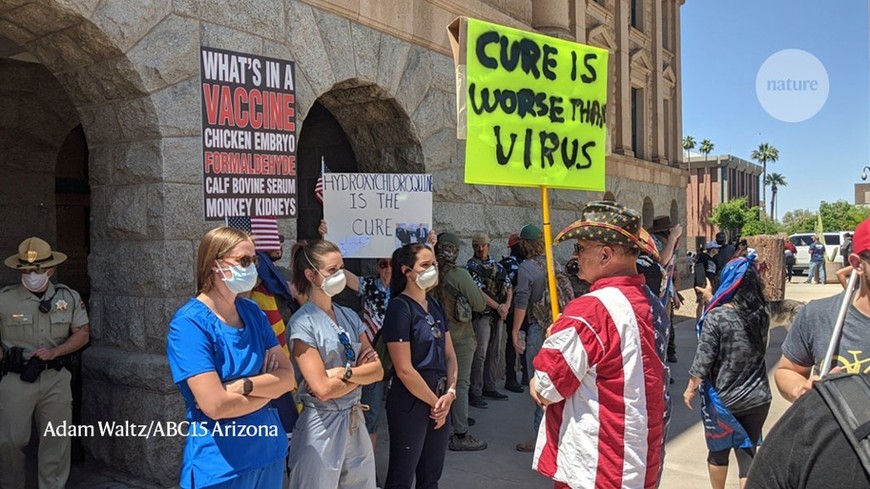
The epic battle against coronavirus misinformation and conspiracy theories

By studying the sources and spread of false information about COVID-19, researchers hope to understand where such information comes from, how it grows and — they hope — how to elevate facts over falsehood. It’s a battle that can’t be won completely, researchers agree — it’s not possible to stop people from spreading ill-founded rumours. But in the language of epidemiology, the hope is to come up with effective strategies to ‘flatten the curve’ of the infodemic, so that bad information can’t spread as far and as fast.

Source: www.nature.com

Lenia and Expanded Universe

Bert Wang-Chak Chan


We report experimental extensions of Lenia, a continuous cellular automata family capable of producing lifelike self-organizing autonomous patterns. The rule of Lenia was generalized into higher dimensions, multiple kernels, and multiple channels. The final architecture approaches what can be seen as a recurrent convolutional neural network. Using semi-automatic search e.g. genetic algorithm, we discovered new phenomena like polyhedral symmetries, individuality, self-replication, emission, growth by ingestion, and saw the emergence of "virtual eukaryotes" that possess internal division of labor and type differentiation. We discuss the results in the contexts of biology, artificial life, and artificial intelligence.

Source: arxiv.org

The information theory of individuality

David Krakauer, Nils Bertschinger, Eckehard Olbrich, Jessica C. Flack & Nihat Ay 
Theory in Biosciences volume 139, pages209–223(2020)


Despite the near universal assumption of individuality in biology, there is little agreement about what individuals are and few rigorous quantitative methods for their identification. Here, we propose that individuals are aggregates that preserve a measure of temporal integrity, i.e., “propagate” information from their past into their futures. We formalize this idea using information theory and graphical models. This mathematical formulation yields three principled and distinct forms of individuality—an organismal, a colonial, and a driven form—each of which varies in the degree of environmental dependence and inherited information. This approach can be thought of as a Gestalt approach to evolution where selection makes figure-ground (agent–environment) distinctions using suitable information-theoretic lenses. A benefit of the approach is that it expands the scope of allowable individuals to include adaptive aggregations in systems that are multi-scale, highly distributed, and do not necessarily have physical boundaries such as cell walls or clonal somatic tissue. Such individuals might be visible to selection but hard to detect by observers without suitable measurement principles. The information theory of individuality allows for the identification of individuals at all levels of organization from molecular to cultural and provides a basis for testing assumptions about the natural scales of a system and argues for the importance of uncertainty reduction through coarse-graining in adaptive systems.

Source: link.springer.com