

Author: cxdig

Chaos | The Great Courses

It has been called the third great revolution of 20th-century physics, after relativity and quantum theory. But how can something called chaos theory help you understand an orderly world? What practical things might it be good for? What, in fact, is chaos theory? "Chaos theory," according to Dr. Steven Strogatz, Director of the Center for Applied Mathematics at Cornell University, "is the science of how things change." It describes the behavior of any system whose state evolves over time and whose behavior is sensitive to small changes in its initial conditions.

Source: www.thegreatcourses.com
Metrics of Emergence, Self-Organization, and Complexity for EWOM Research

Juan C. Correa

Front. Phys., 21 February 2020


In a recent round table organized by the Santa Fe Institute, the complexity of commerce captured the attention of those interested in understanding how complex systems science can be applicable for settings where consumers and providers interact. Despite the usefulness of applied complexity for commerce-related phenomena, few works have attempted to provide insightful ideas. This mini-review aims at providing a succinct discussion of how the metrics of emergence, self-organization, and complexity might benefit the research agenda of applied complexity and commerce/consumer studies. In particular, the paper argues possible pragmatic ways to understanding the valuable information present in word-of-mouth data found on electronic commerce platforms.

Source: www.frontiersin.org

Tesco Grocery 1.0, a large-scale dataset of grocery purchases in London

Luca Maria Aiello, Daniele Quercia, Rossano Schifanella & Lucia Del Prete 
Scientific Data volume 7, Article number: 57 (2020)


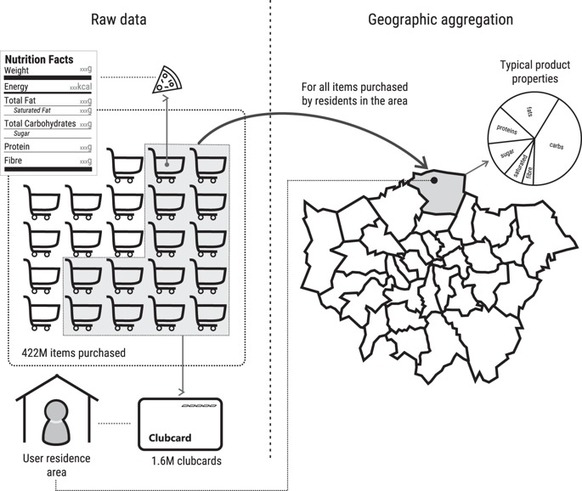
We present the Tesco Grocery 1.0 dataset: a record of 420 M food items purchased by 1.6 M fidelity card owners who shopped at the 411 Tesco stores in Greater London over the course of the entire year of 2015, aggregated at the level of census areas to preserve anonymity. For each area, we report the number of transactions and nutritional properties of the typical food item bought including the average caloric intake and the composition of nutrients. The set of global trade international numbers (barcodes) for each food type is also included. To establish data validity we: i) compare food purchase volumes to population from census to assess representativeness, and ii) match nutrient and energy intake to official statistics of food-related illnesses to appraise the extent to which the dataset is ecologically valid. Given its unprecedented scale and geographic granularity, the data can be used to link food purchases to a number of geographically-salient indicators, which enables studies on health outcomes, cultural aspects, and economic factors.

Source: www.nature.com

The role of worldviews in the governance of sustainable mobility

Frank Chuang, Ed Manley, Arthur Petersen

PNAS


In sustainability policy-making, a critical task is to value present and future needs in order to realize good quality of life. To analyze complex ideas of how people interpret reality, develop value orientations, and define needs and the good life, the notion of worldviews proved to be useful. We use worldviews to study how people of distinct ways of life perceive and assess sustainable mobility issues. Through exploring three worldviews (egalitarianism, hierarchy, and individualism), our results map across British people’s attitudes to mobility debates in terms of the economic, environmental, social, and political dimensions. In so doing, our study demonstrates a framework for identifying what behavioral and institutional barriers hinder the transformations needed to achieve better cities and societies.

Source: www.pnas.org

What Differs Us From Machines?

Carlos Gershenson


One of the most amazing things about reading R.U.R. a century after it was first published is noticing how many questions underlying the story are still current. It is worth noting that Čapek’s robots are not mechanical, but living. In this sense, they are closer to artificial life than to artificial intelligence. One has to consider that the play was staged before the first electronic computers were built and before DNA was discovered (no mobile phones, no commercial aviation, no Internet). We still do not have agreed definitions of life nor intelligence, imagine how ambiguous these should have been a century ago.

Source: papers.ssrn.com