Author: cxdig

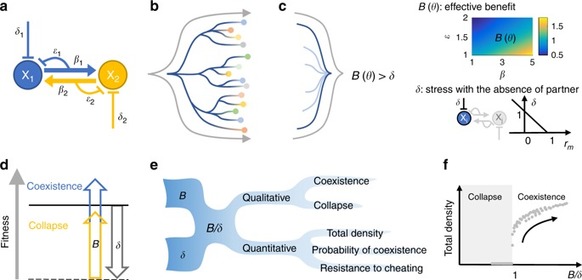
A unifying framework for interpreting and predicting mutualistic systems

Biological complexity has impeded our ability to predict the dynamics of mutualistic interactions. Here, the authors deduce a general rule to predict outcomes of mutualistic systems and introduce an approach that permits making predictions even in the absence of knowledge of mechanistic details.

Source: www.nature.com

Embodied Dyadic Interaction Increases Complexity of Neural Dynamics: A Minimal Agent-Based Simulation Model

The concept of social interaction is at the core of embodied and enactive approaches to social cognitive processes, yet scientifically it remains poorly understood. Traditionally, cognitive science had relegated all behavior to being the end result of internal neural activity. However, the role of feedback from the interactions between agent and their environment has become increasingly important to understanding behavior. We focus on the role that social interaction plays in the behavioral and neural activity of the individuals taking part in it. Is social interaction merely a source of complex inputs to the individual, or can social interaction increase the individuals’ own complexity? Here we provide a proof of concept of the latter possibility by artificially evolving pairs of simulated mobile robots to increase their neural complexity, which consistently gave rise to strategies that take advantage of their capacity for interaction. We found that during social interaction, the neural controllers exhibited dynamics of higher-dimensionality than were possible in social isolation. Moreover, by testing evolved strategies against unresponsive ghost partners, we demonstrated that under some conditions this effect was dependent on mutually responsive co-regulation, rather than on the mere presence of another agent’s behavior as such. Our findings provide an illustration of how social interaction can augment the internal degrees of freedom of individuals who are actively engaged in participation.


Embodied Dyadic Interaction Increases Complexity of Neural Dynamics: A Minimal Agent-Based Simulation Model

Madhavun Candadai, Matt Setzler, Eduardo J. Izquierdo and Tom Froese

Front. Psychol., 21 March 2019 | https://doi.org/10.3389/fpsyg.2019.00540

Source: www.frontiersin.org

A good example of interactions generating relevant novel information that is not present in initial nor boundary conditions, inherently limiting the predictability of complex systems.

Complexity Applications in Language and Communication Sciences

This book offers insights on the study of natural language as a complex adaptive system. It discusses a new way to tackle the problem of language modeling, and provides clues on how the close relation between natural language and some biological structures can be very fruitful for science. The book examines the theoretical framework and then applies its main principles to various areas of linguistics. It discusses applications in language contact, language change, diachronic linguistics, and the potential enhancement of classical approaches to historical linguistics by means of new methodologies used in physics, biology, and agent systems theory. It shows how studying language evolution and change using computational simulations enables to integrate social structures in the evolution of language, and how this can give rise to a new way to approach sociolinguistics. Finally, it explores applications for discourse analysis, semantics and cognition.


Complexity Applications in Language and Communication Sciences

Editors: Massip Bonet, Àngels, Bel-Enguix, Gemma, Bastardas-Boada, Albert

Source: www.springer.com

See Also: Introduction https://www.researchgate.net/publication/330715416_Introduction_Chapter_1 

Dynamic organization of flocking behaviors in a large-scale boids model

A simulation of a half-million flock is studied using a simple boids model originally proposed by Craig Reynolds. It was modeled with a differential equation in 3D space with a periodic boundary. Flocking is collective behavior of active agents, which is often observed in the real world (e.g., starling swarms). It is, nevertheless, hard to rigorously define flocks (or their boundaries). First, even within the same swarm, the members are constantly updated, and second, flocks sometimes merge or divide dynamically. To define individual flocks and to capture their dynamic features, we applied a DBSCAN and a non-negative matrix factorization (NMF) to the boid dataset. Flocking behavior has different types of dynamics depending on the size of the flock. A function of different flocks is discussed with the result of NMF analysis.


Dynamic organization of flocking behaviors in a large-scale boids model
Norihiro Maruyama Daichi Saito Yasuhiro Hashimoto Takashi Ikegami

Journal of Computational Social Science

Source: link.springer.com