
Author: cxdig

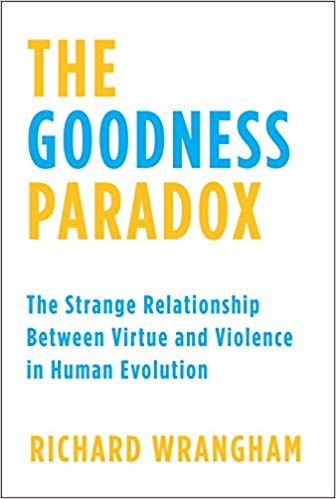
The Goodness Paradox: The Strange Relationship Between Virtue and Violence in Human Evolution (Richard Wrangham)

We Homo sapiens can be the nicest of species and also the nastiest. What occurred during human evolution to account for this paradox? What are the two kinds of aggression that primates are prone to, and why did each evolve separately? How does the intensity of violence among humans compare with the aggressive behavior of other primates? How did humans domesticate themselves? And how were the acquisition of language and the practice of capital punishment determining factors in the rise of culture and civilization?

Authoritative, provocative, and engaging, The Goodness Paradox offers a startlingly original theory of how, in the last 250 million years, humankind became an increasingly peaceful species in daily interactions even as its capacity for coolly planned and devastating violence remains undiminished. In tracing the evolutionary histories of reactive and proactive aggression, biological anthropologist Richard Wrangham forcefully and persuasively argues for the necessity of social tolerance and the control of savage divisiveness still haunting us today.

Source: www.amazon.com
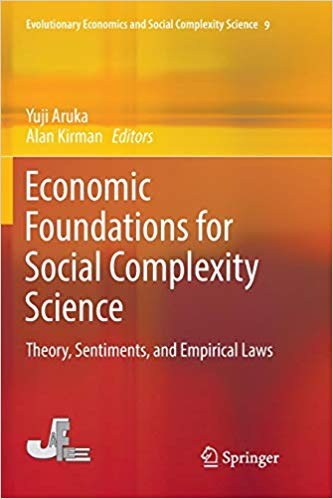
Economic Foundations for Social Complexity Science: Theory, Sentiments, and Empirical Laws (edited by Yuji Aruka & Alan Kirman)

This book focuses on how important massive information is and how sensitive outcomes are to information. In this century humans now are coming up against the massive utilization of information in various contexts. The advent of super intelligence is drastically accelerating the evolution of the socio-economic system. Our traditional analytic approach must therefore be radically reformed in order to adapt to an information-sensitive framework, which means giving up myopic purification and the elimination of all considerations of massive information. In this book, authors who have shared and exchanged their ideas over the last 20 years, offer thorough examinations of the theoretical-ontological basis of complex economic interaction, econophysics, and agent-based modeling during the last several decades. This book thus provides the indispensable philosophical-scientific foundations for this new approach, and then moves on to empirical-epistemological studies concerning changes in sentiments and other movements in financial markets.

Source: www.amazon.co.uk

Narrating Complexity (edited by Richard Walsh & Susan Stepney)

This book stages a dialogue between international researchers from the broad fields of complexity science and narrative studies. It presents an edited collection of chapters on aspects of how narrative theory from the humanities may be exploited to understand, explain, describe, and communicate aspects of complex systems, such as their emergent properties, feedbacks, and downwards causation; and how ideas from complexity science can inform narrative theory, and help explain, understand, and construct new, more complex models of narrative as a cognitive faculty and as a pervasive cultural form in new and old media.

The book is suitable for academics, practitioners, and professionals, and postgraduates in complex systems, narrative theory, literary and film studies, new media and game studies, and science communication.

Source: www.amazon.co.uk

Complex Networks: Theory, Methods, and Applications – Lake Como School of Advanced Studies – May 13-17, 2019

Complex networks: theory, methods, and applications (5th edition)
Villa del Grumello, Como, Italy, May 13-17, 2019

Many real systems can be modeled as networks, where the elements of the system are nodes and interactions between elements are edges. An even larger set of systems can be modeled using dynamical processes on networks, which are in turn affected by the dynamics. Networks thus represent the backbone of many complex systems, and their theoretical and computational analysis makes it possible to gain insights into numerous applications. Networks permeate almost every conceivable discipline —including sociology, transportation, economics and finance, biology, and myriad others — and the study of “network science” has thus become a crucial component of modern scientific education.

The school “Complex Networks: Theory, Methods, and Applications” offers a succinct education in network science. It is open to all aspiring scholars in any area of science or engineering who wish to study networks of any kind (whether theoretical or applied), and it is especially addressed to doctoral students and young postdoctoral scholars. The aim of the school is to deepen into both theoretical developments and applications in targeted fields.

Source: ntme.lakecomoschool.org

Fake news on Twitter during the 2016 U.S. presidential election

The spread of fake news on social media became a public concern in the United States after the 2016 presidential election. We examined exposure to and sharing of fake news by registered voters on Twitter and found that engagement with fake news sources was extremely concentrated. Only 1% of individuals accounted for 80% of fake news source exposures, and 0.1% accounted for nearly 80% of fake news sources shared. Individuals most likely to engage with fake news sources were conservative leaning, older, and highly engaged with political news. A cluster of fake news sources shared overlapping audiences on the extreme right, but for people across the political spectrum, most political news exposure still came from mainstream media outlets.


Fake news on Twitter during the 2016 U.S. presidential election
Nir Grinberg, Kenneth Joseph, Lisa Friedland, Briony Swire-Thompson, David Lazer

Science  25 Jan 2019:
Vol. 363, Issue 6425, pp. 374-378
DOI: 10.1126/science.aau2706

Source: science.sciencemag.org