
Author: cxdig

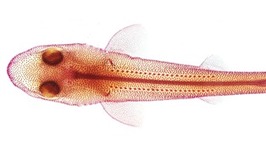
Where Does a Shark’s Skin Get Its Pattern?

In 1952, well before developmental biologists spoke in terms of Hoxgenes and transcription factors, or even understood DNA’s structure, Alan Turing had an idea. The famed mathematician who hastened the end of World War II by cracking the Enigma code turned his mind to the natural world and devised an elegant mathematical model of pattern formation. His theory outlined how endless varieties of stripes, spots, and scales could emerge from the interaction of two simple, hypothetical chemical agents, or “morphogens.”

Decades passed before biologists seriously considered that this mathematical theory could in fact explain myriad biological patterns. The development of mammalian hair, the feathers of birds, and even those ridges on the roof of your mouth all stem from Turing-like mechanisms.

Source: nautil.us

Pull out all the stops: Textual analysis via punctuation sequences

Whether enjoying the lucid prose of a favorite author or slogging through some other writer’s cumbersome, heavy-set prattle (full of parentheses, em-dashes, compound adjectives, and Oxford commas), readers will notice stylistic signatures not only in word choice and grammar, but also in punctuation itself. Indeed, visual sequences of punctuation from different authors produce marvelously different (and visually striking) sequences. Punctuation is a largely overlooked stylistic feature in “stylometry”, the quantitative analysis of written text. In this paper, we examine punctuation sequences in a corpus of literary documents and ask the following questions: Are the properties of such sequences a distinctive feature of different authors? Is it possible to distinguish literary genres based on their punctuation sequences? Do the punctuation styles of authors evolve over time? Are we on to something interesting in trying to do stylometry without words, or are we full of sound and fury (signifying nothing)?


Pull out all the stops: Textual analysis via punctuation sequences
Alexandra N. M. Darmon Marya Bazzi Sam D. Howison Mason Porter

Source: osf.io

Complexity and Self-Organization | Frontiers Research Topic

Complexity occurs when relevant interactions prevent the study of elements of a system in isolation. These interactions between elements may lead to the self-organization of the system. In computational intelligence, complexity and self-organization have been studied and exploited with different purposes. This Research Topic aims to bring together novel research into a coherent collection, spanning from theory and methods to simulations and applications.

Computational measures of complexity and self-organization have been proposed and applied to study a broad range of phenomena. Methodologies for facing complexity and harnessing self-organization have been used to design and build a variety of systems. Computer simulations have been tools which enabled us to study complexity and self-organization, from cellular automata and artificial neural networks to multi-agent systems and computational social science. The applications of these approaches have been vast.

Considering that complexity and self-organization are very broad themes, this Research Topic focusses only on the aspects related to computational intelligence.


Submission Deadlines
31 July 2019 Abstract
30 September 2019 Manuscript

Source: www.frontiersin.org

Complex Systems Summer School | Santa Fe Institute

The SFI Complex Systems Summer School (CSSS) offers an intensive 4-week introduction to complex behavior in mathematical, physical, living, and social systems. Lectures are taught by the faculty of the Santa Fe Institute (SFI) and other leading educators and scholars. The school is for graduate students, postdoctoral fellows, and professionals seeking to transcend traditional disciplinary boundaries, take intellectual risks, and ask big questions about complex systems.

The program consists of an intensive series of lectures, labs, and discussions focusing on foundational concepts, tools, and current topics in complexity science. These include nonlinear dynamics, scaling theory, information theory, adaptation and evolution, networks, machine learning, agent-based models, and other topical areas and case studies. Participants collaborate in developing novel research projects throughout the four weeks of the program that culminate in final presentations and papers. 


Begins: Jun 09 2019
Ends: Jul 05 2019

Deadline extension: now Thursday, January 31.

Source: www.santafe.edu