
Author: cxdig

Entraining chaotic dynamics: A novel movement sonification paradigm could promote generalization

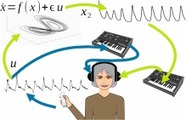
Tasks encountered in daily living may have instabilities and more dimensions than are sampled by the senses such as when carrying a cup of coffee and only the surface motion and overall momentum are sensed, not the fluid dynamics. Anticipating non-periodic dynamics is difficult but not impossible because mutual coordination allows for chaotic processes to synchronize to each other and become periodic. A chaotic oscillator with random period and amplitude affords being stabilized onto a periodic trajectory by a weak input if the driver incorporates information about the oscillator. We studied synchronization with predictable and unpredictable stimuli where the unpredictable stimuli could be non-interactive or interactive. The latter condition required learning to control a chaotic system. We expected better overall performance with the predictable but more learning and generalization with unpredictable interactive stimuli. Participants practiced an auditory-motor synchronization task by matching their sonified hand movements to sonified tutors: the Non-Interactive Predictable tutor (NI-P) was a sinusoid, the Non-Interactive Unpredictable (NI-U) was a chaotic system, the Interactive Unpredictable (I-U) was the same chaotic system with an added weak input from the participant’s movement. Different pre/post-practice stimuli evaluated generalization. Quick improvement was seen in NI-P. Synchronization, dynamic similarity, and causal interaction increased with practice in I-U but not in NI-U. Generalization was seen for few pre-post stimuli in NI-P, none in NI-U, and most stimuli in I-U. Synchronization with novel chaotic dynamics is challenging but mutual interaction enables the behavioral control of such dynamics and the practice of complex motor skills.


Entraining chaotic dynamics: A novel movement sonification paradigm could promote generalization
Dobromir Dotov, Tom Froese

Human Movement Science
Volume 61, October 2018, Pages 27-41

Source: www.sciencedirect.com
Smeared phase transitions in percolation on real complex networks

Percolation on complex networks is used both as a model for dynamics on networks, such as network robustness or epidemic spreading, and as a benchmark for our models of networks, where our ability to predict percolation measures our ability to describe the networks themselves. In many applications, correctly identifying the phase transition of percolation on real-world networks is of critical importance. Unfortunately, this phase transition is obfuscated by the finite size of real systems, making it hard to distinguish finite size effects from the inaccuracy of a given approach that fails to capture important structural features. Here, we borrow the perspective of smeared phase transitions and argue that many observed discrepancies are due to the complex structure of real networks rather than to finite size effects only. In fact, several real networks often used as benchmarks feature a smeared phase transition where inhomogeneities in the topological distribution of the order parameter do not vanish in the thermodynamic limit. We find that these smeared transitions are sometimes better described as sequential phase transitions within correlated subsystems. Our results shed light not only on the nature of the percolation transition in complex systems, but also provide two important insights on the numerical and analytical tools we use to study them. First, we propose a measure of local susceptibility to better detect both clean and smeared phase transitions by looking at the topological variability of the order parameter. Second, we highlight a shortcoming in state-of-the-art analytical approaches such as message passing, which can detect smeared transitions but not characterize their nature.


Smeared phase transitions in percolation on real complex networks
Laurent Hébert-Dufresne, Antoine Allard

Source: arxiv.org

Dynamical Criticality in Gene Regulatory Networks

A well-known hypothesis, with far-reaching implications, is that biological evolution should preferentially lead to states that are dynamically critical. In previous papers, we showed that a well-known model of genetic regulatory networks, namely, that of random Boolean networks, allows one to study in depth the relationship between the dynamical regime of a living being’s gene network and its response to permanent perturbations. In this paper, we analyze a huge set of new experimental data on single gene knockouts in S. cerevisiae, laying down a statistical framework to determine its dynamical regime. We find that the S. cerevisiae network appears to be slightly ordered, but close to the critical region. Since our analysis relies on dichotomizing continuous data, we carefully consider the issue of an optimal threshold choice.


Dynamical Criticality in Gene Regulatory Networks
Marco Villani, Luca La Rocca, Stuart Alan Kauffman, and Roberto Serra

Complexity
Volume 2018, Article ID 5980636, 14 pages
https://doi.org/10.1155/2018/5980636

Source: www.hindawi.com

Philosophies | Special Issue : Philosophy and Epistemology of Deep Learning

Call For Papers:
Deadline for manuscript submissions: 15 March 2019
Guest Editors:
Dr. Hector Zenil
Prof. Dr. Selmer Bringsjord
Current popular approaches to Machine Learning (ML), Deep Learning (DL) and Artificial Intelligence (AI) are mostly statistical in nature, and are not well equipped to deal with abstraction and explanation. In particular, they cannot generate candidate models or make generalizations directly from data to discover possible causal mechanisms. One method that researchers are resorting to in order to discover how deep learning algorithms work involves using what are called ‘generative models’ (a possible misnomer). They train a learning algorithm and handicap it systematically whilst asking it to generate examples. By observing the resulting examples they are able to make inferences about what may be happening in the algorithm at some level. 
However, current trends and methods are widely considered black-box approaches that have worked amazingly well in classification tasks, but provide little to no understanding of causation and are unable to deal with forms of symbolic computation such as logical inference and explanation. As a consequence, they also fail to be scalable in domains they have not been trained for, and require tons of data to be trained on, before they can do anything interesting—-and they require training every time they are presented with (even slightly) different data. 
Furthermore, how other cognitive features, such as human consciousness, may be related to current and future directions in deep learning, and whether such features may prove advantageous or disadvantageous remains an open question.
The aim of this special issue is thus to attempt to ask the right questions and shed some light on the achievements, limitations and future directions in reinforcement/deep learning approaches and differentiable programming. Its particular focus will be on the interplay of data and model-driven approaches that go beyond current ones, which for the most part are  based on traditional statistics. It will attempt to ascertain whether a fundamental theory is needed or whether one already exists, and to explore the implications of current and future technologies based on deep learning and differentiable programming for science, technology and society.

Special issue website:

https://www.mdpi.com/journal/philosophies/special_issues/deep_learning

Source: www.mdpi.com

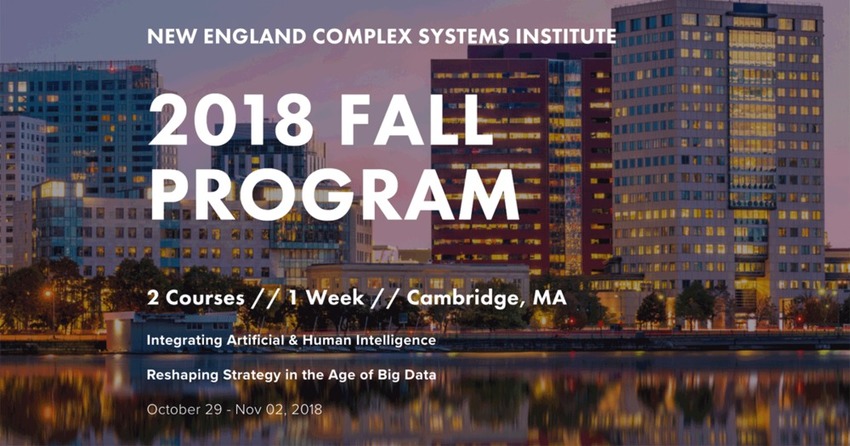
NECSI Executive Courses:  Integrating Artificial and Human Intelligence & Reshaping Strategy in the Age of Data

Business and society are transforming and becoming increasingly complex. Artificial Intelligence, machine learning, big data analytics and hybrid human-machine systems are playing an increasing role in business products, strategy, and in the organization itself. 

NECSI is hosting two courses as part of its week-long NECSI Executive 2018 Fall Program in Boston, MA. Each course can stand alone, but together they form a potent and practical training experience for the executive leader. 

Source: necsi-exec.org