Author: cxdig

The reachability of contagion in temporal contact networks: how disease latency can exploit the rhythm of human behavior

The reproductive potential of pathogens is linked inextricably to the host social behavior required for transmission. We propose that future work should consider contact periodicity in models of disease dynamics, and suggest the possibility that disease control strategies may be designed to optimize against the effects of synchronization.


The reachability of contagion in temporal contact networks: how disease latency can exploit the rhythm of human behavior
Ewan ColmanEmail author, Kristen Spies and Shweta Bansal
BMC Infectious Diseases201818:219
https://doi.org/10.1186/s12879-018-3117-6

Source: bmcinfectdis.biomedcentral.com

How Networks Learn An Interview with Cesar Hidalgo

In this episode, Haley talks with physicist, complexity scientist, and MIT professor, Cesar Hidalgo. Hidalgo discusses his interest in the physics of networks and complex system science and shares why he believes these fields are so important. He talks about his book, Why Information Grows: The Evolution of Order, from Atoms to Economies, which takes a scientific look at global economic complexity. Hidalgo also shares how economic development is linked to making networks more knowledgeable.

Source: www.human-current.com

ICCS 2018 T-Shirt Design Contest

The ICCS Executive Committee invites you to submit an original design to be featured on the official conference t-shirts. The design should incorporate complex systems ideas or concepts. Designs should be submitted by June 10, 2018. The ICCS Executive Committee will select the winner and announce their decision on June 20, 2018.

The winning contestant will receive two free t-shirts printed with their design, public recognition of their achievement, and the choice of (a) two free tickets to the Sunset Cruise on Saturday, July 21st, or (b) one free ticket to the Banquet on Wednesday, July 25th.


http://www.necsi.edu/events/iccs2018/tshirt.html 

Source: www.necsi.edu

The gender gap in science: How long until women are equally represented?

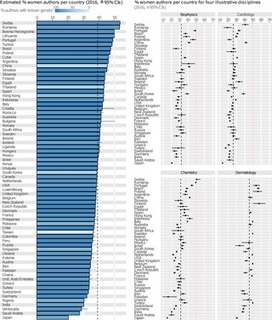
In most fields of science, medicine, and technology research, men comprise more than half of the workforce, particularly at senior levels. Most previous work has concluded that the gender gap is smaller today than it was in the past, giving the impression that there will soon be equal numbers of men and women researchers and that current initiatives to recruit and retain more women are working adequately. Here, we used computational methods to determine the numbers of men and women authors listed on >10 million academic papers published since 2002, allowing us to precisely estimate the gender gap among researchers, as well as its rate of change, for most disciplines of science and medicine. We conclude that many research specialties (e.g., surgery, computer science, physics, and maths) will not reach gender parity this century, given present-day rates of increase in the number of women authors. Additionally, the gender gap varies greatly across countries, with Japan, Germany, and Switzerland having strikingly few women authors. Women were less often commissioned to write ‘invited’ papers, consistent with gender bias by journal editors, and were less often found in authorship positions usually associated with seniority (i.e., the last-listed or sole author). Our results support a need for further reforms to close the gender gap.


Holman L, Stuart-Fox D, Hauser CE (2018) The gender gap in science: How long until women are equally represented? PLoS Biol 16(4): e2004956. https://doi.org/10.1371/journal.pbio.2004956

Source: journals.plos.org

How the Father of Computer Science Decoded Nature’s Mysterious Patterns

Many have heard of Alan Turing, the mathematician and logician who invented modern computing in 1935. They know Turing, the cryptologist who cracked the Nazi Enigma code, helped win World War II. And they remember Turing as a martyr for gay rights who, after being prosecuted and sentenced to chemical castration, committed suicide by eating an apple laced with cyanide in 1954.

But few have heard of Turing, the naturalist who explained patterns in nature with math. Nearly half a century after publishing his final paper in 1952, chemists and biological mathematicians came to appreciate the power of his late work to explain problems they were solving, like how zebrafish get their stripes or cheetahs get spots. And even now, scientists are finding new insights from Turing’s legacy.

Source: www.nytimes.com