
Center for Collective Dynamics of Complex Systems (CoCo) Seminar Series April 18, 2018 Hyobin Kim (Systems Science, Binghamton University) “The Role of Criticality…
Source: vimeo.com
Networking the complexity community since 1999
Author: cxdig
Center for Collective Dynamics of Complex Systems (CoCo) Seminar Series April 18, 2018 Hyobin Kim (Systems Science, Binghamton University) “The Role of Criticality…
Source: vimeo.com
Computer experiments that mirror the evolutionary dynamics of sexual and asexual organisms as they occur in nature were used to test features proposed to explain the evolution of sexual recombination. Results show that this evolution is better described as a network of interactions between possible sexual forms, including diploidy, thelytoky, facultative sex, assortation, bisexuality, and division of labor between the sexes, rather than a simple transition from parthenogenesis to sexual recombination. Diploidy was shown to be fundamental for the evolution of sex; bisexual reproduction emerged only among anisogamic diploids with a synergistic division of reproductive labor; and facultative sex was more likely to evolve among haploids practicing assortative mating. Looking at the evolution of sex as a complex system through individual-based simulations explains better the diversity of sexual strategies known to exist in nature, compared to classical analytical models.
Synergy from reproductive division of labor and genetic complexity drive the evolution of sex
Klaus Jaffe
Journal of Biological Physics
Source: link.springer.com
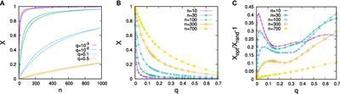
In this paper, we investigate influence maximization, or optimal opinion control, in a modified version of the two-state voter dynamics in which a native state and a controlled or influenced state are accounted for. We include agent predispositions to resist influence in the form of a probability q with which agents spontaneously switch back to the native state when in the controlled state. We argue that in contrast to the original voter model, optimal control in this setting depends on q: For low strength of predispositions q, optimal control should focus on hub nodes, but for large q, optimal control can be achieved by focusing on the lowest degree nodes. We investigate this transition between hub and low-degree node control for heterogeneous undirected networks and give analytical and numerical arguments for the existence of two control regimes.
Resisting Influence: How the Strength of Predispositions to Resist Control Can Change Strategies for Optimal Opinion Control in the Voter Model
Markus Brede, Valerio Restocchi and Sebastian Stein
Front. Robot. AI, 17 April 2018 | https://doi.org/10.3389/frobt.2018.00034
Source: www.frontiersin.org
Whereas the relationship between criticality of gene regulatory networks (GRNs) and dynamics of GRNs at a single-cell level has been vigorously studied, the relationship between the criticality of GRNs and system properties at a higher level has not been fully explored. Here we aim at revealing a potential role of criticality of GRNs in morphogenesis, which is hard to uncover through the single-cell-level studies, especially from an evolutionary viewpoint. Our model simulated the growth of a cell population from a single seed cell. All the cells were assumed to have identical intracellular GRNs. We induced genetic perturbations to the GRN of the seed cell by adding, deleting, or switching a regulatory link between a pair of genes. From numerical simulations, we found that the criticality of GRNs facilitated the formation of nontrivial morphologies when the GRNs were critical in the presence of the evolutionary perturbations. Moreover, the criticality of GRNs produced topologically homogeneous cell clusters by adjusting the spatial arrangements of cells, which led to the formation of nontrivial morphogenetic patterns. Our findings correspond to an epigenetic viewpoint that heterogeneous and complex features emerge from homogeneous and less complex components through the interactions among them. Thus, our results imply that highly structured tissues or organs in morphogenesis of multicellular organisms might stem from the criticality of GRNs.
How Criticality of Gene Regulatory Networks Affects the Resulting Morphogenesis under Genetic Perturbations
Hyobin Kim and Hiroki Sayama
Artificial Life
https://doi.org/10.1162/artl_a_00262
Source: www.mitpressjournals.org
Network models, stress testing methods and early warning systems are attracting growing interest both among scholars and practitioners. In this short paper, we illustrate some of the insights they have to offer both in terms of new fundamental scientific understanding of the emergence systemic risk and in terms of concrete applications to the policy areas of financial stability and macro-prudential policy. Finally, we discuss new research pathways to address the challenging questions still open, including multiplex networks, big financial data, and climate-finance.
Financial networks and stress testing: Challenges and new research avenues for systemic risk analysis and financial stability implications
Stefano Battiston, Serafin Martinez-Jaramillo
Journal of Financial Stability
Volume 35, April 2018, Pages 6-16
Source: www.sciencedirect.com
See Also: Special Issue: Network models, stress testing and other tools for financial stability monitoring and acroprudential policy design and implementation
Edited by Dr Serafín Martínez Jaramillo, Dr.Stefano Battiston
Volume 35, Pages 1-242 (April 2018)

