Author: cxdig

CITIZEN DATA SCIENCE FOR SOCIAL GOOD IN COMPLEX SYSTEMS

The confluence of massive amounts of openly available data, sophisticated machine learning algorithms and an enlightened citizenry willing to engage in data science presents novel opportunities for crowd sourced data science for social good. In this submission, I present vignettes of data science projects that I have been involved in and which have impact in various spheres of life and on social good. Complex systems are all around us: from social networks to transportation systems, cities, economies and financial markets. Understanding these complex systems may lead to solutions for problems ranging from famines, global crises, poverty, climate change and sustainable living despite over-population. Big data and citizen data science allows unprecedented computational power and collective intelligence to be brought to bear on fundamental challenges facing humanity like poverty, diseases, famines and developmental challenges.


CITIZEN DATA SCIENCE FOR
SOCIAL GOOD IN COMPLEX SYSTEMS

Soumya Banerjee
INDECS 16(1), 88-91, 2018
DOI 10.7906/indecs.16.1.6

Source: indecs.eu
Success in books: a big data approach to bestsellers

Reading remains the preferred leisure activity for most individuals, continuing to offer a unique path to knowledge and learning. As such, books remain an important cultural product, consumed widely. Yet, while over 3 million books are published each year, very few are read widely and less than 500 make it to the New York Times bestseller lists. And once there, only a handful of authors can command the lists for more than a few weeks. Here we bring a big data approach to book success by investigating the properties and sales trajectories of bestsellers. We find that there are seasonal patterns to book sales with more books being sold during holidays, and even among bestsellers, fiction books sell more copies than nonfiction books. General fiction and biographies make the list more often than any other genre books, and the higher a book’s initial place in the rankings, the longer the book stays on the list as well. Looking at patterns characterizing authors, we find that fiction writers are more productive than nonfiction writers, commonly achieving bestseller status with multiple books. Additionally, there is no gender disparity among bestselling fiction authors but nonfiction, most bestsellers are written by male authors. Finally we find that there is a universal pattern to book sales. Using this universality we introduce a statistical model to explain the time evolution of sales. This model not only reproduces the entire sales trajectory of a book but also predicts the total number of copies it will sell in its lifetime, based on its early sales numbers. The analysis of the bestseller characteristics and the discovery of the universal nature of sales patterns with its driving forces are crucial for our understanding of the book industry, and more generally, of how we as a society interact with cultural products.


Success in books: a big data approach to bestsellers
Burcu Yucesoy, Xindi Wang, Junming Huang and Albert-László BarabásiEmail authorView ORCID ID profile
EPJ Data Science20187:7
https://doi.org/10.1140/epjds/s13688-018-0135-y

Source: epjdatascience.springeropen.com

See Also: http://bestsellers.barabasilab.com 

Optimal diversification strategies in the networks of related products and of related research areas

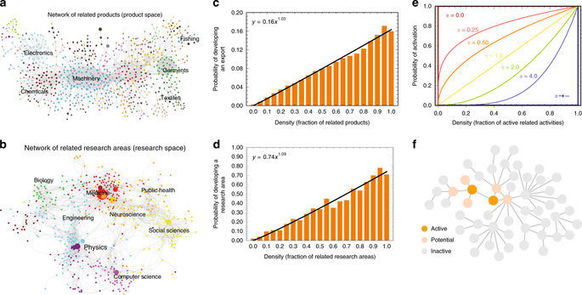
Countries and cities are likely to enter economic activities that are related to those that are already present in them. Yet, while these path dependencies are universally acknowledged, we lack an understanding of the diversification strategies that can optimally balance the development of related and unrelated activities. Here, we develop algorithms to identify the activities that are optimal to target at each time step. We find that the strategies that minimize the total time needed to diversify an economy target highly connected activities during a narrow and specific time window. We compare the strategies suggested by our model with the strategies followed by countries in the diversification of their exports and research activities, finding that countries follow strategies that are close to the ones suggested by the model. These findings add to our understanding of economic diversification and also to our general understanding of diffusion in networks.


Optimal diversification strategies in the networks of related products and of related research areas
Aamena Alshamsi, Flávio L. Pinheiro & Cesar A. Hidalgo

Nature Communications volume 9, Article number: 1328 (2018)
doi:10.1038/s41467-018-03740-9

Source: www.nature.com

Critical diversity: Divided or united states of social coordination

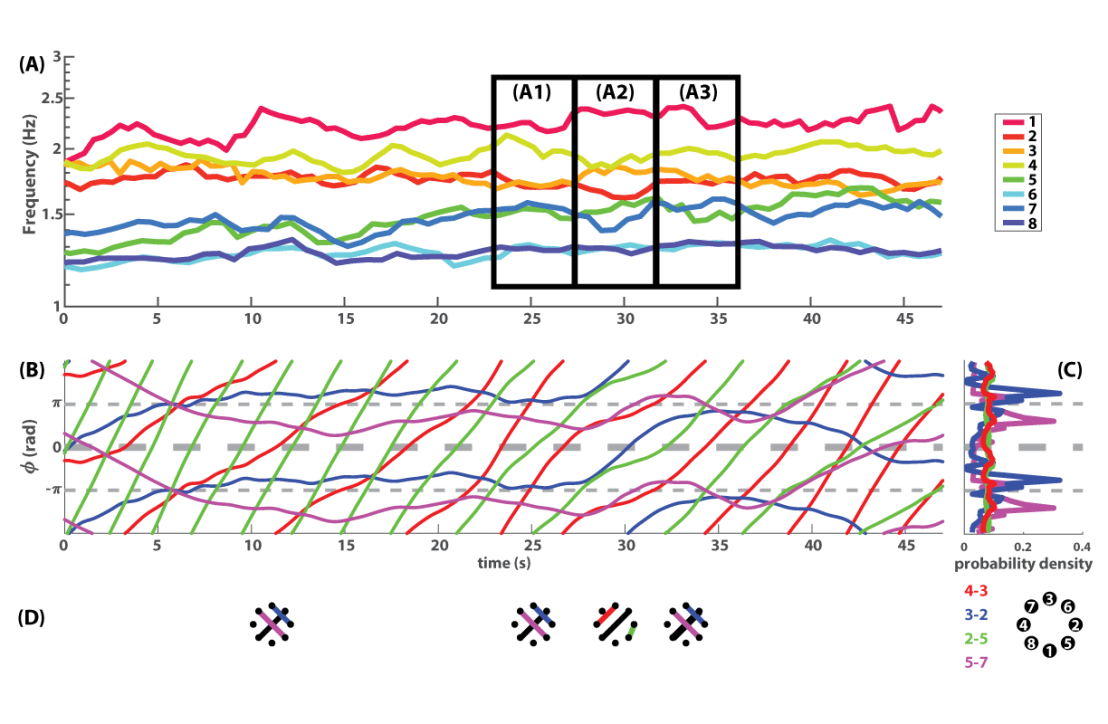
Much of our knowledge of coordination comes from studies of simple, dyadic systems or systems containing large numbers of components. The huge gap ‘in between’ is seldom addressed, empirically or theoretically. We introduce a new paradigm to study the coordination dynamics of such intermediate-sized ensembles with the goal of identifying key mechanisms of interaction. Rhythmic coordination was studied in ensembles of eight people, with differences in movement frequency (‘diversity’) manipulated within the ensemble. Quantitative change in diversity led to qualitative changes in coordination, a critical value separating régimes of integration and segregation between groups. Metastable and multifrequency coordination between participants enabled communication across segregated groups within the ensemble, without destroying overall order. These novel findings reveal key factors underlying coordination in ensemble sizes previously considered too complicated or ‘messy’ for systematic study and supply future theoretical/computational models with new empirical checkpoints.


Zhang M, Kelso JAS, Tognoli E (2018) Critical diversity: Divided or united states of social coordination. PLoS ONE 13(4): e0193843. https://doi.org/10.1371/journal.pone.0193843

Source: journals.plos.org

Self-Organization and Artificial Life: A Review

Self-organization has been an important concept within a number of disciplines, which Artificial Life (ALife) also has heavily utilized since its inception. The term and its implications, however, are often confusing or misinterpreted. In this work, we provide a mini-review of self-organization and its relationship with ALife, aiming at initiating discussions on this important topic with the interested audience. We first articulate some fundamental aspects of self-organization, outline its usage, and review its applications to ALife within its soft, hard, and wet domains. We also provide perspectives for further research.


Self-Organization and Artificial Life: A Review
Carlos Gershenson, Vito Trianni, Justin Werfel, Hiroki Sayama

Source: arxiv.org